

Executive Summary
Every practice wants to deliver a better patient experience. But most approach it as a satisfaction problem, or something that can be fixed with a survey, a new reminder tool, or a faster check-in kiosk.
The reality is more structural: poor patient experience is an indicator of operational health.
When patients feel frustrated, confused, or disconnected from their care, it’s rarely because of a single broken interaction. It’s because the journey itself is fragmented. Scheduling doesn’t talk to intake. Intake doesn’t inform the visit. And, between appointments, patients silently drift away until the next time they need something.
The healthcare industry has spent two decades digitizing touchpoints—scheduling systems, patient portals, and billing software—without connecting them into journeys. The result is more technology, but less continuity.
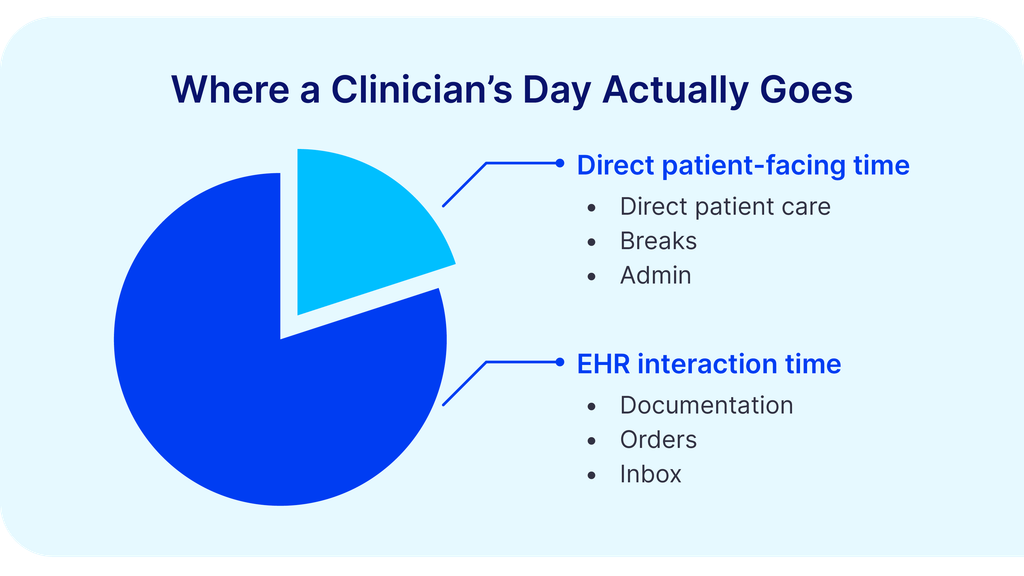
Clinicians bear the cost just as much as patients do. Primary care physicians now spend more than half their workday—nearly six hours—interacting with EHR systems during and after clinic hours. Staff attention shifts from patients to screens. Practices are working harder while feeling less in control.
AI offers a way to restore that control, not by replacing clinical judgment, but by connecting the touchpoints where journeys fall apart. AI works best not when used as automation, but as orchestration to connect workflows across systems and reduce cognitive load. This report maps where journeys break across four dimensions of control (time, attention, decisions, and workflow), examines what the research shows about the stakes, and lays out how connected, AI-powered workflows can address these disconnections across every stage of the visit lifecycle.
The Patient Journey Breaks When Practices Lose Control
Patient experience problems are usually control problems. When a practice loses control of time, attention, decisions, and workflow, both the patient and operations suffer.
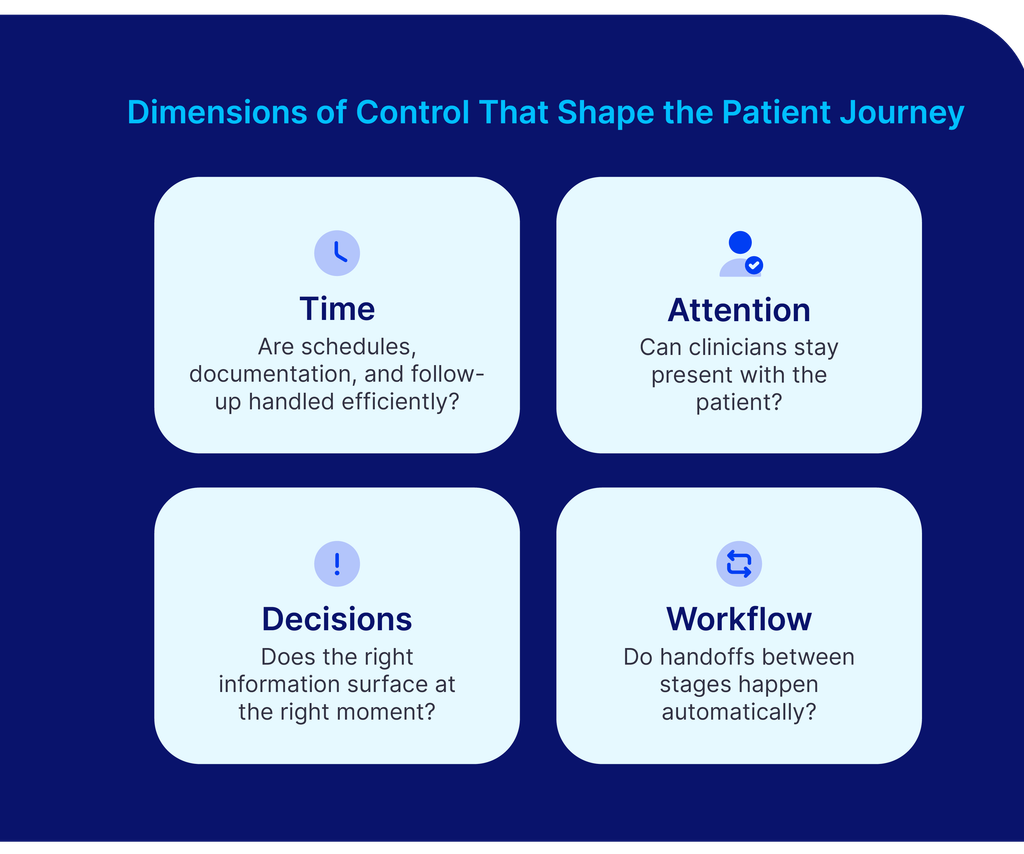
For example, patients feel friction when the practice loses control at handoff. The practice feels this friction in unused capacity, claims denials, rework, and margin erosion.
Each dimension of control maps not only to patient frustration but also to specific performance outcomes.
Control of Time
Scheduling mismatches increase reschedules and delays, reducing throughput and lowering revenue per day. No-shows create unused capacity and last-minute scrambling, which wastes provider time that cannot be recovered. Manual intake and data entry lengthen check-in and increase errors, slowing patient flow and generating rework downstream. Phone tag and repeated outreach consume staff time, increasing labor cost per patient.
The evidence supports targeted interventions here. Systematic reviews and meta-analyses, as well as studies from the Cochrane Library, confirm that automated tools like SMS reminders improve appointment attendance. AI restores time by enabling predictive scheduling, automated reminders, and digital intake, giving time back to staff and patients before friction accumulates.
Control of Attention
Clinician attention is fragmented across navigation, chart hunting, and documentation load. As EHR workload continues to grow, attention is diverted away from care.
A study from the Annals of Family Medicine found that clerical and administrative tasks, including documentation, order entry, billing, and system security, accounted for nearly half of total EHR time in primary care practices. A follow-up study from the same research team published in 2024 found that the average time PCPs spent in the EHR per eight hours of scheduled clinic appointments increased 7.8% between 2019 and 2023.
Meanwhile, staff attention shifts from patients to system tasks. The downstream effects are measurable and include reduced visit quality, lower patient satisfaction scores, and weaker retention. A systematic review found positive associations between patient experience and both clinical safety and effectiveness. Patients who interpret divided attention as disinterest, even when clinicians are simply trying to keep up, are more likely to leave and less likely to refer.
AI protects attention through pre-visit summarization, ambient documentation, and intelligent chart navigation. These capabilities reduce the cognitive overhead that pulls clinicians away from the patient.
Control of Decisions
Wrong visit type selection increases backtracking and incomplete visits, wasting appointment slots and producing incomplete billing. Missing context leads to repeated questions and incomplete assessments, lowering care quality, increasing safety risks, and frustrating patients.
According to research published in the medical journal Family Practice, the impact on patients is clear. Unclear next steps cause confusion about medications, labs, referrals, and follow-up timing, which drives lower treatment adherence, missed follow-up revenue, and increased liability risk.
AI improves decision quality by surfacing the right patient context at the right moment—through summaries, integrating records, and eligibility verification—so decisions are made with complete information instead of partial recall.
Control of Workflow
When workflows break, next steps and protected information escape the system, ending up on sticky notes and inside spreadsheets. This creates compliance risks and dropped care loops. Handoffs between the front desk, clinical staff, and billing fall apart, resulting in claims denials, delayed reimbursement, and rework. Results and messages sit untriaged, which carries real safety risks, including missed diagnoses and increased after-hours burden.
Billing is another point of failure when workflows break. When billing questions surface late, they damage trust. According to RevSpring’s 2023 Voice of the Patient Survey, 56% of patients would switch providers if they had a poor billing experience. Nearly three in four respondents aged 18 to 26 said they would likely make that switch.
AI reduces workflow chaos by routing tasks, triaging messages, and surfacing exceptions automatically. Work stays inside the system instead of escaping it. Research supports the role of prediction here as well. A study published in JMIR Formative Research found that implementation of an AI-powered no-show prediction model resulted in a 50.7% reduction in no-show rates. Separate research published in The Permanente Journal found that for primary care visits, an additional targeted text message reduced the chance of a no-show by 7%.
Why Point Solutions Fail
Separate tools for reminders, forms, documentation, messaging, and billing increase fragmentation. They digitize individual tasks without connecting the journey. Practices don’t need more tools. They need connected workflows across patient entry, care delivery, and continuity.
When AI acts as orchestration rather than isolated automation, it becomes the connective tissue between systems. That’s what turns operational health into a better patient experience. A study published in JAMIA Open underscored this, finding that machine learning techniques have meaningful potential to inform interventions that improve appointment adherence, particularly in transitional care environments where handoffs are most vulnerable.
Implementing Connected Workflows Powered by AI Across the Entire Visit Lifecycle
AI isn’t a single, standalone feature. It’s workflow intelligence that predicts, summarizes, routes, drafts, and prioritizes. The goal is to reduce handoffs, create fewer re-entries, prevent compliance risks, and provide more continuity for patients.
A connected approach powered by AI works across the entire patient journey: access and entry, visit preparation, the in-visit experience, post-visit follow-up, between-visit continuity, and the performance overlay that ties it all together.
Access and Entry
AI-powered integrated practice management and EHR systems restore control of time for both patients and staff. For instance, self-scheduling restores control of time for both patients and staff. Automated reminders via phone, text, and email can keep patients engaged and reduce the manual outreach burden on front-desk staff.
This directly addresses the issue of control of time. Staff spend less time on phone tag and manual confirmation, while patients experience fewer barriers to entry.
No-show prediction uses AI to target outreach where it matters most. DrChrono’s AI-powered no-show predictor tool identifies patients likely to miss appointments, enabling proactive intervention before the no-show happens. As the earlier JMIR Formative Research study demonstrated, AI-driven no-show prediction can cut missed appointment rates in half.
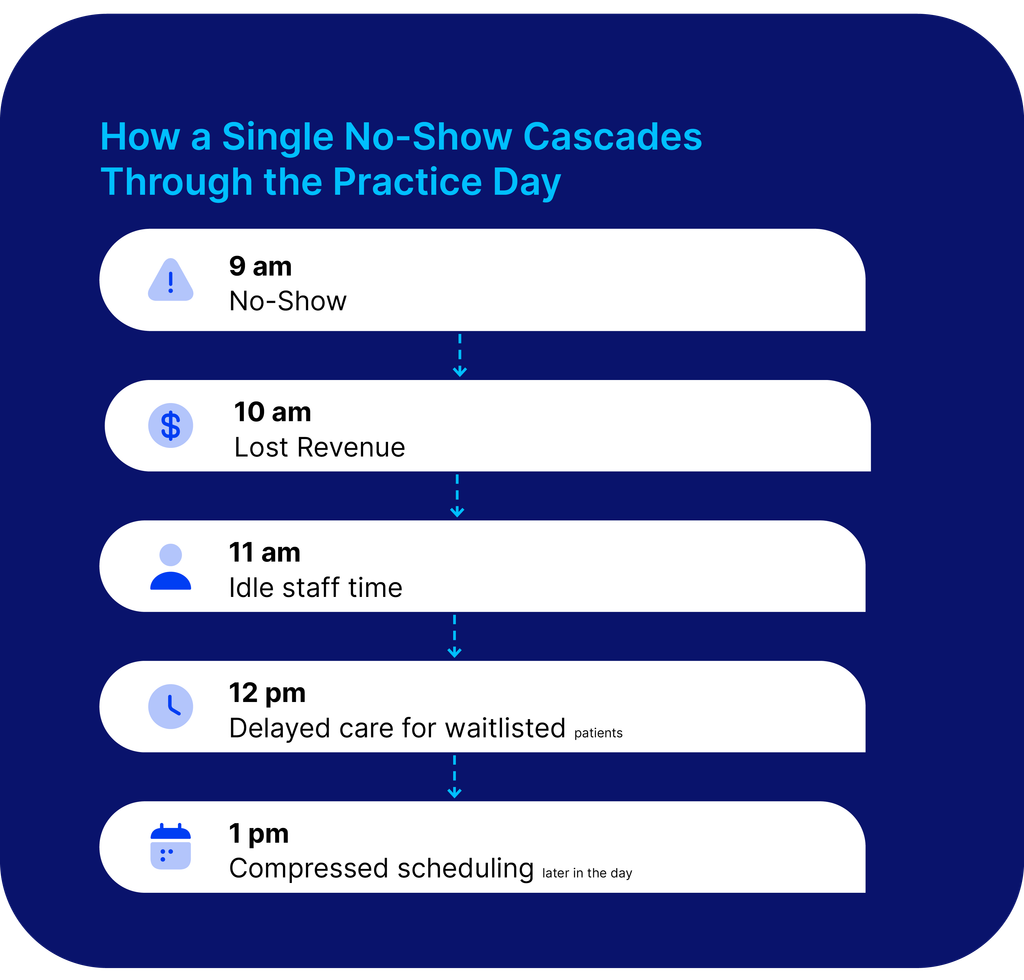
Additionally, price transparency sets financial expectations before the visit. Offering patients a better understanding of medical costs before visits improves the experience and helps staff be proactive with billing. Furthermore, real-time insurance eligibility verification surfaces billing risks at scheduling rather than post-visit, functioning as an early friction-detection mechanism.
Pre-Visit Preparation
If access and entry are where connective tissue begins to form, pre-visit preparation is where it prevents the journey from restarting. By completing intake, surfacing records, and verifying eligibility before the appointment, AI compresses the administrative burden that would otherwise consume the first minutes of the visit.
Patients complete intake forms, upload records, sign consent documents, and provide insurance information digitally before the visit. This shifts administrative work from the waiting room to the patient’s own timeline. Pre-visit forms tailored to the visit type collect the right information upfront, reducing redundant questions and incomplete data. Staff can review and verify submissions ahead of time to catch errors or gaps before they create day-of delays.
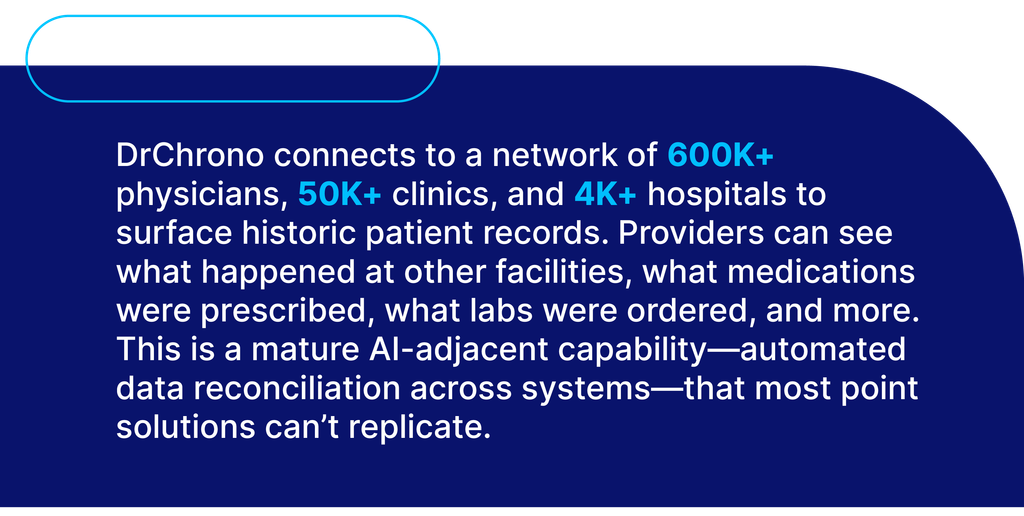
Actionable patient summaries provide clinicians with context before the appointment. For example, DrChrono surfaces patient information in a single, unified format through a comprehensive patient summary. This means clinicians aren’t hunting through charts to piece together why the patient is here and what’s unresolved.
Real-time eligibility verification catches billing risks before the appointment, and cost estimate tools surface insurance and coverage issues during prep, not post-visit. As a result, billing questions no longer surface late and damage patient trust.
Integrated eRx, labs, and referrals ensure the right context is available. Access to patients’ prescription history, preferred pharmacies, and ordering from 40,000+ labs, the full clinical picture informs the visit. Providers no longer need to ask patients to repeat what medications they’re on or which lab they prefer because all the information is easily accessible.
In-Visit Experience
During the visit itself, AI protects the human moment by getting out of the way. Instead of taking over, it handles the administrative weight so the clinician can be fully present. Documentation, ordering, and navigation happen with less manual effort, which means the clinician’s focus stays on the patient instead of the screen.
AI-powered clinical documentation, such as ambient listening, reduces manual work and produces clear, actionable notes, allowing clinicians to look patients in the eye instead of typing. Ambient AI takes the burden off physicians for documentation and charting, but it keeps the clinician in control of the quality and accuracy of the notes. That means more time spent caring for patients.
This concept is already working at scale. Jefferson Health piloted ambient AI scribe technology across its system and found that it significantly reduced documentation burden while preserving the clinician-patient interaction. Jefferson Health President Baligh Yehia, MD, noted that the technology allows “for more interaction, literally being able to look face-to-face with a patient versus typing. It’s definitely saved a lot of time for our doctors. It has very high net promoter scores.”
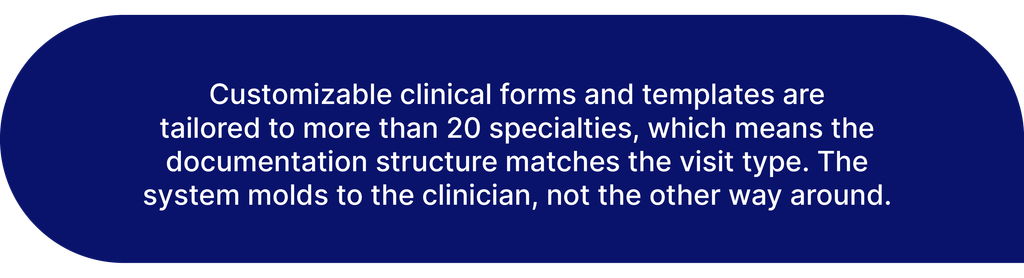
Modern, customizable interfaces in platforms such as DrChrono adapt to clinician workflows. DrChrono’s customizable chart navigation lets providers align tools with their workflow instead of molding their workflow to a rigid system.
Mobile-native EHRs support care delivery anywhere. DrChrono was the first EHR to build a native app for iPad and iPhone. Providers can use touch, pencil, keyboard, or trackpad to annotate or make notes. Free draw capabilities allow providers to annotate uploaded photos or capture them directly from the app. Clinicians document in the way that’s most natural for the clinical scenario.
Seamless prescription and diagnostic ordering keep the visit flowing. E-prescribing, including EPCS functionality, plus ordering from 40,000+ labs, happens inside the same platform so there’s no need for toggling between applications.
Telehealth extends the in-visit experience to virtual care. A McKinsey Consumer Health Insights Survey, found that more than half of patients were “much more satisfied” with telehealth care, and 60% found virtual care more convenient. With an integrated platform, providers can access charts without leaving the appointment, and there’s no context-switching between a video tool and the clinical record, making telehealth a better experience for both patients and providers.
Post-Visit Follow-Up
AI closes the loop so care feels continuous instead of episodic. An AI-powered EHR with a patient portal keeps patients connected with automated follow-ups, personalized care plans, and continuous engagement. Patients can access medical records, see test results, pay bills, and securely message their physician directly through the portal.
Optimized billing statements and flexible payment options also reduce post-visit friction. For instance, your EHR should generate detailed billing statements on demand with analysis and filtering tools. And, flexible payment options reduce patient stress while maintaining practice financial health by making on-time payment easier.
Between-visit continuity
The visit is one moment in an ongoing relationship. AI keeps that relationship active. Between visits is when the journey is most likely to go silent and where manual follow-up is most likely to fall through the cracks. AI-driven outreach, automated recall, and connected messaging keep patients engaged without requiring staff to track every outstanding task on spreadsheets or sticky notes.
Secure messaging prioritizes patient confidentiality while staying current with technology standards, keeping communication inside your EHR system instead of reverting to phone tag or untracked email.
For behavioral health practices specifically, between-visit engagement is core to treatment effectiveness. Secure virtual check-ins and ongoing communication both support this engagement to ensure continuity of care.
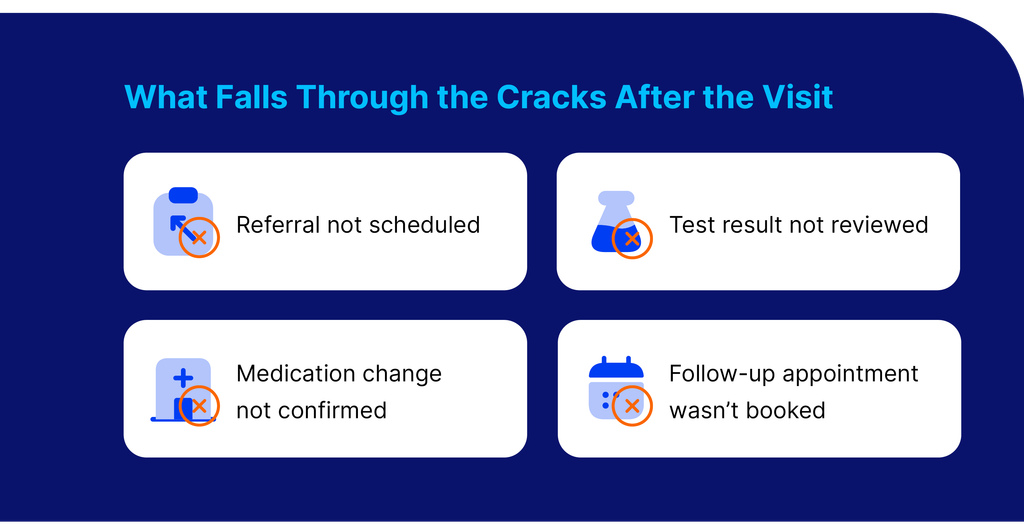
Engagement tools such as automated follow-ups can help build long-term loyalty and patient satisfaction. Patients who feel connected between visits are more likely to return, refer, and adhere to treatment.
Performance overlay
AI makes the entire patient journey manageable at scale. Interactive dashboards give real-time operational visibility. Instead of operating from memory or side spreadsheets, practice leaders can see the full picture in real time. AI should surface the information that matters most, like which appointments are likely to be no-shows and where documentation gaps could lead to claim delays or denials.
Operational reporting enables ongoing charge management. Practices can generate critical reports covering patient payment analyses, no-shows, and invoice reviews. Reporting automation means insights are analysis-ready without additional manual work. Financial dashboards and intelligence tools provide 24/7 insight for faster decision-making.
Data-driven growth requires predictive analytics. Integrated reporting and analytics tools that help you identify trends, improve retention, and expand high-value services. That means automating the patient survey process so you can collect feedback and close the loop between patient experience data and operational improvement.
Control the Workflow, Transform the Experience
The patient journey can fray between scheduling and intake, documentation and follow-up, and during the visit. Each handoff creates opportunities for friction and lost context. When enough of these moments accumulate, patients feel confusion while clinicians and staff feel a loss of control.
The research confirms what providers already sense. Patient experience correlates with clinical and operational effectiveness. AI-powered systems help clinicians and staff regain control over their time, attention, decision-making, and workflows. Predictive outreach reduces no-shows. Ambient scribe tools reduce the documentation burden. Automated follow-ups improve after-care and engagement.
Applied AI improves the patient experience not by adding more technology, but by connecting what already exists. For practice leaders figuring out where to start, identify the stage where disconnections create the most friction for patients and staff alike. Connect that workflow, restore control, and build outward.
DrChrono’s all-in-one AI-powered EHR brings scheduling, clinical workflows, patient engagement, and billing into a single connected system built to support the entire patient journey. To see how it works in your practice, schedule a demo today.