

Executive summary
Many new practice owners treat opening a medical practice as the finish line. In truth, opening day marks the moment real work begins.
The first 12 to 24 months shape everything that follows: staffing needs, clinician workload, financial performance, and your ability to grow sustainably. Early decisions influence clinician workload, staffing structure, financial performance, and the ability to grow with confidence. As patient volume increases, administrative responsibilities expand alongside it. Documentation, billing, compliance, and communication all become part of the daily rhythm.
If you design workflows intentionally from the start, your teams operate with clarity instead of constant adjustment. That’s the key to operational and financial strength, not a full calendar.
Sustainable practices pay attention to how work flows behind the scenes. They make sure they can see what is happening financially—not just at month-end but as operations unfold. They clarify who owns each part of the day, from scheduling to documentation to billing. And they select systems that help the team move together, rather than forcing people to stitch processes together manually.
Your technological infrastructure plays an important role here. It helps reduce manual effort and connect clinical and financial workflows. With an integrated operational foundation, it’s easier to improve revenue cycle performance, protect clinician time, and adapt as your patient list grows.
Ultimately, sustainable practices don’t focus solely on opening successfully. They focus on building an operating model that supports stability, flexibility, and long-term independence.
The Myth of “Opening Day”
Opening a medical practice is a milestone. Months of effort go into licensing, credentialing, payer enrollment, legal formation, and securing space. These steps are mandatory and time-bound, so they command attention.
The vision is clear: build a practice that delivers excellent care, protects autonomy, and supports long-term independence. By the time the doors open, practice owners often feel they’ve completed the hard part.
In reality, opening day marks the beginning of operational reality.
The problem is that most startup guidance focuses on regulatory and logistical readiness. Far less attention goes to designing how work will move once patients begin arriving.
- Who owns billing performance?
- How will documentation flow?
- How will financial visibility work?
- What happens when volume increases?
Without intentional answers to these questions before opening, your teams improvise. They build their own processes in real time. This leads to early shortcuts to solve immediate needs. But over time, those shortcuts become embedded habits that hold back your practice’s potential.
Sustainable practices treat operating design as part of launch preparation, not a problem to solve later.
The First 24 Months as a Compounding Window
The first two years of an independent practice do more than test stability. They amplify the operating decisions made at launch. Early workflow choices shape how time feels day-to-day, how predictable revenue becomes, and how confidently leaders can plan.
Small inefficiencies don’t disappear on their own. With thoughtful design, small improvements compound just as powerfully. Practices that approach these first 24 months with intention create momentum instead of friction.
Protecting Time, Autonomy, and Focus Becomes Harder Than Expected
Most physicians open independent practices to practice medicine on their own terms—to control clinical decisions, patient experience, and the pace of care. But most, don’t have formal business training, which means they often don’t design workflow systems deliberately from the beginning. Operational demands start to accumulate in the background.
Administrative work rarely announces itself all at once. Documentation stretches past clinic hours. Billing questions require follow-up. Prior authorizations multiply. And as the American Medical Association’s (AMA) Dr. Christine Sinsky explains, many physicians now spend one to two hours each evening completing electronic health record documentation — commonly known as “pajama time.”
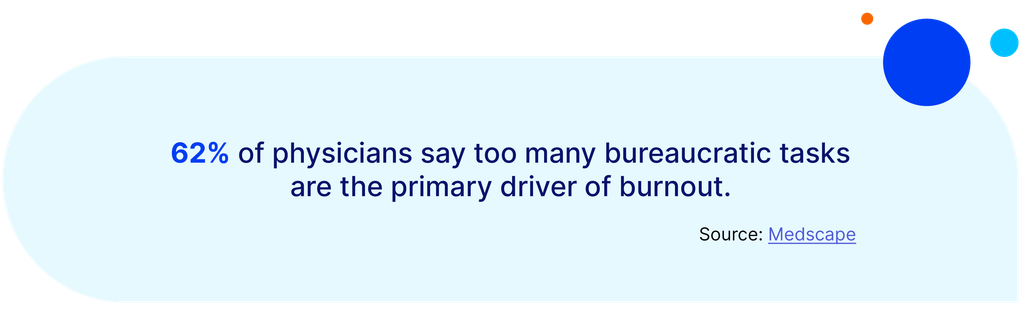
This burden carries consequences. As Medscape’s 2024 Physician Burnout and Depression Report found, most physicians say that being overwhelmed by bureaucratic tasks is the leading driver of burnout.
And for patients? Research in the Canadian Family Physician journal shows that rising administrative load reduces time available for patient care and affects well-being.
Over time, the impact of a little too much paperwork every day shifts what it means to practice medicine. You get less control over the patient experience, less flexibility over how you spend your time, and less autonomy than you expected as an owner.
That’s why designing workflows, ownership, and financial visibility early is critical. It protects the autonomy physicians set out to build when they first decide to open an independent practice.
Compliance Becomes an Ongoing Operational Burden
Compliance is a permanent operational function. Credentialing renewals, payer enrollment updates, audits, documentation standards, and regulatory changes continue long after opening day.
But when practices don’t assign clear ownership or build compliance into daily workflows, it interrupts operations later:
- Missing documentation surfaces only after claims are rejected.
- Enrollment delays can slow reimbursement for new providers.
- Work that no one formally owns often falls to whoever is available.
When compliance is loosely assigned or managed reactively, small lapses create operational disruption. A missed payer enrollment update can delay reimbursement for weeks. When an audit request arrives without preparation, your team has to pause billing, scheduling, or patient coordination to gather documentation.
As the AMA’s 2024 Policy Research Perspective found, of the physicians who sold their practices, 63.6% said they were struggling to manage payer and administrative requirements.

Proactive compliance doesn’t need to overwhelm a practice. But it does need a defined structure, with high visibility and clear accountability from the outset to prevent lapses from turning into excessive paperwork issues.
Financial Processes that Start Informally Create Long-Term Instability
In the first year, many practices focus on getting claims out the door quickly. Billing workflows often prioritize speed over visibility, so financial tracking develops informally. Practice owners think that as long as cash arrives in the bank and the schedule stays full, performance is strong.
But busy does not equal financially healthy. Without structured financial visibility, this appearance of stability can be misleading.
Revenue may look good on paper, but in the background, denials increase, payments slow, and costs rise. Without structured reporting, owners may not know how much revenue remains unpaid, how long reimbursements take, or whether margins are narrowing. Financial data often surfaces weeks after activity occurs, making it difficult to correct problems before they get out of control.
Experian’s 2025 State of Claims report shows that 41% of providers report denial rates above 10%, and 50% of denials stem from missing or inaccurate claim data. High denial rates impact cash flow, soak up administrative time, and lead to persistent revenue loss. This highlights how revenue leakage can become significant when not monitored closely.
Revenue cycle issues are a well-known problem in healthcare. As one 2025 study in the International Journal of Science and Research puts it, “Traditionally, [the healthcare revenue cycle] process has been marred by inefficiencies, manual errors, and delays that result in significant revenue loss and operational bottlenecks.”
Defined, visible financial workflows are critical. Without real-time clarity, you’re making hiring and investment decisions without a full picture of financial performance.
Workflows Designed Under Pressure Become Inefficient by Default
Early in a practice’s life, teams solve problems quickly. They adjust schedules, resend claims, build manual tracking systems, and create temporary fixes to keep work moving.
But without well-defined workflows, those temporary fixes become permanent infrastructure that buckles under the weight of growth.
And that’s where the challenge comes in. As more patients enter the practice, growth is layered onto systems that were never designed to scale.
Prior authorization illustrates this clearly. Documentation demands are rising, but workflow effectiveness can’t match them. According to AMA’s 2024 Prior Authorization Physician Survey, practices now complete an average of 39 prior authorizations per physician each week. This has led to physicians and staff spending roughly 13 hours a week managing them.
If you don’t account for prior authorizations when making staffing decisions or build workflows to manage them, as patient volume increases, workload demand can get out of control.
The potential for a small issue that starts as a trickle to turn into a full-fledged disaster happens across all workflows, from patient care to financial billing systems. As volume increases, staff rely on memory, spreadsheets, and duplicate data entry.
Ultimately, busyness increases errors, and errors increase busyness.
Eventually, teams become too overloaded to redesign the systems creating the strain. Resistance to change grows—not because improvement lacks value, but because no one has time to implement it.
Staffing Expands to Compensate for Systems that Don’t Scale
When workflows can’t absorb growing administrative demands, practices hire to keep up. New team members manage billing queues, prior authorizations, and scheduling gaps created by inefficient systems. Yet expansion doesn’t always relieve pressure.
According to MGMA’s 2024 Stat Poll, 53% of medical group leaders now cite staffing as their top operational challenge. Experian’s 2025 report found that revenue cycle teams report similar strain, with 43% describing themselves as understaffed.
The issue isn’t headcount. It’s that fragmented workflows require more manual coordination, oversight, and rework.
And as payroll grows, inefficiencies harden. New hires learn the same reactive processes that created the backlog in the first place. Even with more staff, teams often feel chronically understaffed.
Without scalable workflow design, adding people increases complexity faster than capacity.
Growth Magnifies Operational Weaknesses Instead of Solving Them
Growth doesn’t automatically strengthen a practice. It amplifies whatever systems are already in place. As patient demand increases, scheduling, billing, documentation, and communication all scale at once. Processes that functioned at lower volume now begin to buckle.
When workflows lack structure, inefficiencies grow faster than revenue.
This is problematic when 90% of medical groups report increasing expenses, with an average 11.1% jump in operating costs, according to MGMA’s 2025 Stat Poll.
If leaders spend more time troubleshooting operational friction, they have less time to plan ways to handle these costs strategically.
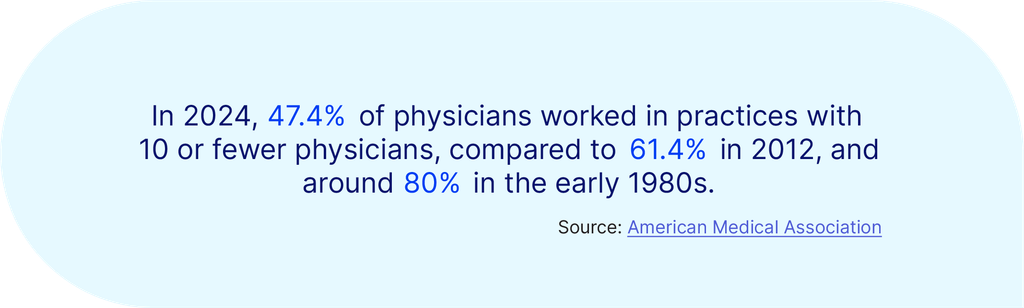
Over time, strain reshapes the landscape of independence. This leads to fewer independent practices. As AMA’s Policy Research Perspectives report shows, in 2024, only 47.4% of physicians worked in practices with 10 or fewer physicians, down from 61.4% in 2012 and 80% in the early 1980s.
Growth should create stability. Without operational design, it simply exposes fragility.
Designing the Operating Model Before the Workload
Sustainable practices don’t wait for operational strain to dictate how work moves. They define how scheduling, billing, documentation, compliance, staffing, and reporting will function before patient demand increases. Growth becomes something the practice can support, not something to survive.
Operational readiness is something you build deliberately across five core pillars. When you define these pillars early, expansion becomes a choice rather than a disruption.
Pillar 1: Design Workflow Architecture Before Volume Increases
Scheduling, intake, documentation, handoffs between teams, and patient communication should be defined clearly before volume rises. And ownership must be explicit. Each step should have one accountable role, while systems should reduce duplicate entry and eliminate unnecessary handoffs.
When workflows are standardized early, staff work consistently. Variation decreases. Errors fall. Onboarding accelerates. It’s also easier to track time spent on tasks and identify bottlenecks when it’s clear who’s doing what, what steps they follow, and when the task occurs within the workflow.
When workflows remain informal, small inefficiencies multiply as demand increases.
The test is simple: can leadership clearly describe how work moves from appointment booking to payment reconciliation? If you can’t map the journey clearly, the system will not scale cleanly.
Operational design determines how much administrative time is required per patient. Good design is key to building a sustainable practice because it allows you to track time spent at each step and identify areas along the workflow that need improvement.
Pillar 2: Build Financial Visibility from Day One
Financial stability doesn’t come from seeing more patients. It comes from knowing, in real time, how revenue moves through the practice.
From the first month of operation, you should define:
- Who owns billing performance
- What gets reviewed weekly
- What triggers an investigation
- How quickly financial feedback is available
Financial visibility means being able to answer, at any time:
- How much revenue is still outstanding?
- How long are payments taking?
- Where are delays occurring?
- Are collections keeping pace with expenses?
Reporting cadence matters here. Waiting until the month-end to review performance makes corrections slow and reactive. Weekly review creates control.
Rising operating costs across medical groups reinforce the need for this level of discipline. When expenses increase, small inefficiencies narrow margins quickly. Without clear visibility into performance, those margin pressures go unnoticed until cash flow tightens. Structured financial workflows give leaders the insight they need to act early and protect decision-making.
Hiring, adding services, adjusting schedules, or investing in equipment should be based on current performance data, not assumptions. If leadership cannot explain revenue flow confidently enough to defend their decisions, it’s because they don’t have complete visibility into the financial system.
Pillar 3: Embed Compliance into Daily Operations
Poor compliance workflows don’t just create paperwork. They pull attention away from the work that keeps the practice stable.
Compliance readiness requires ownership and systemization:
- Deadlines must be tracked proactively.
- Documentation standards should be clear.
- Renewal cycles should be visible long before expiration.
- Administrative requirements should integrate into routine workflows rather than surface only during crises.
When compliance functions are predictable, it protects revenue and reduces operational volatility.
Pillar 4: Structure Staffing Around Processes, Not Pressure
Make sure your underlying structure is ready to support hiring when it’s time to grow.
Before adding headcount, put these systems in place:
- Defined workflow ownership for scheduling, billing, documentation, and compliance
- Clear role outcomes, not shared or shifting responsibilities
- Standardized onboarding tied to documented processes
- Weekly performance review cadence, not month-end surprises
- Integrated systems that reduce duplicate entry and handoffs
When the process comes first, hiring increases capacity and facilitates growth.
Pillar 5: Plan for Growth as an Operational Capability
Treat growth as something you prepare for early, not something you figure out in the moment. Before you add a provider, open a second location, or expand services, pressure-test your current systems:
- Could your scheduling template handle 20% more volume without longer wait times?
- Could your billing team absorb higher claim volume without adding manual tracking?
- Could your reporting structure show performance by provider without rebuilding spreadsheets?
If expansion requires redesigning core processes, those processes were never built to scale.
Design systems that absorb volume without reinvention. Standardize workflows with clear documentation that’s regularly updated. Define ownership clearly. Centralize reporting with technology that captures data across operations, connecting scheduling, EHR, and billing instead of fragmenting them.
Growth readiness is not about committing to expansion. It is about preserving the option. You should be able to grow because you choose to, not because operational limits leave you with few alternatives.
Operational design gives you control over that choice.
Year One Operational Readiness Checklist
In your first 12 months, your practice should be able to answer the following questions with confidence:
- Workflow clarity: Can you clearly map how a patient moves from scheduling to payment, with defined ownership at each step?
- Financial visibility: Can you see accounts receivable, denial trends, and cash flow weekly, not just at month-end?
- Compliance structure: Are credentialing, renewals, and payer updates tracked proactively with assigned accountability?
- Administrative load: Is documentation spilling consistently into evenings, or have workflows reduced “pajama time”?
- Scalability test: Could you increase patient volume by 20% without adding overtime or rebuilding systems?
Remember, the first 24 months compound whatever foundation you build. Small improvements create momentum. Design intentionally now, and the practice grows stronger instead of heavier.
Building an Integrated Operating System for Your Practice
Technology does not fix broken workflows by default. With well-designed systems, it removes work. Without them, it multiplies coordination.
The difference lies in architecture.
Practices that treat technology as isolated tools often recreate the fragmentation they are trying to escape. Practices that treat technology as operational infrastructure reduce administrative load, improve financial performance, and create systems that scale.
Automation Should Remove Work, Not Relocate It
Technology delivers value when it eliminates manual effort. How do you know if it’s working?
Ask yourself whether clinicians and staff are spending less time:
- Re-entering data
- Chasing missing information
- Tracking claim status across systems
- Resubmitting preventable errors
If those tasks still consume the same number of hours, your technology isn’t solving the problems it should.
However, when you apply the right architecture to defined workflows, automation produces measurable change.
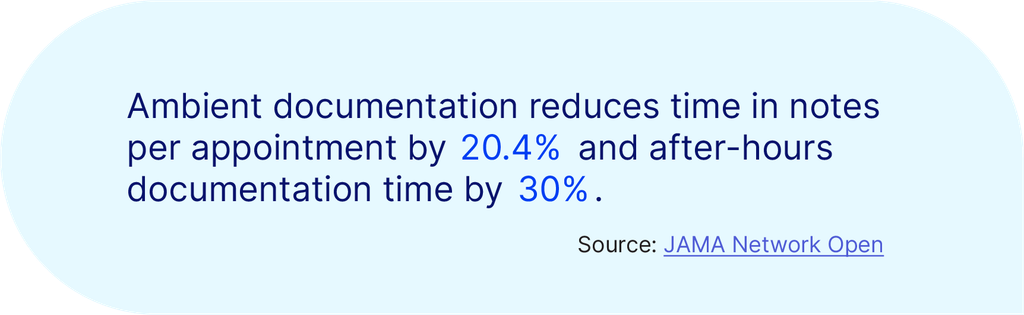
- Ambient AI documentation: According to 2025 research by Diggan et al., ambient documentation reduces time spent on notes per appointment by 20.4% and after-hours documentation time by 30%.
- Prior authorization software: 2025 research by Chen et al. found that prior authorization software reduced median authorization time by 33.9% and improved coordination between clinical and revenue cycle teams.
- AI in revenue cycle operations
- According to WayStar, 71% of healthcare organizations using AI reported revenue increases in 2024, and 56% reported reduced operational costs.

These outcomes matter because they signal real work being removed.
The goal is not more technology. It’s fewer manual steps, fewer handoffs, and fewer places where work can stall.
The “Integration Tax” of Point Solutions
Early-stage practices often assemble tools one at a time. A scheduler here. A billing add-on there. A documentation module layered on top.
Each purchase feels justified, but the gaps between those tools become daily operational friction.
This might manifest as:
- Double entry between intake and clinical notes
- Manual reconciliation between documentation and billing
- Reporting that requires exporting and stitching spreadsheets
- Staff switching between systems to answer simple questions
This is the “Integration Tax.” It’s the hidden cost of making disconnected systems talk to each other. McKinsey warns healthcare organizations about this, saying that “unless leaders course correct now, they will merely automate today’s inefficiencies.”
The same research also recommends interoperable architecture. It states that interoperable operating systems—not isolated software—will “lower administrative burden and reduce revenue leakage.”
The implication for practice leaders is practical:
- Designate a primary platform to anchor your core workflows.
- Anchor scheduling, clinical documentation, billing, and reporting inside that environment, rather than spreading them across disconnected platforms.
- Limit the number of handoffs between systems.
- Make sure revenue cycle workflows pull directly from structured clinical documentation instead of requiring manual reconciliation.
Your EHR should not function as a digital filing cabinet. It should sit at the center of patient access, clinical workflows, and financial performance. When those elements connect inside a single architecture, manual coordination decreases, and visibility improves. That’s what prevents fragmentation.
The EHR as the Operational Backbone
In a sustainable practice, the EHR is not just a place to chart. It’s the backbone where clinical workflows, patient access, and financial performance intersect.
When scheduling, documentation, billing, and reporting operate inside a connected system, expansion doesn’t require reinvention. Training becomes simpler because workflows are consistent. Visibility improves because data flows end-to-end. Staffing pressure decreases because manual handoffs shrink.
This is where infrastructure differs from software.
DrChrono’s all-in-one AI-powered EHR platform illustrates this architectural model.
- Claims flow directly from standardized clinical documentation into billing workflows.
- Performance data becomes visible without manual reconciliation.
- Administrative tasks such as faxing and intermediary handling are removed.
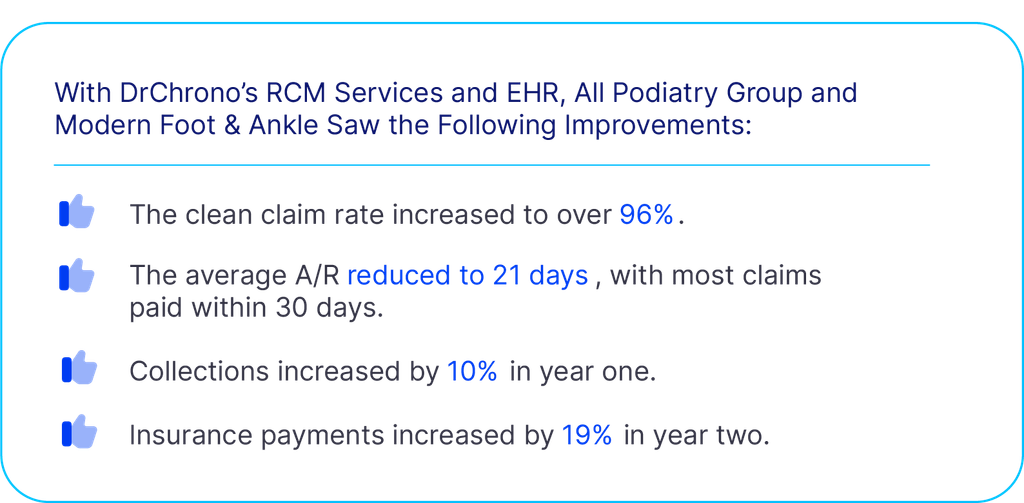
At All Podiatry Group, adopting DrChrono’s EHR and RCM services created a unified claims and reporting environment.
By doing this, the practice increased its clean claim rate to over 96%, reduced average accounts receivable to 21 days, and increased collections by 10% in year one and insurance payments by 19% in year two. Plus, manual billing tasks decreased because the workflow no longer required fragmented handoffs.
Integration, in this context, is not an IT upgrade. It’s operational design.
Technology should reduce coordination work, not create it. When the architecture is correct, growth becomes absorbable, visibility improves, and administrative burden declines. When it’s not, practices continue paying the “Integration Tax” in time, staffing, and lost focus.
What Sustainable New Practices Do Differently
Sustainable practices don’t succeed by working longer hours or seeing more patients. They succeed by designing their operations with intention from the start. Instead of reacting to strain, they reduce friction early and build systems that support growth before it arrives.
Fewer Systems, Better Connected
Sustainable practices resist stacking disconnected tools to solve isolated problems. Every additional platform creates handoffs, duplicate entries, and blind spots in reporting.
Instead, they consolidate scheduling, documentation, billing, and reporting into an integrated environment. When workflows connect end-to-end, administrative burden falls, and visibility improves. Growth becomes absorbable because you don’t need to rebuild your systems as your volume increases.
Earlier Attention to Workflows
Rather than improvising within a high-demand environment, sustainable practices define how work moves through the organization early. Think scheduling templates, intake processes, documentation standards, billing handoffs, and communication channels—all mapped and assigned clear ownership.
This prevents temporary fixes from becoming permanent infrastructure.
Standardized workflows reduce variation and rework. Staff can train consistently because expectations are clear. New hires step into defined processes instead of inheriting habits shaped by urgency.
Operational discipline becomes the norm, rather than a crisis response.
Clear Ownership of Operations
Sustainable practices decide early who is responsible for what, and they make that responsibility visible.
Billing performance does not “belong to the team.” It belongs to someone. Scheduling capacity is not assumed to be fine. Someone reviews it regularly. Compliance deadlines aren’t remembered when they surface; they are tracked and owned.
When accountability is explicit, problems surface earlier. Leaders see patterns in revenue, scheduling strain, or workflow delays before they become crises. Nobody’s relying on instinct or scattered updates. Teams rely on defined reporting rhythms and clear lines of responsibility.
That clarity changes the way leadership makes decisions. Staffing, technology investments, and growth plans are grounded in measurable performance, not reactive fixes.
Willingness to Invest Upfront to Avoid Long-Term Pain
Sustainable practices understand that strong systems require early effort. They don’t just pick the solution that’s fastest or cheapest at launch, because this might create friction later.
Instead, they invest in connected workflows that reduce manual coordination and improve visibility from the beginning.
That investment shows up later when there are fewer workarounds, fewer duplicated tasks, and fewer late-stage corrections. Rather than repeatedly fixing operational strain as volume increases, they build infrastructure that absorbs growth from the start.
What this Looks Like in Practice
Prior to implementing a unified system, Integrated Musculoskeletal Care expanded across multiple clinics while relying on fragmented billing tools and partial paper workflows.
As the organization grew, claims required manual handling, reporting lacked consistency across locations, and leadership struggled to see performance clearly in real time.
After implementing a fully electronic EHR and outsourcing billing through DrChrono’s RCM services, the practice centralized operations and reduced manual handling.
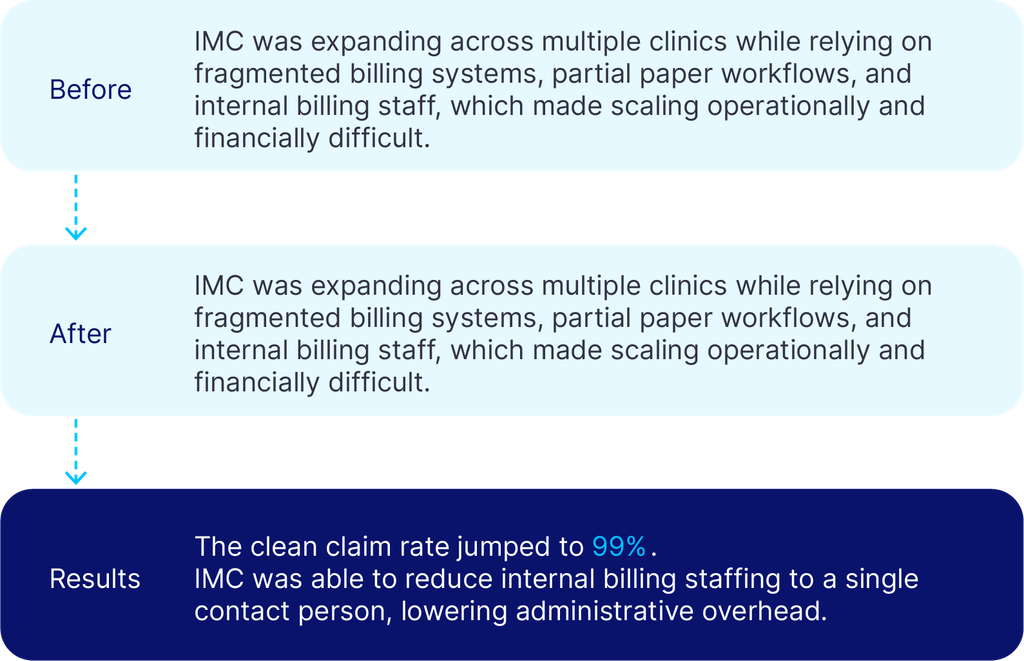
- Clean claim rates reached 99%.
- Average accounts receivable dropped to 14.8 days.
- Internal billing overhead decreased.
Build a Practice Designed to Last
Independent practices succeed when structure supports vision. They don’t rely on improvisation or short-term fixes. They evaluate operational readiness across compliance, financial visibility, staffing design, and patient access, and identify workflow gaps before volume exposes them.
They invest in systems that remove friction instead of adding layers. The result is not just efficiency. It’s control. Control over your time, revenue, and growth decisions. Design your operating model with intention, and growth becomes a choice rather than a strain.
Thinking about starting your own practice? Take this quiz to see how ready you are.
Learn how DrChrono helps independent practices build durable operations, simplify revenue cycle management, and protect the time that matters most—time focused on patient care.