

Patient portals have become a standard component of the modern healthcare experience.
According to the Office of the National Coordinator for Health Information Technology (ONC), in 2024, 65% of individuals nationwide accessed their online medical records or patient portals, up from just 25% in 2014, reflecting the growing role of digital tools in patient engagement. As portal adoption rises, healthcare practices have an opportunity to rethink how these platforms support patient relationships across the care journey.
Many practices still use patient portals for transactional communication: patients send messages, access records, or view test results, and the interaction ends there. While convenient, these interactions do little to build the kind of engagement that drives loyalty, continuity of care, or long-term satisfaction.
Moving beyond transactions requires a shift in how portals are viewed. Providers should see them not as messaging tools but as relationship management infrastructure—platforms that support continuous engagement between visits, centralize care coordination, improve patient understanding, and encourage participation through accessible digital experiences.
Practices that make this shift can strengthen patient relationships, improve care continuity, reduce administrative burden, and create a more differentiated patient experience. The goal isn’t simply increasing portal activity; it’s building lasting patient connections through every digital touchpoint.
This guide explores four common barriers that prevent patient portals from fulfilling their relationship management potential: reactive communication, fragmented care coordination, ineffective information sharing, and low patient adoption. It also examines practical strategies healthcare practices can use to transform patient portal engagement into a foundation for stronger patient relationships, improved continuity of care, and long-term practice growth.
The Relationship Management Opportunity for Patient Portals
Healthcare practices have traditionally measured the value of patient portals by what they allow patients to do: send a message, view a result, or complete a task. But this transactional view overlooks a larger opportunity.
Each portal interaction is part of a longer patient relationship. Taken together, these interactions shape how connected patients feel to a practice and how easily that relationship continues over time. That framing invites healthcare providers to think beyond individual transactions and design the portal around the full relationship.
The shift also changes how portal success is measured. Logins, registrations, and completed tasks still matter, but they don’t show whether the portal is strengthening the patient experience over time. A relationship-centered strategy asks a broader question: Does each interaction give the patient a reason to stay connected to the practice?
Realizing that opportunity requires addressing four barriers that limit how effectively most practices use their portals today.
Reactive Messaging Creates Episodic Rather Than Ongoing Relationships
Patients log in when they need a prescription refill, have a question about their care, want to review test results, or need help with scheduling. Once the issue is resolved, the interaction ends.
This improves communication efficiency, but it doesn’t strengthen the ongoing relationship between patients and their care teams. Engagement becomes tied to immediate needs rather than continuous connection.
Patients may go weeks or months without interacting with their providers between appointments, reducing opportunities to reinforce preventive care, encourage healthy behaviors, and maintain continuity of care.
This transactional pattern creates a missed opportunity for practices that need to build stronger patient relationships. Long-term engagement is rarely driven by isolated interactions. Instead, it develops through consistent communication that keeps patients connected even when they’re not actively seeking care.
Transforming Reactive Messaging into Continuous Patient Engagement
Portals can do more than respond—they can initiate connections. Preventive care reminders, annual wellness outreach, seasonal health content, and structured post-appointment follow-ups all create touchpoints between visits. The portal isn’t just answering questions;it’s keeping the relationship alive year-round.
The value of these interactions goes beyond increasing portal activity. Consistent, relevant communication can reinforce continuity by showing patients that the relationship with their care team extends beyond individual appointments. Over time, that continued presence can strengthen trust and give patients more reasons to be more engaged in their own health, while staying more connected to the practice.
There’s evidence this works. A paper published in Digital Health found that higher levels of patient portal engagement correlate with greater participation in preventive care, including cancer screenings and vaccinations.
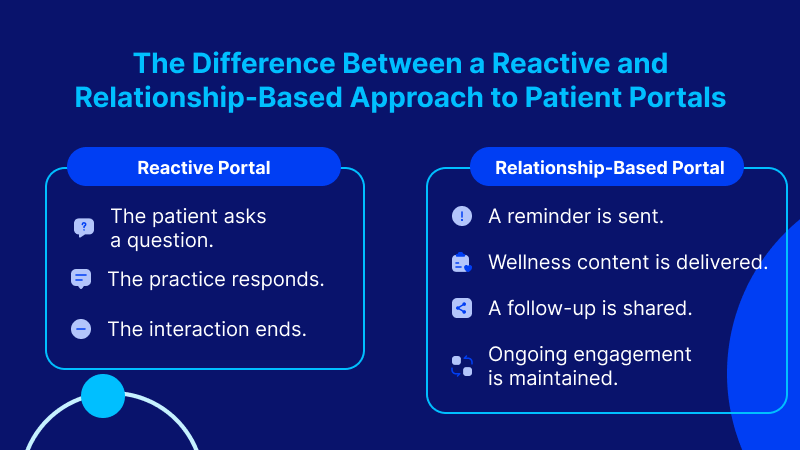
For practices, the opportunity is to use each touchpoint as part of a longer relationship rather than an isolated communication. The result is greater continuity between visits and a stronger foundation for patient trust and long-term loyalty.
Fragmented Care Coordination Weakens the Patient Experience
Even when patient portals are available, many healthcare practices continue to manage care coordination across multiple channels.
A patient may call the office to schedule an appointment, receive referral instructions by email, check lab results in the portal, and contact staff separately with prescription questions. Each interaction may work on its own, yet the patient is still left to connect the pieces.
For patients, this fragmentation often creates unnecessary friction. Information must be tracked across multiple communication channels; important updates can be overlooked, and routine tasks may require additional effort. These challenges matter because convenience increasingly influences how patients evaluate healthcare experiences.
When routine tasks become complicated, frustration can undermine trust and satisfaction. Conversely, a coordinated experience can make interactions feel more seamless and connected, reinforcing continuity throughout the patient journey.
Centralizing Coordination Through Patient Portal Software
Patient portals can serve as a central hub for care coordination, bringing together appointment scheduling, prescription refills, referral management, document sharing, and provider communication in one place. Integration with scheduling, EHR, and care management systems simplifies the experience further, reducing the need for patients and staff to navigate multiple disconnected workflows.
Centralizing these interactions creates a simpler experience for both patients and staff. Patients spend less time navigating different channels to complete routine tasks or find information, while staff can reduce avoidable phone calls, repeated requests, and manual coordination.
The result is less friction across the care journey: patients have a more convenient way to manage their care, and practices can handle routine coordination more efficiently.
Information Delivery Often Ends the Conversation Instead of Extending It
Patient portals make it easy to share care summaries, lab results, discharge instructions, and educational materials, but delivering information isn’t the same as ensuring patients understand it or act on it.
Too often, information is presented in formats that prioritize transmission over comprehension. Patients receive technical documents or complex results without the context needed to interpret their meaning or what to do next. Important information gets overlooked or misunderstood.
This is a missed opportunity. Information sharing shouldn’t be the end of an interaction; it should be a starting point for deeper engagement, helping patients better understand their health and participate meaningfully in their care.
Turning Information Sharing Into Meaningful Patient Engagement
Practices can close this gap by designing information around comprehension rather than just delivery.
Plain-language explanations, contextual guidance alongside lab results, and action-oriented care summaries can help patients understand what they are seeing and why it matters.
Follow-up prompts, clarification opportunities, and two-way communication tools can further transform document sharing into an interactive experience rather than a one-way transaction.
Care summaries can also serve as engagement touchpoints by prompting follow-up questions that encourage patients to continue the conversation with their care team.
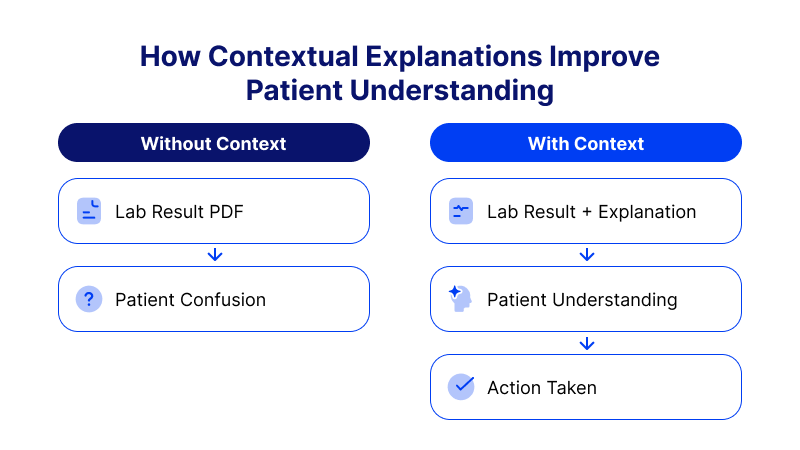
The result is a better understanding of care instructions, greater adherence to care plans, clearer next steps, and more participation in care. By giving patients the context and opportunities for follow-up they need, practices can also create a more meaningful exchange that helps patients feel connected to their care team beyond the clinical encounter.
Low Portal Adoption Limits Relationship Management Potential
Even the most capable portal can’t support relationship management if patients don’t use it. Many healthcare providers face an adoption gap—patients register but rarely return after their first login, leaving engagement infrastructure underutilized.
Low adoption is usually an experience problem, not a technology problem. Patients may not immediately see the portal’s value, onboarding may fail to demonstrate it, or the experience may not match how patients prefer to engage with their care. When participation feels optional or inconvenient, usage declines.
This matters because everything else depends on it. Proactive communication, coordinated care, and meaningful information sharing all require consistent patient participation. Without it, even well-designed engagement strategies fall short.
Improving Patient Portal Engagement and Adoption
Addressing this requires treating adoption as an ongoing effort, not a one-time enrollment task. Effective onboarding clearly demonstrates the value upfront: easier appointment management, faster access to information, more convenient communication with the care team.
Mobile-friendly design, targeted campaigns, and ongoing monitoring of usage patterns all help chip away at the barriers keeping people from logging back in.
The importance of encouragement shouldn’t be underestimated. According to the ONC, 87% of patients whose providers encouraged portal use accessed their portal, compared with 57% of those who didn’t receive encouragement. This highlights the role healthcare providers play in shaping long-term portal participation.
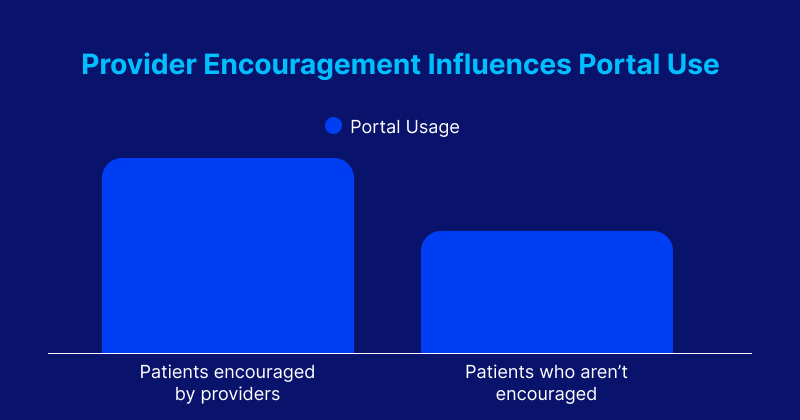
The difference may come down to how the portal is introduced. “Activate your account” gives patients a task. Explaining that they can use the portal to request refills, manage appointments, and access care information gives them a reason to complete it.
This is also where practices can differentiate themselves. Simply offering a portal creates access; actively helping patients see and use its value creates a more connected experience. The differentiator isn’t the technology alone, but how deliberately the practice uses it to support the patient relationship.
The result is more consistent portal use over time and greater value from the technology investment. Rather than becoming underused infrastructure, the portal becomes a meaningful engagement channel that supports long-term relationship management.
Building the Future of Patient Relationships Through Digital Engagement
Patient portals have evolved well beyond secure messaging tools into platforms that support ongoing patient engagement. As practices put more weight on retention, continuity, and patient experience, portals are becoming central to how those relationships get built and sustained.
Used strategically, a portal strengthens every stage of the care journey. Continuous communication keeps patients engaged between visits. Centralized coordination makes routine tasks simpler. Clear, contextual information helps patients know what to do next. Ongoing adoption efforts keep patients using what’s available to them.
Together, these changes create a more connected experience for patients and a more efficient one for staff, cutting friction on one side and administrative overhead on the other.
For healthcare leaders, portal strategy is relationship strategy. Practices that turn scattered digital transactions into a connected experience build stronger continuity, better retention, and relationships that outlast any single appointment. The question isn’t whether to offer a portal; it’s whether that portal gives patients a reason to stay connected.
OnPatient, DrChrono by EverHealth’s patient portal, is designed to make that kind of connected experience the default rather than the exception. Available across web, mobile web, iOS, and Android, OnPatient gives patients a single, consistent place to schedule appointments, access lab results and health records, track vitals over time, communicate with their care team, manage billing, and engage with health education materials—all without leaving the practice’s ecosystem. Because OnPatient is natively integrated into the DrChrono platform, there are no third-party systems to register with or sync. For practices, that means less administrative overhead and faster time to value. For patients, it means one place that makes their care genuinely easier to manage.
The practices that will win on patient relationships are the ones that stop treating the portal as an access tool and start treating it as an engagement channel. OnPatient is built for that purpose. Contact us to learn how DrChrono can help your practice create a more connected patient experience—from first appointment through every interaction that follows.