

Executive Summary
The Merit-based Incentive Payment System (MIPS) is practice performance infrastructure that happens to satisfy regulatory requirements. The same data used for MIPS reporting can help practices improve patient outcomes, strengthen financial performance, highlight operational challenges, and prepare for future value-based reimbursement models.
But according to recent research in the Journal of General Internal Medicine, physicians see MIPS as an administrative burden. There are concerns around reporting complexity and administrative workload, with little view on how it meaningfully improves patient care.
It’s easy to see why physicians have come to view MIPS this way.
For many practices, MIPS is treated as a compliance exercise. Teams collect the required data, submit their measures, discuss payment adjustments, and then move on. MIPS doesn’t come up until the next reporting cycle.
But that compliance-first approach leaves value on the table.
The practices that create the most value from MIPS all recognize something important. MIPS is far more than simply a reporting framework. It’s a source of performance insight that can shape decisions throughout the year.
High-performing practices don’t only look at data because deadlines arrive. Instead, they use it throughout the year to identify trends, close care gaps, improve operations, and guide growth decisions.
This means they also view MIPS investment differently. Rather than treating MIPS as a recurring admin cost, they treat it as an investment in long-term value performance measurement and quality improvement as ways to create value over time. The goal isn’t a better MIPS score. It’s building the performance infrastructure that happens to produce one.
This guide explores how practices can shift beyond compliance with MIPS by using performance data to help drive care quality, reimbursement, operations, and long-term growth.
Why the Compliance Mindset Limits MIPS Value
Most practices didn’t decide to treat MIPS as a compliance exercise because they believed that was the best way to use it. They got there because healthcare practices were already managing growing administrative demands when MIPS arrived. New reporting requirements, payer requirements, staffing pressures, technology projects, and reimbursement challenges were competing for attention. MIPS became one more item on an already crowded list.
But when the focus is on compliance, broader performance insights get lost.
MIPS Is Treated as a Year-End Requirement Rather Than a Strategic Performance System
In most practices, MIPS lands on the desk of whoever owns compliance, quality reporting, or practice administration. That individual ensures measures are submitted correctly, deadlines are met, and payment adjustments are tracked.
The problem is that MIPS often stays there.
A familiar pattern emerges. Teams spend months gathering data and validating measures. Leaders look at the results when reporting deadlines approach. The submission goes in, and attention moves elsewhere.
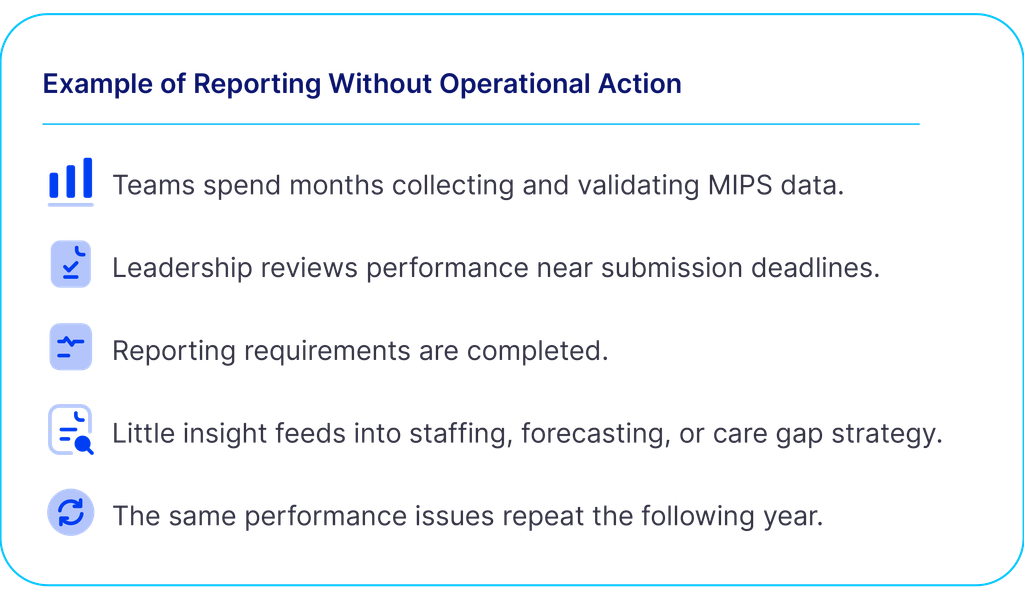
However, many of the measurable outcomes the Centers for Medicare and Medicaid Services (CMS) ties to reimbursement already touch the things leadership cares about most: patient outcomes, growth opportunities, and readiness for future value-based contracts.
The systems and processes required to collect, monitor, and improve those measures also offer broader operational visibility. They help practices understand where care gaps emerge, which service lines perform well, where resources are under pressure, and how performance changes over time.
In other words, the infrastructure that supports MIPS reporting can also serve as a source of operational intelligence.
Yet the people reviewing MIPS data are often not the people making those decisions. By the time performance information reaches leadership discussions, the opportunity to influence the outcome may already have passed.
The issue isn’t the reporting process itself. It’s that useful information often arrives too late to act on.
Performance Data Is Collected but Rarely Used to Drive Strategic Change
Anyone can spot a declining score. The harder part is figuring out why it’s happening.
Imagine a practice notices diabetic patients are missing follow-up appointments and quality scores are slipping. The measure is reported correctly. The gap is documented. The reporting requirement is satisfied.
Yet six months later, the same patients are still missing appointments.
The underlying issue may have nothing to do with reporting. Appointment availability may be limited. Outreach efforts may be inconsistent. Care coordination may be breaking down somewhere in the process.
This is where performance measurement often stalls. Identifying the problem is only the beginning. Improvement depends on understanding the cause and changing what happens next, making it harder to translate performance insight into organization-wide improvement.
That broader lesson extends well beyond MIPS.
The World Economic Forum (WEF) estimates that 97% of healthcare data goes unused. Many practices already have access to valuable clinical, operational, and financial information.
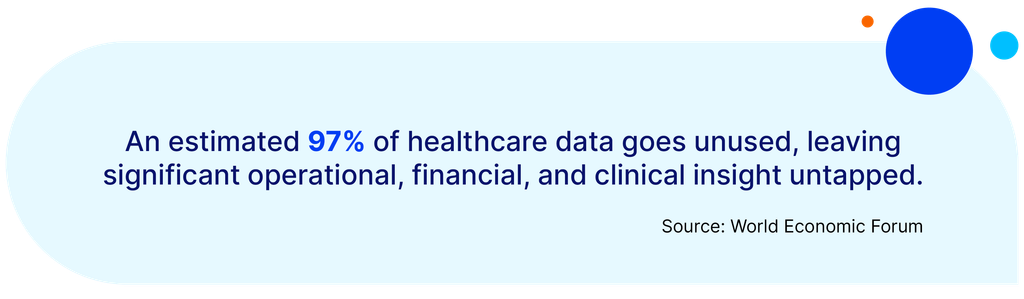
MIPS data is part of that larger opportunity. The very systems used to collect and track performance measures can also provide visibility into where improvements are needed. However, practices often only use it for reporting, rather than ongoing decision-making.
Part of the challenge may be educational. A 2025 survey shared in Family Medicine found that only 27% of family residency program directors have a formal value-based care curriculum in place. According to a 2024 study published in the Journal of General Internal Medicine, 65% of internal medicine residents had little to no exposure to value-based care principles during training.
So while providers have data, that data doesn’t create change on its own. The value only comes when practice leaders use that information to understand where to take action.
Performance Data Isn’t Used to Strengthen Market Position
For many medical practices, performance data is gathered, reported, and then largely shelved.
Meanwhile, referral partners, payers, and prospective patients are all looking for evidence. They want to know who delivers strong outcomes and who can demonstrate results consistently over time.
The practices that can answer those questions clearly are gaining an advantage because trust becomes easier to build. They’re often in a better position for payer negotiations, referral relationships, partnership opportunities, and future value-based arrangements. They are using the evidence of clinical achievement as the foundation for differentiation.
Building a MIPS Strategy for Performance and Growth System
The practices creating the most value from MIPS aren’t working from a different set of metrics. They’re using the same information to make better decisions about patient care, financial performance, operations, and growth.
Use MIPS as a Continuous Performance Signal
Treat reporting as the output of performance management, not the primary objective. A year-end report can tell you what happened. It can’t help you change it.
By the time a performance issue shows up in reporting, it has often been building for months. Missed follow-ups, rising no-show rates, widening care gaps, and declining engagement rarely appear all at once.
Take a practice that’s seeing more mental health patients miss appointments and fewer complete follow-up care. Waiting until year-end confirms the trend. Responding immediately gives the practice a chance to reverse it. More appointment availability, targeted outreach, or additional support for higher-risk patients may be enough to change the trajectory before it starts affecting outcomes or reimbursement.
That’s the difference. MIPS becomes part of how the practice runs, not something that gets dusted off when deadlines arrive.
Connect Quality Performance Directly to Financial Outcomes and Growth Strategy
Most leaders pay attention when performance starts affecting revenue.
CMS already adjusts Medicare reimbursement based on MIPS scores, yet quality and finance are often discussed separately. One team talks about metrics. Another talks about margins. The connection between the two can get lost.
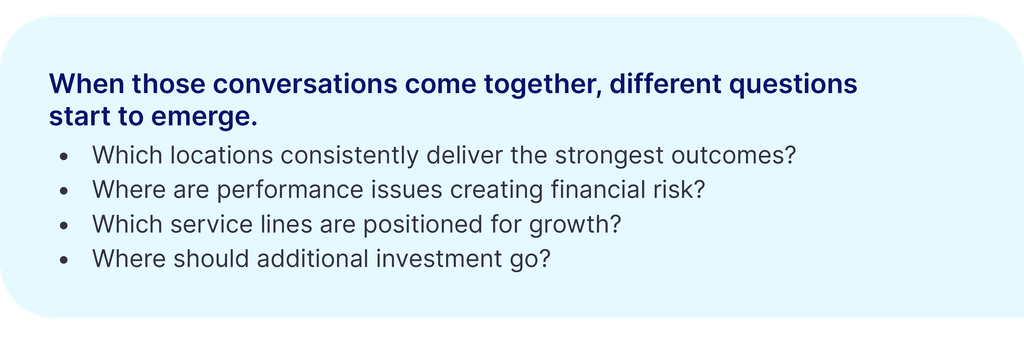
The answers can shape far more than quality improvement efforts. A practice that consistently delivers stronger preventive care outcomes may be a better candidate for expansion than one struggling to maintain performance. Likewise, providers with strong quality results are often further along in building the capabilities needed for value-based care.
That’s important because strategic engagement with MIPS helps you build the operational foundation required for future value-based contracts. The ability to measure performance, pinpoint care gaps, engage patients, and track outcomes over time is increasingly becoming a requirement to participate in performance-based reimbursement models.
CMS’ value-based programs reward providers for delivering high-quality care and improving outcomes through incentive payments, shared savings opportunities, and reimbursement models tied to performance. Many of the capabilities those programs depend on are already visible in day-to-day performance data.
Viewed this way, MIPS extends beyond performance tracking. It becomes a way to build the infrastructure that positions your practice for stronger value-based contract opportunities as reimbursement models continue to evolve.
Use MIPS for Reimbursement Optimization and Growth Planning
A successful MIPS reimbursement optimization approach recognizes that a falling score is rarely the actual problem.
More often, it’s a signal that something else needs attention.
Patients may be struggling to book appointments. Follow-up processes may be inconsistent. Staffing pressures may be affecting access. Looking beyond the numbers often reveals operational issues that reach far beyond reporting.
Practices that monitor performance throughout the year have more room to respond. A decline in preventive care scores, for example, can be addressed through outreach and scheduling adjustments before it begins affecting reimbursement reviews or payer relationships.
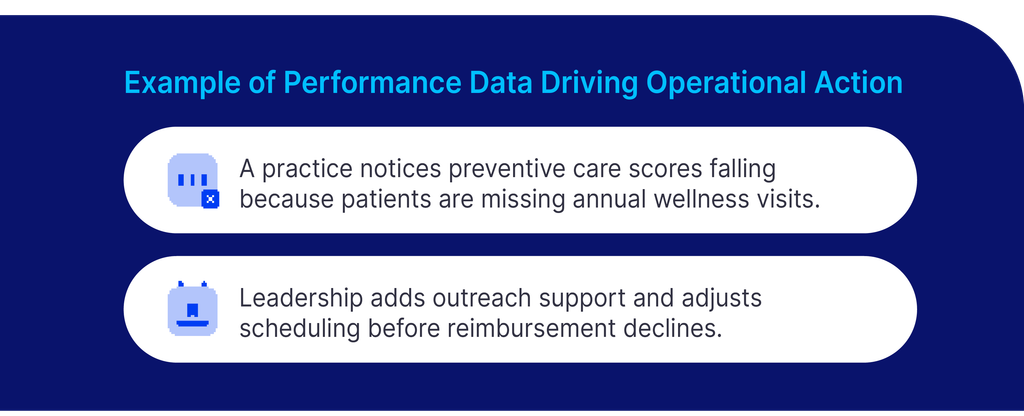
Over time, the systems used to track performance, identify care gaps, and monitor trends become useful for far more than MIPS reporting. They support reimbursement planning, payer discussions, and future growth decisions.
Turn Performance Insight into Operational Improvement
Spotting the problem is the easy part. The harder part is changing the processes behind it.
A report might show that patients with uncontrolled hypertension frequently miss follow-up visits after discharge. That’s useful information, but nothing improves until someone acts on it.
One provider may introduce automated outreach. Another may assign care coordinators to higher-risk patients. A third may redesign follow-up workflows entirely. The specifics matter less than the response.
This is exactly the type of work value-based care models are designed to encourage. Better coordination, earlier intervention, and fewer patients slipping through the cracks.
Research from Humana suggests that this approach works. Healthcare organizations operating in value-based arrangements outperform fee-for-service models on preventive care and chronic disease management measures.
There can also be a financial reward for getting it right. Colorado’s 2024 Value-Based Payments Report found that 19 primary care practices earned shared savings payments while maintaining quality goals. Better care delivery created better outcomes and measurable financial value.
Use Quality Performance to Differentiate and Strengthen Market Position
Use performance data to demonstrate the outcomes your practice delivers and the value it creates.
As value-based reimbursement expands, measurable outcomes carry more weight in payer relationships, partnership discussions, and growth opportunities. Colorado’s Value-Based Payments Report estimated that 52% of Medicaid payments in the state were tied to value-based arrangements in 2024. National research has also found that value-based payment models outperformed fee-for-service across all 15 measured clinical quality outcomes.
Performance can become a competitive advantage, but only if people can see it.
Over time, the infrastructure built around MIPS gives practices a way to demonstrate results, support stronger partnerships, and compete on measurable performance rather than parity alone.
From MIPS Compliance to Performance-Driven Growth
Most practices aren’t failing MIPS. They’re underusing it. Healthcare is heading toward a future where outcomes matter more than ever, performance is under closer scrutiny, and providers are expected to show their value. Practices that already use performance data to guide decisions will be better prepared for that future than those that only look at metrics during reporting periods.
This is why practices need to use the same processes that support MIPS today to make more informed investment and improvement decisions and demonstrate their value more effectively.
Over time, that ability to connect clinical performance, operational decision-making, and financial strategy will become an increasingly important competitive advantage. It creates stronger operations with better visibility and more confident decision-making. Externally, it positions practices to compete for more advanced value-based contracts, strengthen payer relationships, and demonstrate value in an increasingly outcomes-focused market.
DrChrono by EverHealth helps practices bring those pieces together by centralizing performance data, surfacing actionable insights, and connecting quality performance to financial and operational strategy. If you’re ready to move beyond compliance and use MIPS as a driver of performance and growth, learn more about how DrChrono can help turn your data into a strategic advantage.