
Medical practices have more access to clinical and operational data than ever before. Yet most healthcare analytics systems remain anchored to the past, documenting what happened after the fact. Claims performance, patient outcomes, operational metrics, utilization trends: all are reported in retrospect, when the window for intervention has often closed.
That model is broken. As providers face growing administrative complexity, rising chronic disease burden, staffing shortages, physician burnout, and intensifying value-based care pressures, retrospective reporting doesn’t just fall short. It creates a structural blind spot. Leaders are making consequential decisions without the intelligence to anticipate what’s coming.
The shift to predictive clinical and operational analytics isn’t an upgrade to existing tools. It’s a different category of capability entirely. Instead of explaining what went wrong, providers can now detect disease progression before it accelerates, intervene in at-risk populations before costs compound, and correct operational failures before they become crises.
The stakes make this transition urgent. Research published in the BMJ Quality & Safety journal shows that an estimated 795,000 Americans each year become permanently disabled or die because dangerous diseases are misdiagnosed. Many of these cases involve delays in recognizing subtle clinical changes or worsening conditions early enough for timely intervention.
Integrated platforms such as DrChrono help create the connected data foundation needed to support predictive healthcare analytics. By bringing clinical and operational information together, providers can move beyond retrospective reporting toward forward-looking intelligence.
This guide makes the case for clinical pattern intelligence as a foundational shift in how your practice or medical group uses data, from documenting the past to acting on what’s next. It looks at why the retrospective model is holding back clinicians and how intelligence opens the door to more proactive clinical decision-making, operational planning, and patient care.
Treatment Decisions and Disease Progression Are Often Identified Late
There’s a common pattern in chronic disease management. A patient comes in, a treatment is started, and then weeks or months pass before anyone has a clear understanding of whether it’s working. If it’s not, adjustments are made. Then, more waiting. Another adjustment, and the cycle continues.
This is a structural limitation and not a clinical judgment failure. Clinicians rely heavily on what they can observe in the moment, their own experience, and whatever fragmented records are available. Early indicators of disease progression are often present in the data before they become clinically obvious, but they rarely surface in a way that prompts action.
The population-level numbers make this problem harder to ignore. According to the U.S. Centers for Disease Control and Prevention (CDC), six in 10 American adults live with at least one chronic disease, and chronic diseases account for 90% of the nation’s $5.3 trillion in annual U.S. healthcare spending.
In another study published in the Journal of Family Medicine and Primary Care, 41.4% of 30-day readmissions among 2,698 older adults admitted to geriatric wards were potentially avoidable, underscoring the importance of identifying signs of deterioration before patients require rehospitalization.
Since practices already possess extensive information on treatment effectiveness, disease trajectories, medication adherence, and patient outcomes, the challenge is that traditional healthcare analytics systems rarely surface those insights proactively while early warning signs are still emerging.
As a result, treatment decisions are sometimes based on trial and error, and the risk of disease progression may not be identified early enough for timely intervention.
How Healthcare Trend Identification Drives Better-Informed Clinical Decisions
The gap between data and clinical action is mostly a timing problem. Healthcare practices already hold extensive records on treatment outcomes, medication adherence, disease trajectories, and patient response patterns. What most analytics tools don’t do is surface any of that during the actual moment of clinical decision-making. It shows up later, in a report, after the window for a different decision has closed.
Clinical pattern intelligence works differently. Instead of waiting for performance reviews, it continuously analyzes longitudinal patient data to find treatment-response patterns and early deterioration signals. Then, it surfaces those findings when they are still actionable. A current patient is compared against similar historical cases and matched on diagnosis, demographics, lab values, comorbidities, medication adherence, and utilization history. The result is a richer clinical picture than any single chart review can provide.
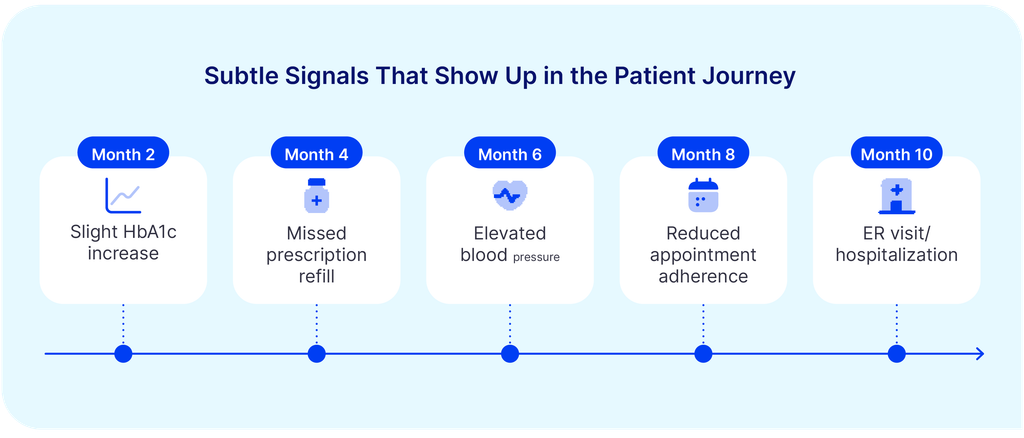
Consider a diabetes patient. They show gradually rising HbA1c across several visits, combined with widening refill gaps and slowly climbing blood pressure readings, which may not look alarming on any individual data point. But those three trends converging over time tell a different story. They show the current treatment plan is losing effectiveness and that the trajectory is heading in the wrong direction. Catching that pattern at month four rather than month 10 is the difference between an outpatient medication adjustment and an avoidable hospitalization.
For patients, earlier identification shortens the time spent on ineffective therapies. For practices under value-based care contracts, it reduces avoidable utilization and supports stronger performance against outcome benchmarks. Neither of those outcomes requires perfect prediction. They just require earlier visibility into what the data is already showing.
As practices face growing pressure to improve both quality and efficiency, the ability to identify successful treatment patterns prospectively rather than retrospectively is becoming increasingly important.
Operational Inefficiencies Continue Because Practices Struggle to Identify Recurring Systemic Patterns
Operational problems rarely occur in isolation. Many healthcare practices repeatedly experience scheduling bottlenecks, staffing imbalances, documentation slowdowns, workflow inefficiencies, and administrative overload. These issues often appear as daily frustrations rather than identifiable systemic trends.
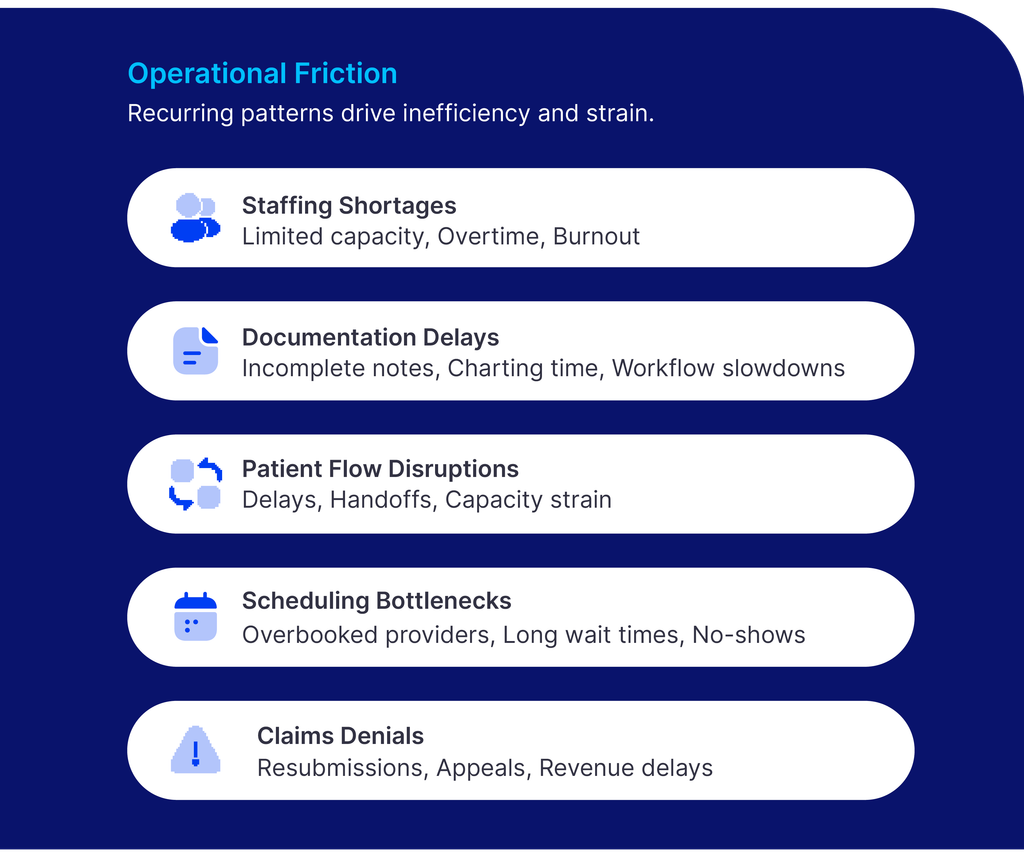
These issues can create recurring inefficiencies that disrupt patient flow and reduce operational predictability. At the same time, physician burnout and staff turnover continue to challenge operational stability across the healthcare industry. According to a 2025 American Medical Association (AMA) study, physicians report working with an understaffed team 38.5% of the time in medical specialty practices, and close to 50% of the time in surgical care. The study also found that not having enough staff is a major cause of burnout among physicians.
Together, these pressures can reduce workflow consistency, strain available resources, and make it more difficult to maintain efficient and sustainable operations. Denial rates and reimbursement friction add another layer, requiring staff time for appeals and resubmissions that compounds an already stretched operational environment. Because many of these issues emerge gradually across multiple workflows, practices often address individual symptoms rather than identifying the recurring operational patterns driving them.
Traditional reporting systems can identify isolated operational problems after performance metrics decline. However, retrospective reporting alone often provides limited visibility into how these challenges repeatedly interact across time.
How Forward-Looking Clinical Analytics Can Help Practices Eliminate Systematic Issues
Healthcare analytics applied at the operational level provides a different kind of visibility. Rather than reviewing individual performance events, practices can analyze workflow, staffing, utilization, and reimbursement trends over time to understand how recurring operational variables interact.
Practices can evaluate:
- Scheduling trends
- Staffing utilization
- Appointment utilization patterns
- Denial patterns
- Workflow timing
- Documentation delays
- Patient flow fluctuations
- Resource allocation trends
This longitudinal operational visibility helps practices identify recurring friction points that may remain difficult to recognize through isolated reports or short-term performance reviews. For example, a practice may discover that appointment bottlenecks consistently emerge during specific periods due to predictable staffing shortages. In response, they can evaluate whether temporary staff or outsourcing specific administrative tasks would reduce pressure on the in-house team.
They also might see that documentation time per encounter rises when there aren’t enough staff on hand. That means being short-staffed isn’t just impacting the patient experience and patient throughput; it’s also affecting physician burnout and possibly slowing claim submissions, which impacts the revenue cycle. Clinical intelligence can surface these patterns, helping practice leaders connect the dots faster.
Practices can improve staffing alignment, optimize scheduling structures, reduce recurring bottlenecks, and strengthen operational predictability across care delivery environments when they have the intelligence they need to look ahead.
Population Health Opportunities Are Difficult to Identify Within Broad Patient Populations
Providers understand the importance of population health management. However, determining which patient groups require different levels of outreach, monitoring, and care coordination remains a significant challenge.
Large patient populations contain substantial variation in:
- Risk exposure
- Utilization behavior
- Treatment responsiveness
- Engagement consistency
- Long-term outcomes
Without structured population-level analysis, it’s difficult to distinguish which patient cohorts require more intensive preventive support versus broader routine engagement strategies.
As a result, many practices apply broad population health programs across large patient groups despite meaningful differences in utilization patterns, care needs, and engagement behavior. This can reduce the precision of preventive care initiatives while limiting the effectiveness of outreach and care coordination efforts.
Resources may be distributed too broadly across populations, making it more difficult to prioritize patients with elevated utilization patterns, declining engagement, or more complex care coordination needs.
How Healthcare Data Analytics Leads to Proactive Care Management
Healthcare data analytics helps practices identify meaningful population-level trends through more advanced cohort segmentation strategies.
Providers can use healthcare data to group patient populations based on:
- Risk profiles
- Utilization trends
- Outcome patterns
- Engagement behavior
- Intervention responsiveness
- Chronic disease progression trends
This segmentation approach helps practices better understand which patient cohorts may benefit from different preventive care strategies, monitoring intensity, and outreach models.
For example, a provider may identify a subgroup of diabetic patients demonstrating rising utilization combined with worsening medication adherence and declining engagement patterns.
Without stronger cohort-level segmentation, these patients may remain grouped within broader diabetic populations despite demonstrating significantly different utilization behavior and support needs.
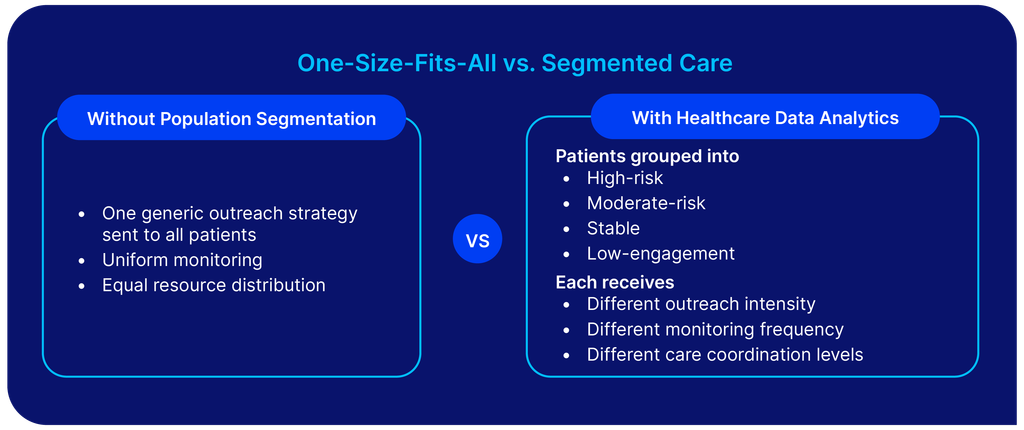
Stronger visibility into population-level trends helps providers prioritize outreach, care coordination, and preventive monitoring resources more strategically. This improves the precision of population health initiatives while helping to focus limited resources on patient groups with the greatest potential need.
Healthcare data analytics also helps organizations evaluate which intervention approaches produce stronger outcomes across different patient cohorts—whether that’s outreach models that improve engagement, care strategies that reduce avoidable utilization, or programs that produce better outcomes for specific populations. The result is a more targeted approach to population health rather than a one-size-fits-all program.
From Retrospective Reporting to Proactive Healthcare Decision-Making
There’s a version of healthcare analytics that tells practices what happened. Most tools still operate this way: quarterly reports, annual summaries, post-event reviews. They are all useful in their own context, but far less valuable when the goal is to identify emerging risks and intervene before problems escalate.
Clinical pattern intelligence represents a meaningful departure from that model. The same clinical and operational data that currently feed retrospective reports can also be used to identify emerging trends, anticipate risks, and surface opportunities for earlier intervention. The data is not the constraint. The architecture and the timing of insight delivery are.
As healthcare complexity continues to increase, the practices that are positioned to manage it will be those that can move from explaining what happened to anticipating what’s likely to happen next. That shift supports more proactive care management, more efficient operations, and more targeted population health planning.
DrChrono by EverHealth supports this approach by providing the trusted data foundation providers need to generate meaningful insights from clinical and operational information and act on those insights before conditions worsen. Learn more about DrChrono and how your practice can use healthcare data analytics to identify meaningful trends earlier, improve operational performance, and support better patient outcomes.