

Executive Summary
The economics of ambulatory care are being rewritten in real time. In 2012, less than 30% of physicians were consolidated with hospital systems. By 2024, at least 47% were employed by or affiliated with a hospital system.
Growth is no longer optional for practices that want to remain competitive, but growth without infrastructure maturity is where most multi-location organizations fail. This is because infrastructure maturity—not capital, reputation, or market timing—determines whether practice growth strengthens or destabilizes operations.
This guide examines how fragmentation takes hold as practices expand: each new location becomes an operational island, leadership loses comparative visibility, culture and clinical standards dilute across sites, and governance structures fail to keep up the pace. It then proposes the governance frameworks, reporting standardization, and integrated oversight that allow for scaling without this fragmentation.
How Fragmentation Takes Hold in Growing Practices
Multi-location growth rarely fails at the capital or hiring stage. Instead, it fails at the operational replication stage, where the infrastructure was never designed to carry the weight of scale.
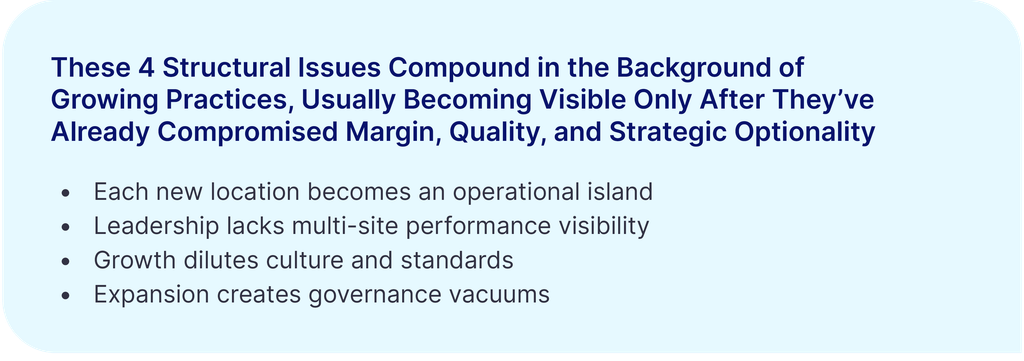
The four issues below describe structural failure modes that compound in the background, usually becoming visible only after they’ve already compromised margin, quality, and strategic optionality.
Each represents a different dimension of the same underlying problem: the systems that worked at one location don’t automatically work at five, ten, or twenty.
Each New Location Becomes an Operational Island
When a new location is at the operational replication stage, it develops its own rhythms, reporting methods, and performance standards. This is where the expansion typically fails. What worked at the original location doesn’t always transfer, which means each new expansion essentially starts from scratch.
With operational islands, medical groups end up duplicating administrative overhead that a true group practice would have consolidated, as explained in Medical Economics. The transition from a “group-up” to a coherent group practice can take three to five years of deliberate work on compensation, governance, site consolidation, and common policies. Unfortunately, most practices underestimate this timeline by half.
This operational island problem compounds with every new acquisition. Each inherited practice comes with its own embedded systems, vendor relationships, and workflow habits that leadership must actively integrate rather than passively absorb. As a Bain & Company analysis shows, the most successful platforms convert disparate practices into coordinated systems with shared infrastructure, the opposite of operational islands.
This operational island pattern has valuation consequences that independent practices should be aware of. Private equity (PE) buyers increasingly penalize loose confederations of locations, since they’re less interested in how many locations a practice has and more interested in how well those locations actually function.
This is a valuation signal that applies equally to independent practices planning organic growth. Leadership loses unified visibility the moment sites diverge, and without comparability, there’s no way to identify which location models deserve replication or which are underperforming. Enterprise value depends on the performance of the weakest operational island, not the strongest.
Leadership Lacks Multi-Site Performance Visibility
Multi-location practice executives can’t answer basic strategic questions, such as:

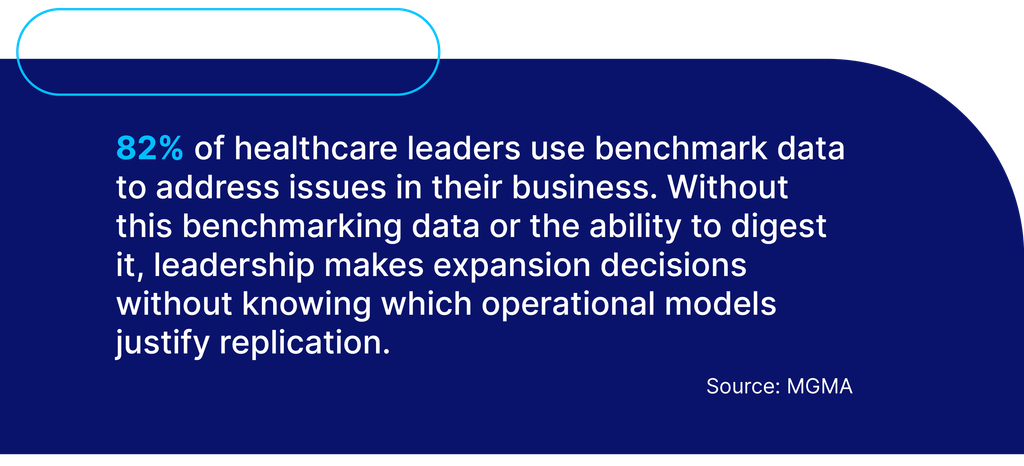
Each location may have its own reports, but they use different metrics, definitions, and timeframes. This makes comparison and true benchmarking impossible in an industry where benchmarking data is essential for success. According to the Medical Group Management Association (MGMA), 82% of healthcare leaders use benchmark data to address issues in their business.A systematic literature review by BMC Health Services Research also concluded that benchmarking is a growing field that may stimulate improvements in quality.
Further, a peer-reviewed study published by BMC Health Services Research shows that enterprise-level dashboards, once deployed across multiple specialty areas, can improve data transparency and enable reliable tracking of provider productivity, recruitment decisions, and performance expectations.
Without any of this benchmarking data or the ability to digest it, leadership makes expansion decisions without knowing which operational models justify replication. Practices end up replicating operational models that look successful on the surface, but haven’t been validated against comparable data from other sites. And every month of fragmented reporting is a month of decisions made with incomplete information.
Growth Dilutes Culture and Standards
As practices expand, the clinical and operational culture that made the original location successful becomes harder to maintain. Some of these factors depend heavily on proximity, informal transmission, and personality, none of which can scale geographically. New locations may interpret protocols differently, hold different quality standards, or develop distinct operational philosophies.
The solution isn’t to resist expansion; it’s to systematize what made the original location successful. While healthcare has been slower to embrace systematic standardization, evidence from aviation, nuclear energy, and anesthesia demonstrates that standardization has reduced adverse events significantly over the past 25 years, according to the American College of Obstetricians & Gynecologists (ACOG). The elimination of variation in processes is an important cornerstone of this improved performance. Additionally, according to a study in JMIR Research, medical practice variation is associated with poorer health outcomes, increased costs, disparities in care, and added burden on medical systems.
Patient experience inconsistency across locations will erode brand equity faster than any marketing investment can restore it. A culture that lives only in the founding partners’ heads can’t survive a third, fourth, or fifth location, but a culture embedded in operational systems, measurable dashboards, and encoded protocols stands a chance.
Expansion Creates Governance Vacuums
Multi-location growth often happens faster than governance structures evolve. Practices find themselves with distributed operations, but they have centralized decision-making that creates bottlenecks. Or, they push decision authority to sites without adequate performance oversight.
Either approach creates problems. Either approach creates problems: strategic drift, inconsistent accountability, and reactive intervention that only occurs after performance has already eroded.
The life-cycle economics of private equity-backed practices compound this pressure. Secondary buyouts require aggressive growth over short horizons and raise open questions about longer-term investments in infrastructure, personnel, and quality, as explained in Health Affairs Scholar.
Governance failure is usually invisible until a crisis forces a redesign. At this point, the redesign happens under duress instead of by design. The former carries a significantly higher cost than the latter. Decision authority that’s centralized by default creates bottlenecks that slow every site equally, while decision authority that’s delegated without oversight creates variance that compounds across the network.
Sustainable governance requires explicit definitions of which decisions belong to site leadership, which belong to regional or specialty leadership, and which belong to the board. It also requires a reporting infrastructure that surfaces exceptions rather than dumping raw operational data on executives.
How to Build Infrastructure to Scale Without Fragmentation
Healthcare leaders won’t find the remedy for fragmentation through more meetings, dashboards, and consultants. They need to look at infrastructure maturity built through three interlocking systems.
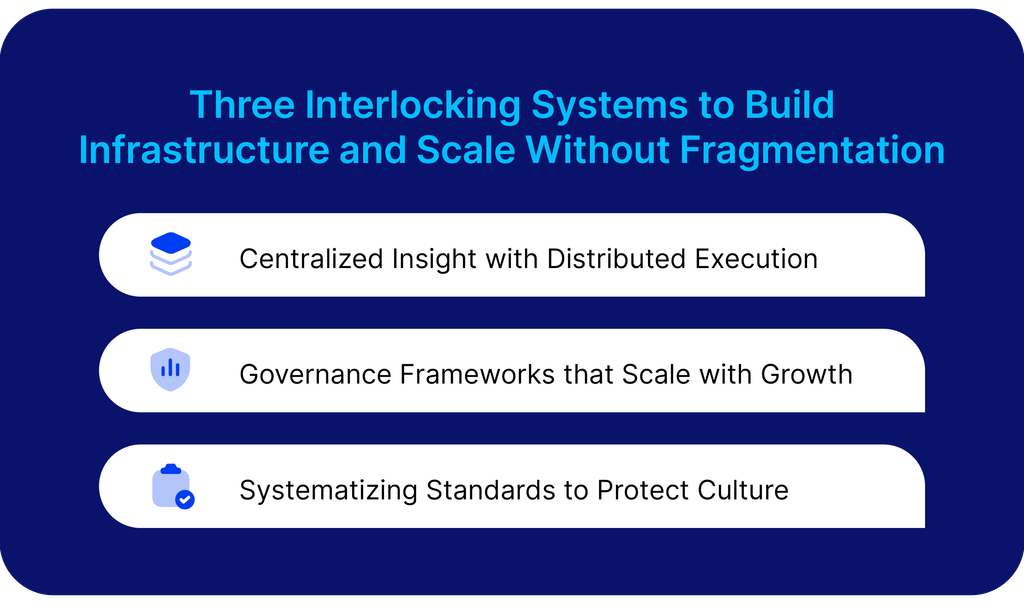
The first system is centralized insight paired with distributed execution, so leadership sees the whole network while site leaders retain the autonomy to act. The second is governance frameworks designed to scale with growth rather than requiring crisis redesign once the cracks appear. Finally, the third is systematized standards that protect the culture by encoding it into operational infrastructure rather than relying on informal transmission.
Together, these three interlocking systems define the difference between practices that scale with coherence and those that risk fragmentation.
Centralized Insight with Distributed Execution
Operational excellence, including improvements in access, workflow, and care coordination enabled by data and analytics, has become the central lever of value creation in physician practice platforms, according to Medical Economics. Integrated reporting infrastructure, such as what’s possible with an intelligence platform like DrChrono, aggregates financial, operational, and clinical performance from every site into comparative dashboards built on consistent metric definitions. This centralized insight paves the path for operational excellence.
The most successful multi-location platforms, according to Becker’s ASC Review, turn loose confederations into coordinated systems with shared infrastructure and clearly defined roles. Site leaders receive the granular data they need for local decisions, while central leadership receives the comparative visibility required for strategic oversight. This eliminates the false choice between autonomy and accountability.
For example, let’s consider a five-location orthopedic group that knows one site generates higher revenue per visit but can’t explain why, because each location reports differently. After deploying a unified dashboard with standardized definitions, leadership discovers the outperforming site schedules 15% more follow-up visits within 10 days of initial consultation via a front-desk rebooking workflow the site manager built independently. Central leadership validates the model against outcomes and satisfaction data across all sites, confirms it holds, and rolls it out network-wide within the same quarter.
Analytics that reveal which location characteristics correlate with superior performance convert expansion from a real estate exercise into a replication of proven models exercise. Unified visibility is the prerequisite for every other scaling decision, including where to invest, where to intervene, and where to expand next. This global enterprise intelligence makes every site smarter without making them all identical.
Governance Frameworks That Scale with Growth
Sophisticated executive infrastructure, including professionally trained CEO, CFO, COO, and managed care leadership, is one of the primary advantages that PE-backed groups offer over traditional private practice structures. Independent groups should consider how to replicate that layer without necessarily replicating the capital structure.
A well-designed governance framework is one of the highest-leverage investments a growing practice can make because it shapes every other operational decision downstream. Governance design should precede the next expansion, not follow it. That’s because governance that scales is governance designed to scale, not governance inherited from the single-location era and stretched until it breaks. It should specify clear decision authority at each level of the organization.
Performance oversight maintains accountability without micromanagement by defining which decisions belong to which site leadership, which belong to regional or specialty leadership, and which belong to the executive board. Boards with staggered terms, elected physician representation, and formal escalation paths ensure continuity through partner transitions, acquisitions, and leadership turnover.
Finally, reporting systems should serve governance, not feed it. They should surface exceptions and trend breaks instead of dumping raw data onto executives who’re already stretched thin.
Systematizing Standards to Protect Culture
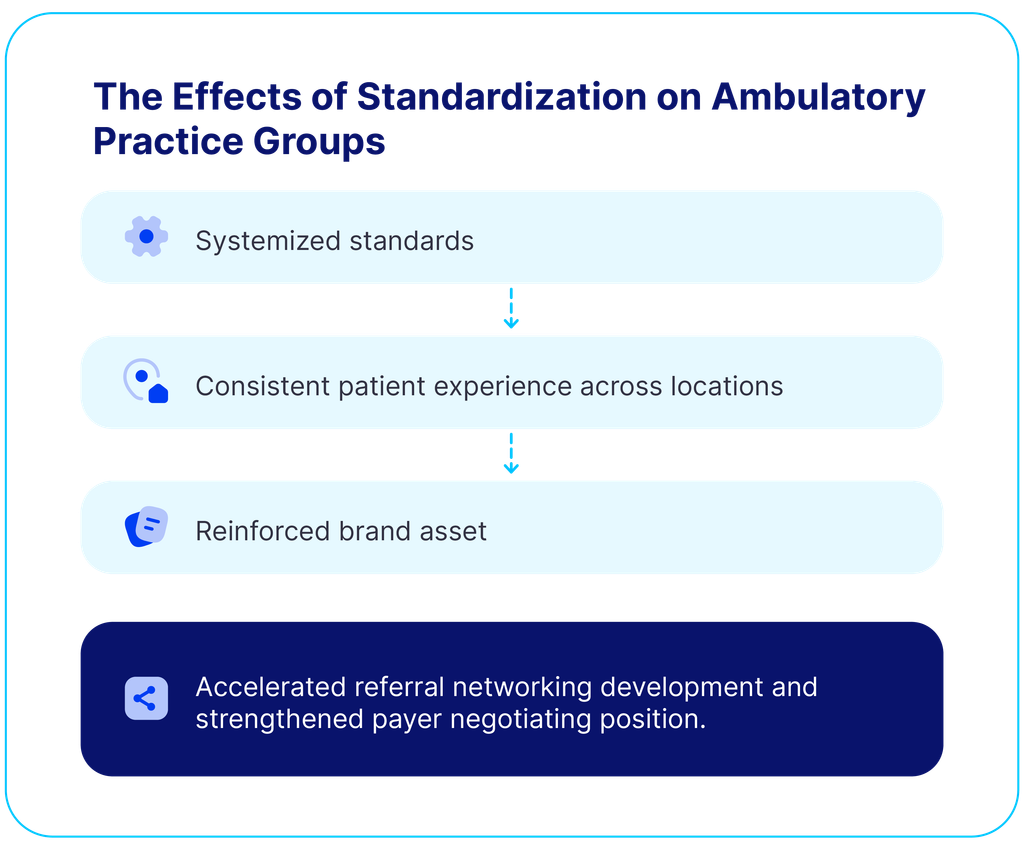
Clinical protocols, quality monitoring, and patient experience standards should be encoded into the operational systems of every site rather than transmitted informally through conversation or inherited habit. As seen in the industries of aviation, nuclear energy, and anesthesia earlier, standardization of any process through protocols and checklists can achieve meaningful reductions in harmful events.
When leadership systematizes a practice group’s standards instead of allowing them to remain personality-dependent, the group maintains its identity, culture, and reputation across every new market it enters. Consistent patient experience across locations becomes a reinforcing brand asset. This accelerates referral networking development and strengthens the organization’s payer negotiating position.
Encoded standards also protect practices against the inevitable clinical and administrative staff turnover that accompanies growth, since quality is no longer dependent on the specific people holding the roles.
Build the Foundational Infrastructure Required for Successful Scaling
The consolidation of ambulatory care isn’t slowing down. For multi-provider and multi-location practices, the competitive pressure comes from platforms that have already built the governance, reporting, and standardization infrastructure to grow without fragmenting.
Faster growth isn’t the solution for ambulatory care. Rather, practices that expand with coherence, treating each new location as a reinforcement of enterprise strength rather than a dilution of it, will have the edge over competitors. But first, practices must know whether the infrastructure they have in place today can carry the organization through the growth already planned for tomorrow.
Addressing the fragmentation patterns described in this guide—inconsistent reporting, drifting standards, and governance without visibility—requires technology infrastructure that’s architected for multi-location coherence from the start, not retrofitted after the fact. Cloud-native platforms that unify EHR, practice management, billing, and patient engagement into a single source of truth across every location represent the direction the industry is heading.
The fragmentation patterns described in this paper—inconsistent reporting, drifting standards, and governance without visibility—are exactly what DrChrono by Everhealth was built to eliminate. Unlike EHRs retrofitted for scale, DrChrono is a cloud-native intelligence platform where EHR, practice management, billing, and patient engagement operate from a single truth across every location. Its infrastructure is purpose-built for ambulatory practices scaling with coherence. Schedule a DrChrono demo before your next expansion.