

Executive Summary
Electronic health records are now universal in ambulatory care, with over 75% of office-based clinicians and 96% of hospitals using a certified EHR. Yet, for practice executives responsible for long-term strategy, there’s a clear paradox. Practices generate more clinical, operational, and financial data than ever but still can’t answer the fundamental questions that determine strategic direction. Where are we vulnerable? Where should we grow? What is about to change?
The industry is entering a new architectural era as EHR shifts from digital record-keeper to integrated intelligence platform. However, this shift is structural, not incremental. Aggregated data streams, once siloed across scheduling, billing, clinical, and communication systems, are becoming a predictive infrastructure that surfaces risk, forecasts performance, and informs executive decisions in real time.
For independent practices navigating accelerating consolidation, rising operating costs, and the transition to value-based care, this evolution is no longer optional. Sustainable independence requires infrastructure that generates insight rather than merely storing information. This paper examines the architectural progression from EHR to intelligence platform, the strategic questions it unlocks for leadership, and why competitive timing on this transformation will determine who leads and who follows in the next decade of ambulatory care.
The EHR Was Built to Store Information, Not Generate Insight
The electronic health record (EHR) emerged to solve a specific and urgent problem. It was meant to replace paper charts with digital records that could be accessed more reliably, shared within a facility, and used to meet regulatory and billing requirements. That mission succeeded. Federal incentives through the HITECH Act of 2009 accelerated adoption dramatically. Within a decade, EHR penetration reached near-universal levels across both hospitals and physician practices.
But the architecture that powered this transformation was designed for its moment and for the problem it was solving. EHR systems were built as repositories optimized for documentation, compliance, and transactional record-keeping. They were never designed to function as analytical engines. This is why the vendors who built them prioritized workflow capture over strategic synthesis.
In 2026, this prioritization makes far less sense. The data is there, but the questions that matter most in this era remain unanswerable without manual analysis that few leadership teams have time to perform.
The architecture that served a decade of digitalization doesn’t serve the next decade of decision-making, where margins are thinner, consolidation is faster, and accountability for outcomes is contractual, not aspirational.
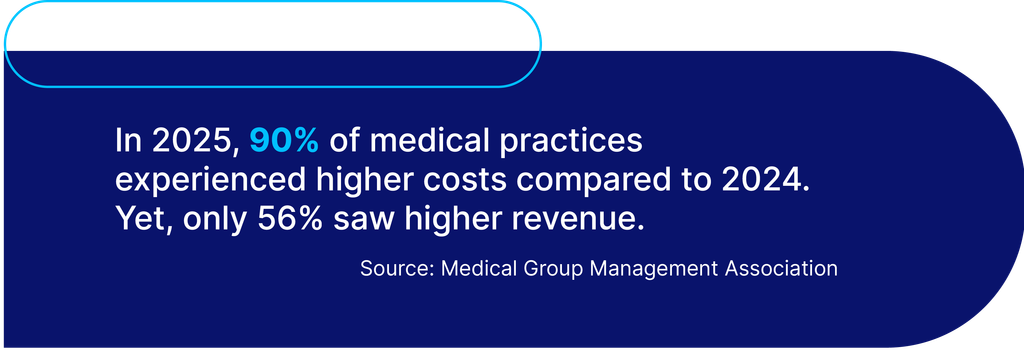
The context in which practices now operate bears little resemblance to the one in which most EHR investments were originally made. For one, tighter margins are putting immense pressure on practices to become more efficient through strategies like increasing automation. According to the Medical Group Management Association (MGMA), medical practice leaders reported an average year-to-date operating expense increase of 11.1% in 2025 compared to the same period in 2024. Yet, only 56% of medical group leaders reported year-to-date revenue increases.
In addition, fewer physicians are part of an independent practice. According to the Bipartisan Policy Center, at least 47% of physicians are now employed by or affiliated with hospital systems, up from less than 30% in 2012. Private equity was responsible for 65% of all physician practice acquisitions from 2019 to2023.
Independent practices are being compressed from both directions, with rising costs on one side and well-capitalized consolidation on the other. The infrastructure most of them rely on was designed for a fundamentally different competitive reality. Against that backdrop, four structural limitations of the EHR-as-record-keeper model now actively constrain leadership from making strategic decisions.
Data Trapped in Silos That Can’t Answer Strategic Questions
Practice executives have clinical records, scheduling systems, billing platforms, and patient communications. Yet, they often can’t answer fundamental questions about which service lines are most profitable, which providers are most efficient, or which patient populations are growing or declining.
Although 95% of physician groups and hospitals have access to advanced analytics, according to Newswire, 84% of healthcare managers report that usage of these tools is negligible. Meanwhile, the Office of the Assistant Secretary for Technology Policy (ASTP) reports that 43% of hospitals share data with other organizations but receive nothing in return. This creates asymmetric information flows that further fragment the operational picture. Even within a single organization, specialty EHRs, billing systems, and departmental tools often operate in isolation from one another.
The data exists, but there’s no infrastructure to extract insight from it, leaving executives saying, “We should be able to answer that,” but without the means to produce the answer.
Inability to Predict What’s Coming vs. Reacting to What Happened
Traditional health IT tells practices what happened last month or last quarter, but provides no visibility into what’s likely to happen next week or next month. Practices respond to revenue dips after they occur, address capacity constraints after they create patient access problems, and react to staff burnout only after turnover has already happened.
This is because healthcare analytics maturity follows a four-stage progression from descriptive (what happened) to diagnostic (why it happened) to predictive (what will happen) to prescriptive (what to do), yet most practices remain stalled at the first stage, according to StatPearls. However, the industry is rapidly moving past descriptive reporting. According to Allied Market Research, the global market for predictive analytics in healthcare was estimated at $14.6 billion in 2023 and is projected to reach $128.2 billion by 2033.
Another paper by the Journal of General Internal Medicine adds that only 64% of large, innovation-focused health systems report having a team or individual accountable for the clinical application of predictive algorithms, which suggests that small practices are even less prepared for a predictive operating model. And practices without this predictive infrastructure operate one step behind their own operations. They’re stuck perpetually managing yesterday’s crises instead of shaping tomorrow’s trajectory.
Strategic Decisions Made on Incomplete Understanding
Practice leadership evaluates major strategic decisions such as technology investments, expansion plans, service line changes, and staffing models without visibility into how those decisions cascade across the organization. A decision that appears beneficial for one department frequently creates unintended consequences elsewhere, and hidden dependencies only reveal themselves after implementation, when course correction is expensive.
A peer-reviewed article from Frontiers in Public Health shows how value-based care transitions, in particular, require substantial upfront investment in technology, data analytics, and care coordination infrastructure, with uncertain ROI timeframes. This amplifies the cost of decisions made without full operational modeling.
Predictive analytics is recognized as an effective approach to support decision-making, calculate risks, and improve resource utilization, according to the International Journal of Medical Informatics. This is particularly true for the complex, interdependent questions that practice leaders now face. Without infrastructure that can model “if we do X, what happens to Y and Z,” strategic initiatives fail not because the strategy was wrong, but because its second-order effects were invisible at the time of the decision.
Architectural Lock-In That Limits Future Flexibility
Many practices discover too late that their current platform architecture constrains what they can do strategically, whether that’s adding services, expanding locations, integrating acquisitions, or participating in value-based contracts. The underlying issue is architectural rigidity, caused by systems built for a specific operational moment that can’t adapt as organizational strategy evolves.
Legacy technology that inhibits provider-to-provider communication, combined with the absence of standardized data formats, is one of the most significant barriers to interoperability in modern healthcare. When platforms store data in unique, non-standardized formats that can’t transmit information to other systems, the organizational cost extends far beyond IT. It also limits strategic optionality itself. Practices constrained by infrastructure decisions made over a decade ago for different operational realities find themselves unable to pursue new opportunities without undertaking a major rebuild. This creates a significant structural disadvantage against competitors whose architecture was designed to be adaptable.
The Architecture of Intelligence: What Comes After the EHR Era
The shift from EHR to an intelligence platform requires progression through distinct architectural stages, not a single leap. Each stage builds on the one before it. The first stage, digitization, is now complete. Clinical data exists in electronic form. Now, the second stage, integration, is underway in varying degrees as organizations connect previously siloed systems into unified data environments.
The third stage is intelligence. It only emerges when practices continuously analyze integrated data streams to surface patterns, anomalies, and insights that no individual system could produce alone. And the fourth stage, prediction, arrives when that intelligence becomes forward-looking and models probable futures instead of only summarizing the past.
Because each stage creates the preconditions for the next, understanding this progression reframes the conversation from “should we upgrade our EHR?” to “where do we sit on the architectural maturity curve, and what does that mean for our strategic ceiling?”
Four capabilities distinguish intelligence platforms from the record-keeping systems they replace, and each directly addresses a structural limitation of the current model.
From Static Repositories to Adaptive Intelligence Engines
Intelligence platforms integrate clinical, operational, and financial streams into a unified system that continuously analyzes aggregated data and surfaces the patterns leadership needs to see. Instead of executives waiting weeks for custom reports, questions about service line profitability, provider efficiency, and patient population shifts are answered in near real-time or on demand.
With this adaptive intelligence, leadership enters strategic planning sessions with answers already in hand. This frees executive time for action rather than data gathering, enabling practices to spot emerging issues before they become crises.
Predictive Infrastructure That Forecasts Rather Than Reports
Modern intelligence platforms function as predictive engines that model future performance based on current patterns. Practice leaders can forecast revenue trajectories, anticipate capacity constraints, identify emerging clinical risks, and predict payer behavior changes. Because they’re designed to learn from practice-specific patterns, they project forward instead of merely summarizing the past. This gives leaders confidence in what to expect in the coming quarters.
Predictive analytics also supports providers in delivering proactive care and helps organizations optimize staffing, resource allocation, and overall operational efficiency. That’s because, according to StatPearls, predictive analytics is effective at forecasting readmission risk, optimizing staffing based on demand, and supporting population health strategies. The transition from reactive management to proactive strategy changes what leadership can know and when they can know it, which is the defining characteristic of infrastructure maturity.
Impact Modeling for Comprehensive Strategic Decisions
Intelligence platforms enable impact modeling that shows how strategic decisions cascade across the entire practice ecosystem. They answer the question, “If we do X, what happens to Y and Z?”
For example, leadership can model a scheduling change against its impact on provider capacity, revenue, patient access, and downstream referral volume simultaneously instead of evaluating it in isolation and correcting it after the fact.
Prescriptive analytics builds on predictive models to recommend specific actions based on clinical guidelines and organizational context. Major decisions grounded in comprehensive analysis rather than partial visibility produce fewer failed initiatives, faster realization of strategic intent, and substantially reduced costs related to operational course-correction.
Architecture Designed for Adaptability and Future Flexibility
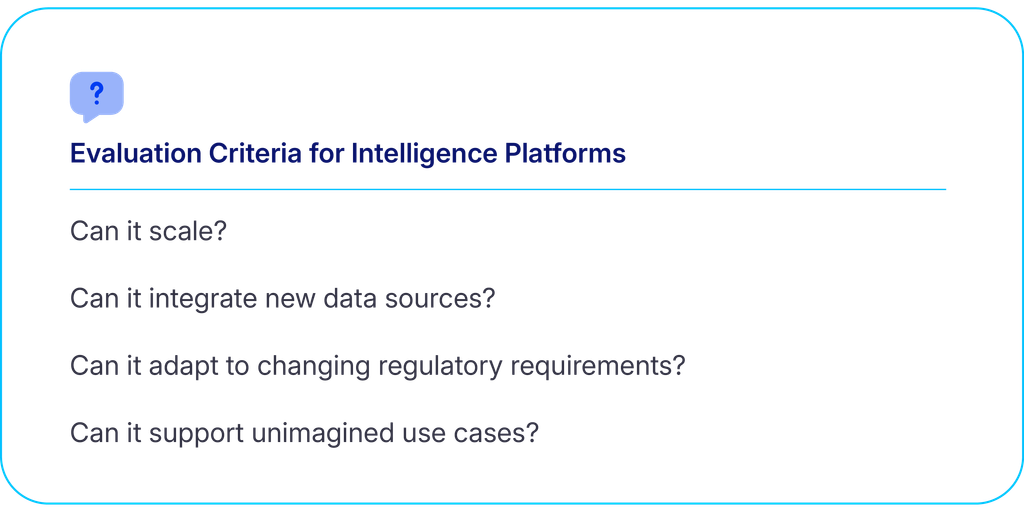
Intelligence platforms treat architecture itself as strategic infrastructure by prioritizing availability, performance, standardization, productivity, maintainability, and flexibility as first-order quality attributes, not just implementation details. The evaluation criteria shift from what a platform does today to what it enables tomorrow.
For example, can it scale? Integrate new data sources? Adapt to changing regulatory requirements? Support currently unimagined use cases?
Scalability and interoperability are increasingly recognized as the defining attributes of health information systems built for the future of the medical industry, according to the journal Health Information Research. Practices with adaptable intelligence platforms can pursue new opportunities, including service expansion, acquisition integration, and value-based contracting, without being blocked by architectural constraints inherited from a previous operational era.
The Strategic Implication of Intelligence Platforms Beyond Individual Practices
The architectural shift from EHR to an intelligence platform carries implications that extend beyond any single organization’s technology roadmap. For independent practices, it represents the infrastructure foundation for sustainable autonomy. This foundation provides the ability to compete on insight rather than scale, to negotiate from data-informed positions, and to demonstrate operational sophistication that historically required system-level resources.
For the investment community evaluating healthcare infrastructure, platform maturity is becoming a proxy for organizational resilience. Practices operating on intelligence architecture present a fundamentally different risk and growth profile than those still running on record-keeping systems with manual reporting workflows.
This transformation is creating a divergence across the competitive landscape. Practices that reach predictive capability early will compound their informational advantage with each passing quarter, while those that delay will find the gap increasingly expensive to close.
Build the Intelligence Infrastructure That Defines Your Next Decade
Moving from EHR to an intelligence platform is inevitable. What remains variable is timing, and competitive timing determines who leads and who follows. The practices that move first will define the standard for operational resilience, strategic flexibility, and sustainable independence in the next decade of ambulatory care.
For the practices investing in this integration now, aggregated clinical, operational, and financial streams become predictive infrastructure — a foundation that compounds in value with every data point added. Those practices will have the capacity to answer strategic questions in real time, surface risk before it escalates, and model the downstream impact of major decisions before committing to them. The alternative is to remain reactive—perpetually managing yesterday’s problems—while consolidated competitors compound their informational advantage quarter over quarter.
DrChrono by Everhealth partners with practice leaders who are building the intelligence infrastructure that makes strategic foresight possible. Schedule a demo to explore how DrChrono can power your practice’s transition from record-keeping to an intelligence platform.