

The healthcare workforce is burning out at an unprecedented rate, and the primary driver isn’t medicine—it’s paperwork. In fact, according to Medscape’s 2024 Physician Burnout and Depression report, 83% of physicians surveyed identified professional stress as the primary contributor to burnout or depression. The main frustration causing this stress doesn’t stem from patient care. It’s all the overwhelming administrative burden layered on top of clinical work that’s causing physician burnout. Documentation requirements, compliance tasks, inbox management, and care coordination consume large portions of the workday and frequently extend into evenings and weekends.
These findings reflect more than temporary strain. The way many medical practices organize and deliver clinical work is placing sustained occupational pressure on clinicians, threatening both provider wellbeing and the sustainability of healthcare delivery itself.
Ultimately, physicians aren’t overwhelmed with caring for patients. They’re overloaded with administrative tasks that pull time and attention away from meaningful patient interactions. This distinction matters because it changes the way the healthcare industry frames and addresses burnout.
Physician burnout is not a resilience problem. It’s not a morale issue or a temporary response to a busy season. It is a significant operational problem with significant operational causes and consequences.
When clinicians spend excessive time on administrative tasks:
- Care quality suffers
- Continuity of care becomes harder to maintain
- Physicians lose their motivation
These outcomes threaten the stability of the workforce as clinicians leave organizations due to burnout or leave the profession altogether.
The structure of tasks, the routing of information, and the design of workflows all shape how clinicians experience their day. When those systems create friction, interruptions, and duplicative work, the burden accumulates quickly. That’s why addressing provider burnout requires more than wellness initiatives or staffing adjustments. It requires changing how work moves through clinical settings.
This is where advances in artificial intelligence (AI) and healthcare workflow automation come in. Healthcare automation tools offer a practical way to redesign processes. When organizations apply these technologies thoughtfully, they remove routine administrative steps, reduce documentation time, prevent errors, and streamline coordination tasks.
Using AI and automation in practice management works. Evidence increasingly shows that alleviating clinician administrative burden also reduces physician burnout pressure. With measurable time-savings and significant reductions in after-hours work, clinicians regain greater control over their schedules and attention.
The opportunity facing medical practice leaders today is clear.
The solution to provider burnout is not asking clinicians to adapt to inefficient systems. It is redesigning those systems so they work the way clinicians actually work.
Provider Burnout Is Creating a Healthcare Crisis
Provider burnout is a well-documented, systemic issue, but the relationship between burnout and depression makes the situation even more alarming.
Almost half of all physicians report burnout, and one-fifth report depression. Critically, Medscape’s 2024 report found that physicians experiencing depression say burnout is the cause. This suggests that burnout isn’t just about job dissatisfaction, but a serious mental health crisis. Physicians who feel exhausted and depressed can’t deliver their best work, threatening both professional engagement and patient outcomes.
Physician burnout doesn’t pass quickly or resolve on its own. In Medscape’s 2024 report, the majority of physicians reporting burnout reported feeling this way for more than a year. This isn’t a bad week or a difficult month. It is sustained occupational distress.
The pressure is built into the day-to-day realities of the job, and it can accumulate over time. Understanding the difference between sustained exposure to pressure and episodic stress is crucial.
Most people can manage short bursts of stress through rest, relaxation, schedule adjustments, or temporary support. But persistent occupational distress gradually erodes resilience, making recovery harder.
Looking at burnout as a systemic problem changes where the responsibility sits. It’s no longer about asking clinicians to cope better or lean on self-care practices. It’s about healthcare organizations fixing the systems that shape how work gets done.
Physician Burnout Isn’t About Patient Volume. It’s About Administrative Burden.
There’s a common assumption that burnout comes from seeing too many patients. But that’s not what physicians themselves report.
Most physicians point to bureaucratic work as the main cause of their burnout. The problem isn’t patient interaction—it’s the documentation, compliance requirements, and administrative tasks that pull clinicians away from care delivery.
If work structure drives burnout, reducing patient volume won’t fix it. The real solution lies in changing how the work happens. When technology handles routine documentation, compliance, and coordination work, clinicians reclaim time for what they do best: practice medicine.
Administrative Work Erodes Work–Life Balance and Clinical Focus
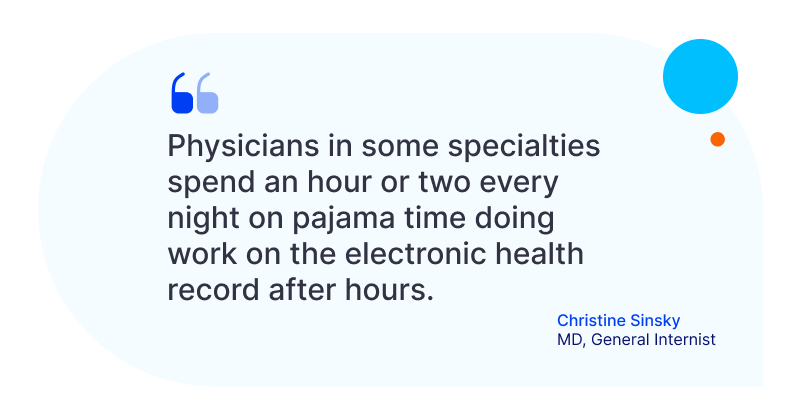
For most clinicians, the workday doesn’t end when the last patient leaves. Documentation, message responses, and administrative tasks continue well into the evening and weekends—a pattern widely known as “pajama time.”
As Dr. Christine Sinsky, former Vice President of Professional Satisfaction at the American Medical Association (AMA), notes: “We spend more time interacting with the computer than with the patient.” This isn’t occasional. It’s routine. And over time, it blurs the boundary between work and personal life.
When those boundaries disappear, recovery time disappears with them. Less rest, less time with family, and fewer opportunities to mentally switch off and recharge. Burnout doesn’t just develop because the workload is heavy but from work that never stops.
Administrative Burden Fragments Clinical Focus
Administrative demands force physicians to constantly shift between patient conversations, documentation, inbox messages, and coordination tasks. Each shift in focus comes at a cognitive cost, making it harder to stay present with patients—even during the actual patient visit.
When clinicians spend more time looking at screens and forms than making eye contact, the encounters start to feel rushed and impersonal. Many physicians describe feeling like their days revolve around navigating systems rather than caring for patients. That loss of meaning contributes directly to emotional exhaustion and burnout.
Operational Complexity Compounds the Problem
Administrative tasks are often more complex than they need to be. Staff toggle between systems, re-enter information, fix mistakes, track down missing details —all work that adds little value to patient care. Without streamlined workflows or integrated tools, the work keeps piling up, and staff spend time managing systems instead of supporting patients.
These problems also affect leaders in practical ways.
When documentation and billing workflows are slow or fragmented, revenue cycle processes slow down as well. Managers and practice owners often know their teams are under pressure, but they can’t see exactly where they’re losing time or which tasks cause the most strain. That makes it almost impossible to fix the real problems, even if they intend to make improvements.
Taken together, these pressures explain why burnout persists in the industry.
Administrative work eats up time, fragments attention, and follows clinicians home. Without visibility into where effort is wasted, organizations can’t address root causes, and the cycle continues, even as everyone works harder to keep up.
Provider Burnout Is a Structural Risk to Healthcare Delivery
When physician burnout becomes this widespread, it becomes an operational and organizational risk. Burnout directly alters how clinicians perform. Continued fatigue and cognitive overload make it harder to concentrate, maintain attention to detail, and manage complex information.
Healthcare providers acknowledge the impact of this stress on their own clinical performance. As MedScape’s report shows, 26% of physicians admit that burnout makes them less careful with patient notes and records, illustrating how exhaustion and time pressure directly threaten patient safety.
Clinicians also experience higher levels of frustration and emotional fatigue during patient interactions. The cumulative effects of overload, constant interruptions, and prolonged stress reduce their ability to deliver thorough care.
Beyond Patient Care: Team Dynamics and Personal Relationships
Burnout affects how clinicians interact with colleagues. Reduced patience, strained communication, and lower psychological safety weaken team dynamics, making coordination and collaboration more difficult.
These effects don’t stop at the workplace. Medscape’s report shows that 86% of physicians say burnout has negatively affected their personal relationships. Healthcare providers are bringing work-related stress home, placing strain on the support systems they rely on. This pressure accelerates disengagement, making clinicians more likely to reduce hours or leave their roles entirely.
The Workforce Attrition Crisis
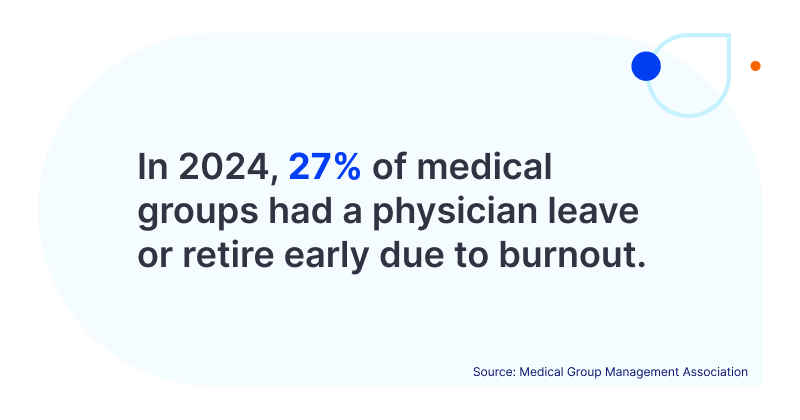
Workforce loss is one of the most serious downstream effects of provider burnout. According to a recent Medical Group Management Association poll, almost one-third of healthcare organizations had a physician leave or retire early in 2024 due to burnout.
And when healthcare providers leave the profession, the pressure on remaining staff intensifies. Patient loads rise, coverage gaps appear, and remaining staff must absorb additional responsibilities. Over time, this cycle compounds, further increasing stress and accelerating burnout across the team.
The consequences extend beyond individual practices to the healthcare system as a whole. Fewer clinicians means less appointment availability, longer wait times, and disruptions in continuity of care.
The cost of replacing physicians is substantial. Organizations absorb operational and financial strain through recruitment, onboarding, and the loss of institutional knowledge. Burnout affects not only clinicians’ well-being but also the long-term stability of healthcare delivery.
The Visibility Problem: Hidden Inefficiencies Drive Provider Burnout
Many practices struggle to see these pressures clearly.
Without the right processes, reporting, and healthcare technology in place, leaders lack visibility into where staff spend time, where administrative work accumulates, and where workflow bottlenecks create unnecessary strain. Inefficiencies consume hours of clinician and staff time each week but remain invisible because they’re hidden across distributed systems.
When leaders can’t measure lost time or workflow inefficiencies, they can’t identify opportunities for improvement. Organizational pressure builds and spreads gradually, while the underlying causes remain unclear.
This lack of visibility makes burnout appear inevitable. But more centralized oversight would identify ways to improve workflow design, clarify processes, and implement tools that remove or simplify routine administrative work. Addressing burnout requires understanding how work moves through the organization so that time, attention, and expertise flow where they matter most: delivering patient care.
What the Data Shows About the Physician Burnout Crisis
Burnout is real and measurable, and it comes down to the structural conditions inside healthcare delivery. The data reveals important patterns.
Burnout Rates Have Improved but Remain Persistently High
As reported by Stanford Medicine, burnout rates have dropped from their peak during the COVID-19 pandemic. That improvement matters because it indicates that changes to conditions can reduce provider burnout.
But just because burnout has declined from its most extreme levels doesn’t mean the problem has been solved.
A recent study published in Mayo Clinic Proceedings shows that nearly half of physicians still report at least one symptom of burnout. Burnout rates decreased from 62.8% in 2021 to 45.2% in 2023. It’s a meaningful decline, but burnout still affects nearly half the profession.
Equally important: Healthcare providers experience higher burnout rates than any other profession, even after researchers adjust for hours worked, age, and other demographic factors.
If workload alone could explain burnout, this difference would disappear once researchers account for hours worked. But it doesn’t. Healthcare providers consistently report higher burnout across specialties, even when work hours are comparable to other professions.
This suggests the issue isn’t just volume—it’s how clinical work is structured, and the administrative burden layered onto patient care.
Administrative Burden Is the Dominant, Repeatable Driver
When researchers ask physicians what causes their burnout, they point to the same issue across specialty, geography, and work environment. They blame excessive administrative work.
Clinicians identify several recurring pressures:
- Extensive documentation requirements
- Repeated paperwork for claims, denials, and compliance
- Prior authorization and payer justification processes
- Disconnected workflows stretching across multiple systems
- Constant administrative interruptions during the workday
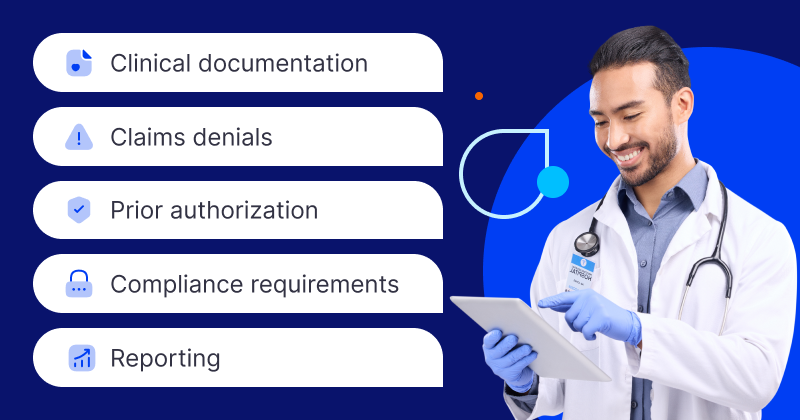
Each individual task may seem manageable. But when clinicians juggle them all at once, the administrative workload reshapes their entire clinical day.
This accumulation didn’t happen overnight. Administrative requirements built up gradually as policy changes, billing rules, reporting requirements, and technology implementations added extra steps without removing existing ones. Over time, non-clinical work grew faster than the systems available to manage it.
Reducing Administrative Load Creates Measurable Improvement
Reducing time spent on documentation and other non-clinical work gives clinicians control over their time. After-hours work decreases and cognitive load drops.
The mechanisms causing strain are visible. When organizations address them through streamlined workflows, clearer processes, and automation that eliminates repetitive tasks, clinicians regain time to focus on delivering exceptional care.
Redesigning Clinical Work with AI and Automation
AI and automation in healthcare offer practical ways to redesign clinical workflows, not by replacing clinicians but by removing mundane, manual administrative work so that information moves more smoothly through the practice.
Why Workflow Redesign Matters Most: It’s What Leaders Can Control
Medicine has always been demanding. Caring for patients requires emotional resilience, complex decision-making, extensive knowledge, and attention to detail. No technology or policy can remove those realities, and most clinicians don’t expect them to.
But practice leaders can change everything surrounding that clinical care.
Most factors driving burnout sit outside the exam room. Documentation requirements, prior authorizations, inbox management, billing workflows, and coordination tasks accumulate through systems, policies, and technology choices. None of these tasks are intrinsic to medicine itself. They exist because of how healthcare organizations design and operate their workflows around the demands of insurance, regulatory bodies, and operational needs.
Better workflow design decisions help clinicians and staff save time, work smarter, and free up mental space for patient care.
How Process Accumulation Creates Administrative Overload
Over time, well-intentioned changes compound. For example, you add documentation processes to the workflow to try and reduce denials. Evaluation management guidelines change, so you create new training for your coding and billing staff and your clinicians to ensure your practice is audit ready. Your practice wants to improve collaboration to align better with value-based care, so you implement more software to track data and connect with other organizations.
With new tools layered on top of old processes, admin work becomes a patchwork that physicians are expected to stitch together.
AI in Healthcare Can Reverse the Trend
Advances in AI and healthcare workflow automation reduce work rather than adding more of it.
Healthcare automation can remove repetitive steps, standardize routine processes, and reduce the need for manual follow-up. AI can summarize notes, extract key data, and flag tasks or decisions that need attention.
These improvements to high-friction tasks make a meaningful difference. They give clinicians minutes back, and those minutes add up. Over weeks and months, they reduce after-hours work, improve focus during visits, and ease the constant pressure that fuels burnout.
Where AI and Automation Can Reduce the Burden
For many clinicians, the idea that more technology will reduce admin work sounds hard to believe. They’ve heard that promise before. Electronic health records, billing systems, and compliance tools were all meant to streamline work. In many cases, they did the opposite, adding clicks, steps, and oversight.
That history explains the skepticism.
The Difference: Today’s Technology Is Measured by Clinical Outcomes
But software has improved and so have the measures of success. Leaders judged earlier systems on features or theoretical efficiency.
Today, the focus is on the outcomes clinicians actually care about:
- Time spent documenting
- After-hours work
- Burnout prevalence and likelihood
These metrics directly reflect the stressors clinicians identify. A growing body of peer-reviewed research shows measurable improvements in each area.
Ambient AI documentation provides the clearest example.
Documentation is one of the most time-consuming parts of clinical work that regularly pushes into rest time.
Ambient scribe tools change how documentation works. During patient visits, these AI-powered tools listen to the conversation and capture information, generating structured clinical notes. Afterward, clinicians review, edit, and approve the notes, rather than writing everything from scratch.
That shift—from creating notes to reviewing them—changes the workload immediately.
A 2025 study in JAMA Network found that clinician burnout dropped from 51.9% to 38.8% within just 30 days of using ambient AI technology. Clinicians showed a 74% lower likelihood of burnout compared to the baseline.
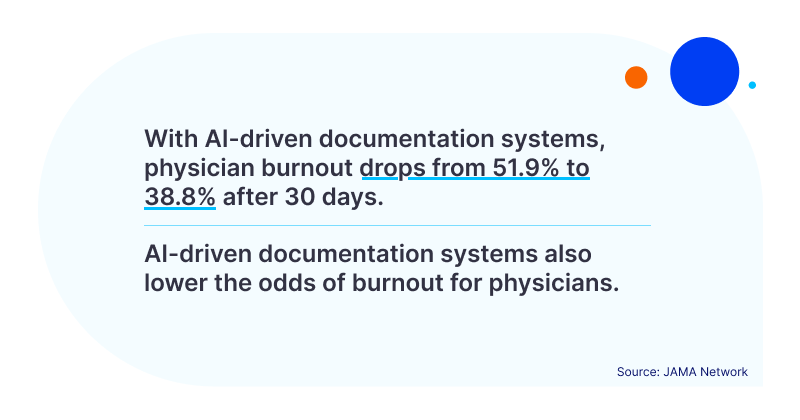
These results appear quickly because the daily workload changes immediately. When documentation time decreases, clinicians feel the difference right away.
Other research shows similar improvements. Another 2025 paper by Duggan et al found:
- 20.4% less time spent on notes per appointment
- 30% reduction in after-hours documentation time
These gains directly improve the metrics clinicians care about most: time spent documenting and the amount of after-hours work.
Healthcare Workflow Automation: Connecting the Gaps Between Visits
The most frustrating tasks in healthcare don’t happen during the visit. They happen between visits, across systems, and in gaps between teams. There’s a whole range of tasks that require information to move smoothly across workflows, including:
- Scheduling follow-ups
- Reconciling billing
- Tracking documentation
- Responding to messages
- Coordinating referrals
- Closing out encounters
When workflows are disconnected, staff spend time chasing information instead of moving care forward. Work slows down, small tasks pile up, and pressure builds.
Workflow design matters as much as staffing or scheduling. Without standardized systems and processes, simple tasks take longer than they should. Providers spend excessive time re-entering data, checking multiple systems, and routing information manually. This creates opportunities for coding or documentation errors, increasing denials, or even flagging your practice for audit.
Modern platforms and workflow automation address this by reducing steps to complete routine tasks. Information moves automatically between scheduling, documentation, billing, and communication workflows, so staff spend less time tracking down details, as fewer tasks stall or bounce between departments.
Real-World Results
Practices are already seeing the effect of this workflow redesign. Dr. Nadeem Vaidya’s practice is one example. Dr. Vaidya adopted DrChrono’s integrated clinical and administrative platform to streamline documentation, billing, and patient workflows. Automation handles repetitive steps, while customized templates make charting faster and more predictable.
The average ophthalmologist spends about 3.7 hours a day on the electronic health record. Dr. Vaidya spends about five minutes charting during each consultation and around 30 minutes on documentation after clinic hours.
With fewer administrative steps interrupting visits and less work waiting at the end of the day, Dr. Vaidya focuses his time on patients.
These changes matter because they make the workday more manageable. When workflows run more smoothly:
- Fewer unfinished tasks pile up at the end of the day
- Less work carries over into evenings
- Clinicians maintain better focus during visits
- Staff spend less time tracking information across systems
- Schedules feel more predictable and manageable
What makes these tools effective is that they don’t add complexity or intelligence for the sake of it. They actively remove work.
Automation handles routine, repeatable steps. AI captures, organizes, and routes information. This means clinicians and staff don’t have to manage those tasks manually, while clinical judgment stays exactly where it belongs.
What Successful Healthcare AI Implementation Looks Like
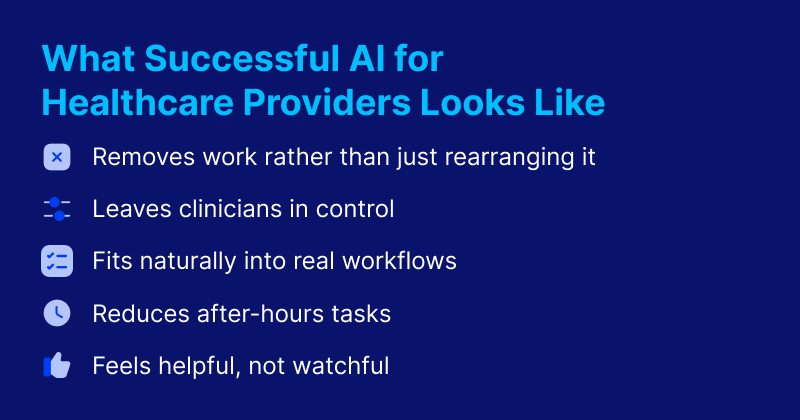
Effective AI implementation has three key characteristics: it removes work, enhances control, and integrates seamlessly.
Remove Work, Don’t Just Speed It Up
Real relief comes from taking tasks off clinician’s plates and alleviating mental load. That means fewer clicks, less typing, and less time re-entering information or fixing errors. The aim isn’t faster documentation for its own sake. It’s less documentation overall and fewer unfinished tasks at the end of the day. AI works best when clinicians feel that they’re using the technology—not that they are being directed by it.
The most effective tools behave like assistants. They draft notes, surface information, offer helpful suggestions, and route tasks, but they leave the final decisions to the clinician.
When systems dictate workflows or second-guess judgment, resistance grows quickly. When clinicians can easily review, adjust, and approve outputs, trust builds.
Research confirms this. A 2025 study by Chen et al found that AI delivers the most value when it augments human judgment rather than replacing it. Tools that feel rigid or prescriptive create frustration rather than relief, no matter how powerful the underlying technology.
Integrate Seamlessly into Existing Workflows
Successful implementations adapt to how clinicians actually work, not how workflows look on paper. Technology should follow the natural flow of a visit rather than interrupt it. Clinicians shouldn’t need to toggle constantly between systems or shift mental gears to keep tools working.
The best solutions are almost invisible. They reduce friction without demanding attention. AI-powered ambient scribe tools work without disrupting the clinician-patient interaction. Meanwhile, they ensure clinicians receive complete, accurate documentation. They can also rely on the AI to help them determine the most appropriate next steps, improving the quality of care for the patient.
Systems that require extensive training or major workflow changes create stress during busy days, which defeats the purpose. Smooth integration matters more than feature lists.
Build Trust Through Support, Not Surveillance
Finally, acceptance depends on whether clinicians feel supported or monitored. Adoption and trust improve when technology clearly saves time and reduces cognitive load. They drop when clinicians feel systems are watching, scoring, or correcting every action.
Measuring Impact: Knowing When Change Is Real
Reducing burnout can’t be a vague goal measured once a year in a staff survey. If burnout hinges on workflow design, real improvement should show up in how work gets done every day.
This requires operational metrics, not just satisfaction scores.
Practice owners need to look beyond engagement surveys and focus on whether clinicians are spending less time on non-clinical tasks. When workflows improve, the signals appear in daily operations long before annual reports. Measuring those signals makes progress visible, repeatable, and accountable.
Key Metrics to Track
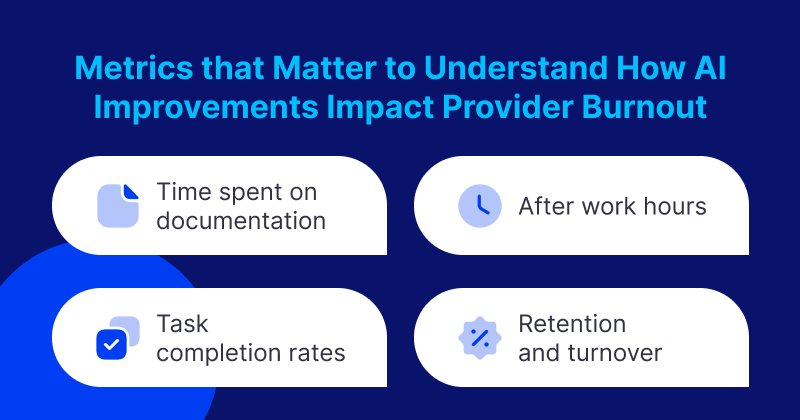
- Time spent documenting: Documentation time is a strong burnout predictor. When documentation time drops, it usually means work has been removed, not just rearranged. Useful indicators include average time per patient visit, total documentation time per day, and time clinicians spend in the electronic health record after visits end.
- After-hours work: After-hours charting reveals whether administrative work is spilling into personal time. Tracking evening and weekend EHR activity provides a clear signal of whether workflows are sustainable. Thoughtful automation significantly reduces after-hours documentation, giving clinicians back time.
- Task completion rates and workflow flow: Administrative friction often appears as stalled tasks, repeated steps, or work routed between teams. Measuring how quickly tasks move through workflows reveals whether processes work or generate unnecessary rework. Improvements here signal better routing, fewer errors, and fewer interruptions, meaning clinicians spend less time on administrative steps.
- Retention and turnover: Burnout ultimately shows up in workforce decisions. Tracking early retirement, voluntary departures, and reductions in clinical hours provides an essential long-term indicator. When workflows improve and pressure decreases, workforce stability often follows.
The Financial Case for Measurement
Leadership teams also have fiscal reasons to measure these changes. Burnout carries measurable organizational costs.
A 2025 study by Lukac et al estimates that physician burnout costs health systems $7,600 per physician per year through lost productivity, turnover, and related expenses.
Even modest reductions in burnout can translate into meaningful operational and financial gains across an organization.
Moving Beyond Provider Burnout with AI and Smarter Workflows
Burnout in healthcare can feel overwhelming, but it’s not unavoidable. Once organizations understand what is driving it, they can change the conditions that cause it.
Provider Burnout Is a Solvable Operational Problem
Too many organizations see provider burnout as a cultural issue or workforce challenge. The evidence shows something different. Burnout stems from poor workflow design. Physicians aren’t struggling because they lack resilience, motivation, or commitment. They’re struggling because modern clinical work demands too much non-clinical labor.
Practice managers already respond to operational signals every day. Rising error rates, payer delays, and workflow bottlenecks all trigger investigation and redesign. Treat burnout the same way: as a signal that systems are placing unsustainable pressure on clinicians.
This shift—from passive problem to active redesign opportunity—makes burnout manageable.
Physician Burnout Reflects System Design Choices
The workflows clinicians operate in today didn’t emerge by accident. Documentation requirements, EHR configurations, inbox routing, billing processes, and approval workflows were introduced over time to solve specific problems, like billing accuracy, regulatory compliance, reporting, and coordination.
Each addition made sense. But together, they added more work. Over time, tasks that took minutes now take hours. Work that once belonged to support staff now sits on clinicians’ desks.
Burnout is the predictable outcome of asking highly trained professionals to spend large portions of their time on administrative work. Systems built through deliberate choices can also be improved through deliberate redesign.
Redesigning Clinical Workflows Is Necessary
The evidence shows that reducing administrative burden leads to measurable improvements in clinician experience and workload sustainability. The question is no longer whether workflows can be redesigned. It’s whether organizations are willing to prioritize that work.
Continuing with high-friction workflows carries real consequences:
- Clinicians reduce hours or leave
- Access gaps widen.
- Recruitment becomes harder
- Patient satisfaction declines
- Organizational pressure increases
Redesign doesn’t require perfection or transformation overnight. Many meaningful improvements begin with targeted changes to the highest-friction workflows. Small reductions in routine work compound quickly across a day, a week, or a year.
Leaders have both the authority and responsibility to address these issues at the system level. Failing to act normalizes burnout as a cost of doing business, which disrespects the healthcare providers under your charge.
AI Is Not a Cure—But It Is a Practical Toolkit
AI-driven solutions aren’t a panacea, and they won’t replace clinicians. But they can remove repetitive, fragmented, non-clinical work.
When organizations apply AI and automation thoughtfully, the impact shows up in practical, measurable ways:
- Less time spent documenting
- Less after-hours work
- Fewer administrative steps interrupting visits
- Fewer errors
- More predictable workflows
Successful tools fit into existing workflows rather than forcing clinicians to adapt.
Real-World Application: DrChrono and Range Urgent Care
DrChrono by EverHealth’s all-in-one AI-powered electronic health system is designed with integrated workflows, automation, and mobile-friendly documentation.
Features like customizable templates, charting shortcuts, and integrated billing workflows help clinicians complete documentation faster and reduce work that follows them home. This kind of workflow design changes the everyday experience of care delivery.
Range Urgent Care, for instance, provides one example. The urgent care organization uses DrChrono for integrated scheduling, charting, and patient intake workflows, streamlining visits, and reducing front-desk workload. Patient intake has moved online, administrative bottlenecks have decreased, and staff spend less time manually handling forms and scheduling changes.
As a result, Range Urgent Care benefits from more efficient operations and less administrative pressure on clinicians and staff. When documentation becomes faster and workflows become more predictable, clinicians can focus more fully during visits instead of thinking about documentation waiting afterward.
The goal isn’t technological sophistication—it’s removing unnecessary work, so clinicians can practice medicine without constant administrative friction.
The Path Forward for Medical Practices
Physician burnout prevention begins with understanding how work actually moves through your organization. Leaders need to see where clinicians spend time charting, responding to messages, and handling administrative tasks and identify bottlenecks.
Once you identify those pressure points, the next step is to remove friction through system redesign.
Workflow-first platforms like DrChrono’s integrated EHR reduce clicks, streamline documentation, and simplify scheduling, billing, and patient communication within a single system. Custom templates and mobile charting allow clinical staff to complete tasks faster and keep admin work from leaking into personal time.
If you’re ready to reduce administrative burden and give clinicians more time for patient care, explore how DrChrono supports independent practices with an all-in-one AI-powered EHR that helps you navigate today’s challenges.