

Healthcare consolidation has created a powerful market assumption: larger systems win. Scale brings visibility, trust, and the impression of seamless care. Patients gravitate toward organizations that look integrated, even when the reality is more complex.
Independent practices without the infrastructure in place to demonstrate performance in this environment risk losing ground. They struggle to position themselves against vertically integrated competitors and find it harder to prove they deliver the same, or better, outcomes.
Infrastructure intelligence changes that balance. When data is connected and visible as work happens, performance becomes something practices can understand and act on in real time. Rather than reacting after the fact, they can intervene earlier, resolve issues at the source, and maintain control as they grow.
The competitive question is no longer about size. It is about clarity and speed. The practices that understand what is happening across their operations and respond before problems escalate are the ones that sustain independence and stay competitive.
This guide explores how the competitive consequences of scale—market dominance, patient assumptions of superiority, and the power of brand recognition—are forcing practices to either transform or risk losing market share. We also show how independence can be a strength, offering a playbook for building infrastructure intelligence and creating a competitive advantage that larger competitors can’t match.
The Uphill Battle Independent Practices Face Due to Market Consolidation
If you’re running an independent practice right now, you’re not just competing on care. You’re competing on how your practice is perceived by the market.
Retail clinics, payer-owned networks, and large health systems don’t just offer services. They present themselves as fully connected environments, where care appears joined under one system.
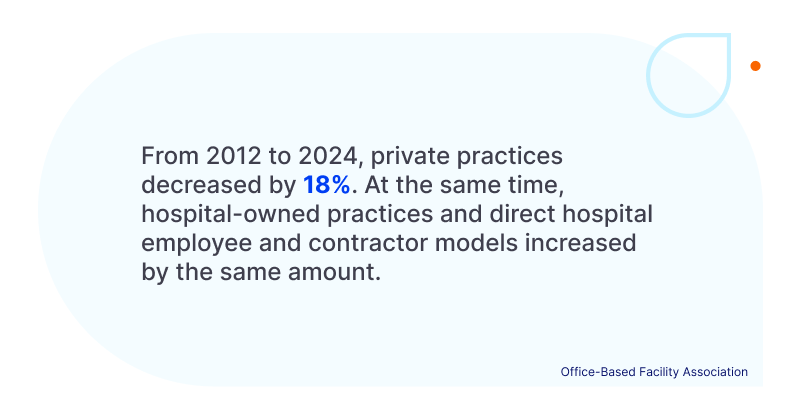
At the same time, independence is shrinking. Data from the American Medical Association (AMA) shows an 18% drop in independent physicians between 2012 and 2024. Many didn’t leave because they wanted to. They were pushed by reimbursement pressure, rising costs, and the weight of administrative work.
But those pressures do something else. They change how patients and partners see you.
Larger systems appear more capable. Independent practices are left trying to prove they can keep up.
Patient Perception that “Bigger Means Better”
When a patient chooses where to go, they’re not thinking about your internal workflows. They’re asking a simpler question: will this be easy?
Large systems answer that upfront. Multiple locations, shared records, coordinated services. It all signals that things will work together. So when care gets complex, patients lean toward what looks connected.
That’s where independent practices lose ground.
Not because your care is worse, but because your coordination isn’t visible. A patient can’t see how you handle referrals, how your information moves between providers, or how you keep track of their journey.
Over time, that compounds into fewer new patients, lower retention, and slower growth.
When Independence Looks Like Fragmentation
This is where the problem shifts from operational to competitive.
You’re being compared to organizations that seem more capable from the outset because they’re larger and more well-known. Independent practices can’t demonstrate market competitiveness when they’re unable to show integrated care capabilities.
Patients expect continuity of care. Referral partners want to know their patients won’t fall through the cracks. Payers are looking for consistency and predictability. If you can’t show that clearly, you’re already behind.
Because the default assumption is this:
- Independent means disconnected
- System-owned means integrated
Even when that’s not true.
If a referral partner can’t see how you coordinate care, they’ll send patients somewhere they can. If a patient isn’t sure how their treatment will be managed across visits, they’ll choose the option that feels safer. You lose before performance even enters the picture.
That pushes you to compete on convenience and price, rather than outcomes and demonstrated value.
When Growth Starts to Feel like a Risk
Independent practices rarely avoid growth due to a lack of demand. The hesitation comes from uncertainty about whether the existing system can support it.
As patient volume increases, so does the workload. More touchpoints, more handoffs, and more opportunities for breakdowns across scheduling, clinical, and medical billing workflows. Without clear visibility across that process, issues aren’t identified early enough. They surface later, after they have already impacted revenue or patient experience.
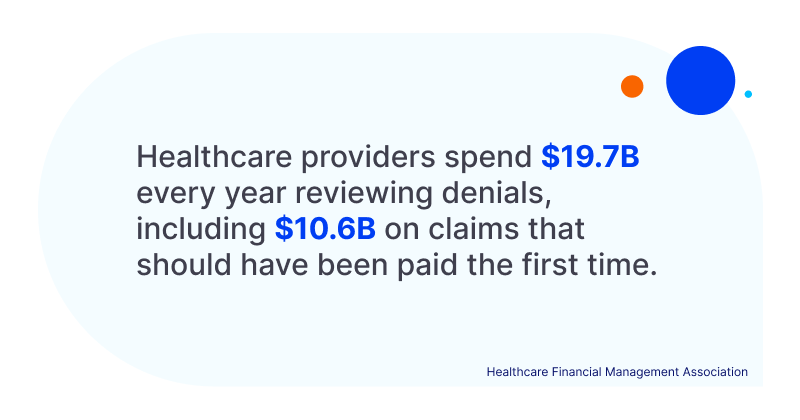
The impact of denials on the revenue cycle illustrates how this can play out. Dealing with denials takes time, and that delay reshapes how your team works. Instead of improving the system, they’re pulled into rework. According to the Healthcare Financial Management Association’s (HFMA) 2024 Revenue Cycle Rollercoaster report, providers spend $19.7 billion each year on denial-related activity.
You’re not only losing revenue through avoidable errors. You’re also losing the time you need to improve processes, prevent future issues, and create more predictable growth.
Larger systems absorb this cost through sheer size, with larger teams and larger budgets. Independent practices operate without that layer of support. As workload increases, the strain on existing teams grows, and operational risk becomes harder to manage.
As a result, growth slows. Expansion is delayed, and new services are introduced cautiously.
This has clear competitive implications.
Slower growth reduces market visibility. Limited capacity constrains patient volume and referral potential. Over time, this weakens overall positioning relative to larger organizations that can scale more confidently.
The outcome is a reinforcing cycle. Constraints on capacity limit growth. Limited growth reduces presence in the market. Reduced presence makes it harder to compete beyond convenience or price.
Without a way to change how performance is managed and controlled, that cycle continues, and consolidation gains further ground.
Intelligence as Competitive Strategy: Why Independent Practices Can Win
The assumption is that scale creates advantage. Larger systems invest in infrastructure, centralize operations, and present a coordinated front to the market. That combination drives patient trust and referral confidence.
Independent practices can build the same level of operational capacity through intelligent systems rather than headcount. And unlike large organizations, they don’t carry the same administrative layers that can delay decision-making.
That changes the competitive dynamic. Independent practices can use intelligence to get ahead when they follow the playbook for intelligent infrastructure. Start by establishing data maturity so your practice can demonstrate operational coherence. Next, integrate AI and automation to improve processes, and then leverage the agility that independence naturally provides to sustain that advantage.
Data Maturity as a Competitive Weapon
Data maturity is often described as an operational capability. In reality, it shapes how you compete in the market.
That plays out in three ways.
First, you can predict your own trajectory.
Instead of making growth decisions based on instinct, you can model options. You can forecast patient demand, understand capacity limits, and assess the financial impact of hiring or expansion before committing.
That level of visibility matters not just internally, but externally. You can show partners, payers, and investors that your growth is predictable, not risky. That changes how you’re evaluated in the market.
Second, you can demonstrate coordination instead of just claiming it.
Patients and referral sources are looking for evidence that care is connected. With mature data, you can show that. You can demonstrate how patients move through your system, how outcomes improve over time, and how consistently you deliver care across providers. That directly counters the assumption that independence means fragmentation, and gives you a way to compete with system-owned providers on evidence, not perception.
Lastly, you can respond faster than larger competitors.
When payer policies change or market conditions shift, large systems often take time to adapt. Independent practices with strong data maturity can see the impact immediately and adjust.
That speed becomes a strategic advantage. You can adjust positioning, pricing, and capacity before larger competitors have a chance to react.
Operational Coherence as a Market Differentiator
Data alone is not enough. It needs to translate into a consistent experience.
Operational coherence is what makes that visible.
When your systems are aligned, patients don’t experience gaps. Appointments connect logically. Test results move without delay. Communication between providers feels coordinated rather than fragmented.
That experience is what patients and partners actually judge.
Research in the Journal of General Internal Medicine shows that better care coordination leads to improved patient outcomes. But beyond clinical impact, it also shapes perception. It shows that your practice operates as a single, integrated system, even without the structure of a large organization behind it.
Instead of being seen as a collection of disconnected services, care feels coordinated, transitions are smooth, and patients don’t need to navigate the system themselves. That visibility builds trust with both patients and referral sources. You’re no longer compared on size, but on how well your system performs. That’s the same ground large systems compete on—and now you can meet them there.
Automation and AI as Competitive Acceleration
The next layer is about how quickly you can innovate and adapt.
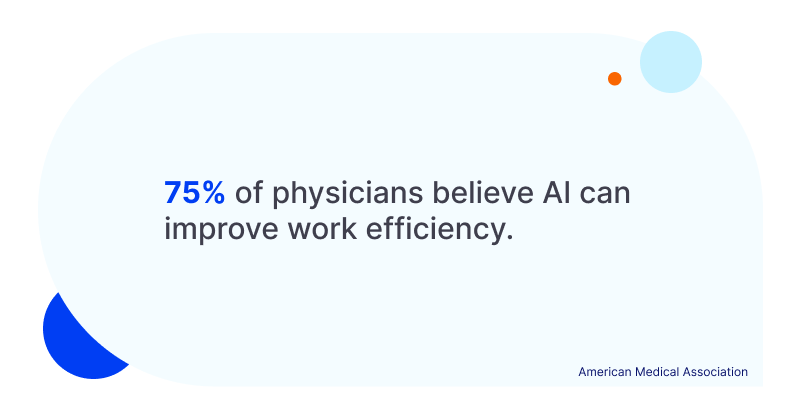
Automation and AI are often positioned as efficiency tools, and that’s how healthcare providers view them. As the AMA’s 2026 Physician Survey on Augmented Intelligence report found, 75% of physicians believe AI can help them work more efficiently.
But in reality, they offer agility. AI and automation determine how quickly a practice can respond to change.
Independent practices are already well-positioned here. They can adopt new technologies faster, test them in smaller environments, and implement changes without navigating complex approval structures.
When you combine that flexibility with intelligent infrastructure, the impact compounds. AI can identify patterns in claims before they fail. Automation can handle validation, eligibility, and submission as part of the workflow rather than as separate tasks.
Across the revenue cycle, these capabilities drive measurable improvements. As one recent study shows, AI and automation lead to 5 to 30% gains in first-pass acceptance rates, denial prevention, and overall efficiency by improving documentation, automating coding, and streamlining claims processing.
That translates directly into competitive advantage.
Revenue becomes more predictable. Performance improves without proportional increases in staffing. Most importantly, the gap between activity and insight closes, so practices can act earlier and with greater confidence.
Agility as a Long-Term Advantage
This is where independence becomes difficult to match.
Large systems can invest in technology, but they struggle to move quickly. Changes take time to implement. Decisions move through layers. By the time adjustments are made, conditions have already shifted.
Organizations without heavy administrative overhead move faster, adapt more quickly, and retain more control over how care is delivered.
As the Physicians Foundation’s survey shows, 67% of physicians in private practice report significant autonomy, compared with 38% in hospital-employed roles. That autonomy translates into faster decisions and fewer barriers to change.
They can respond to payer changes, patient needs, and market opportunities without delay. While McKinsey estimates that automation and analytics could eliminate up to $200 to 360 billion in healthcare inefficiencies, the organizations that capture that value first will be the ones that can act quickly.
And that’s something independence, when supported by intelligence, is uniquely positioned to do.
Building Toward Independent Intelligence
Independent practices don’t need to grow to the size of large health systems to compete. They need clarity.
When data maturity and operational coherence are in place, you get that clarity. Performance becomes visible, measurable, and controllable. That changes how your practice is positioned in the market. You’re no longer compared on size or brand, but on how well you deliver and coordinate care.
The competitive question is simple: who understands their performance better and acts on it faster?
With the right infrastructure, independence becomes an advantage. Explore how DrChrono by EverHealth brings together the visibility and control needed to compete, grow, and sustain independence.