

For practice executives and finance leaders, financial decision-making is happening under increasing pressure—and with less clarity than it should.
You’re expected to make calls on hiring, expansion, and service mix while the numbers you’re looking at are already weeks, sometimes months, out of date. Reports arrive late. Conditions don’t stand still. By the time performance is reviewed, the reality on the ground has already shifted.
That lag creates a reactive model. Problems surface after the damage is done. Revenue dips get explained, but not prevented. Decisions feel heavier because they’re made without a clear view of current performance.
What’s missing isn’t more reporting. It’s immediacy. Context. The ability to see, test, and act quickly. Performance should update continuously, with modeling and payer insight built into the decision itself. When that shift happens, things start to feel different. Leaders can see what’s changing as it happens. They can test decisions before committing. They can act while outcomes are still within reach.
The result is tighter control, more grounded decisions, and performance that holds steady, even as conditions and requirements shift. This guide shows you how to reach this level of clarity. We look at what underlying conditions are creating a financial control gap and how practice leaders can rebuild it into everyday decision-making.
The Financial Control Gap in Healthcare Leadership
The control gap isn’t caused by a lack of data. It’s caused by when that data shows up. That delay changes how organizations operate. Decisions become reactive. Risks are identified after impact. And control over financial performance starts to slip.
Strategic Decisions Are Based on Outdated Financial Data
Most financial decisions in health organizations are still anchored to reporting cycles that lag behind reality. Monthly close processes and delayed reconciliations mean leadership is often working from data that reflects performance from 60 to 90 days ago. That might have worked when conditions were stable. They aren’t anymore.
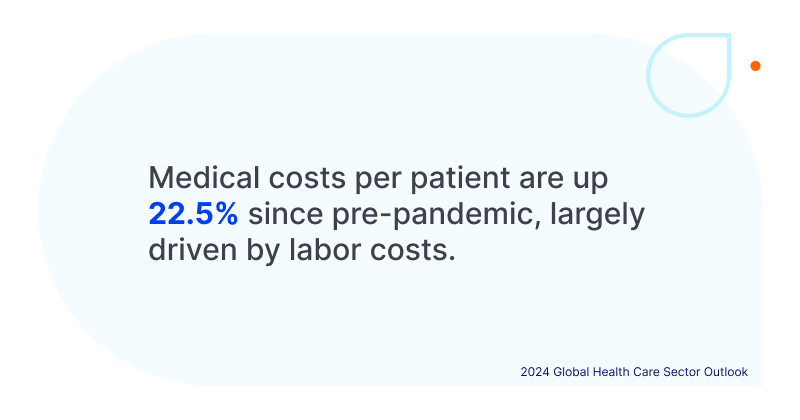
Costs are moving quickly, especially on the labor side. For example, Deloitte’s 2024 Global Health Care Sector Outlook highlights how workforce shortages are pushing organizations toward contract staffing, driving costs up and making them harder to predict,contributing to a 22.5% rise in hospital costs per patient since pre-pandemic, with median operating margins falling to -0.2%.
At the same time, payer behaviour continues to shift. Reimbursement rates, approval requirements, and payment timelines change frequently enough that static reporting can’t keep up. As a result, decisions are made using signals that are already out of date.
You see it in everyday operations. Hiring plans follow last quarter’s numbers instead of projected growth, so your practice scrambles to bring on high-cost contract support. Service expansion moves forward without a clear view of current costs.
By the time performance data confirms an issue, it has already hit revenue. And when problems are identified after impact, there’s no longer an opportunity to change outcomes.
The same lag affects forecasting. When inputs are outdated, projections drift, increasing risk. Leadership ends up steering using a rearview mirror.
Inability to Answer “What If” Financial Questions
When leadership asks “what if,” they’re asking for clarity before committing to a decision. Most organizations can’t provide it.
This is because scenario modeling is still manual. Finance teams pull data from multiple systems, build spreadsheet models, and layer in assumptions to estimate outcomes. By the time analysis is ready, the decision has already been made, or the context has changed.
The Deloitte Center for Health Solutions survey highlights this gap. More than 90% of healthcare finance leaders say they’re focused on growth and performance levers, yet only about one-third see a strong impact from their technology investments. The challenge is turning data into usable insight at the moment decisions are made.
Surfacing insights is also difficult because healthcare financial systems are complex. Variables shift, interact, and compound over time. As research in the Cost Effectiveness and Resource Allocation journal explains, traditional tools were built to explain what already happened, but they can’t model what might happen next.
As a result, finance becomes a reporting function rather than a decision partner. Conversations slow down while teams wait for analysis, or decisions move forward without it. Fewer scenarios get tested. Trade-offs remain unclear. And decisions rely more on instinct than evidence.
Payer Dynamics Remain Opaque Until Revenue Is Impacted
Payer behavior is constantly shifting. Reimbursement rates change, authorization requirements evolve, and claim patterns move over time. Each change creates operational friction. Teams interpret new rules, adjust workflows, and rework claims when requirements aren’t met.
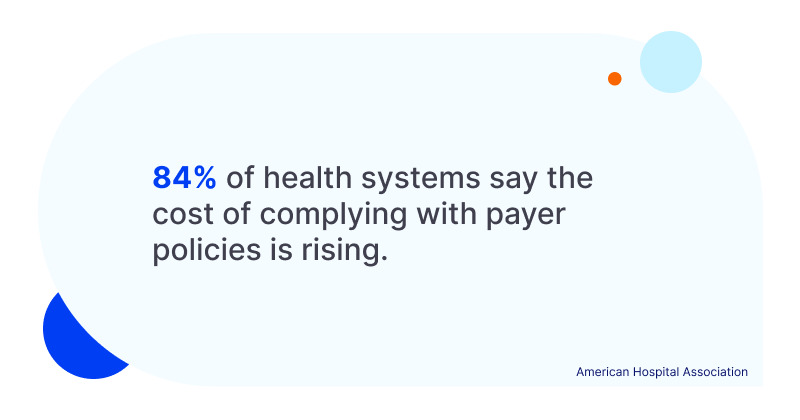
That constant adjustment takes time and drives cost. In fact, a recent AHA survey found that 84% of providers report rising costs to comply with payer policies, while HFMA’s 2024 Revenue Cycle Rollercoaster report shows that 78% of organizations are seeing increased administrative costs tied to claims.
But while these shifts show up early in operations—payment timelines stretch, denial rates rise, and rework increases—those signals rarely reach leadership in time to act. Instead, the impact appears later, once revenue declines, cash flow tightens, or overall performance drops.
The scale of that impact is significant. The same HFMA report shows that 90% of missed revenue opportunities are tied to denials, and 54% of healthcare professionals say claim errors are increasing.
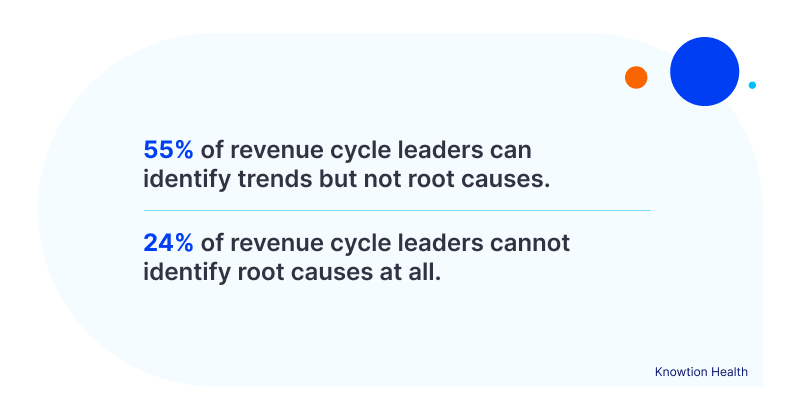
The real issue comes down to a lack of visibility into the cause. As Knowtion Health’s Keeping Pace with Payers report found, only 21% of organizations say they can clearly identify both trends and root causes of payer-related revenue loss, while 55% can spot trends but not causes, and 24% struggle to identify root causes at all.
Without that clarity, teams fix symptoms rather than sources, allowing revenue leakage to continue and weakening negotiating leverage over time.
Margin Understanding Lags Behind Operational Reality
Margin pressure is already high, and it’s still rising. According to Deloitte’s survey of healthcare finance leaders, industry margins sit between 1% and 4%, with some organizations operating at a loss.
Leaders know this matters. The same survey shows that 78% rank margin improvement as a top priority. Yet 25% still report missing their targets over the past three years.
The focus is there. The visibility isn’t. Most practices don’t have a continuous view of profitability. Margin is reviewed periodically—monthly or quarterly—instead of as operations unfold. That makes it hard to see what’s actually driving performance.
Leadership can’t clearly identify which services generate margin, which providers contribute most, or which payer relationships are eroding it. As a result, decisions fall back on what’s visible: volume and demand. High-cost services continue without a clear view of their profitability, while higher-margin opportunities are harder to spot and scale.
The fallout of this shows up in performance variation. Vizient’s 2026 State of the Healthcare Industry report puts margins at 14.3% at the top end, 2.0% at the median, and -2.2% at the bottom quartile. That spread isn’t just market conditions. It reflects how decisions are made.
When margin is only visible after the fact, there’s no opportunity to adjust in time. Investment drifts away from actual profitability, and margin pressure compounds instead of being managed.
How Medical Practice Financial Management Works in Real Time
Fixing the control gap isn’t about adding more reports. Across each of these gaps—timing, modeling, payer visibility, and margin insight—the pattern is the same: insight arrives too late to change the outcome.
The solution is to bring insight forward, making financial performance visible, testable, and actionable at the moment decisions are made.
Make Financial Performance Visible in Real Time
Financial performance needs to function as a live signal, not a monthly output. When revenue, cash flow, and operational performance are reviewed after the fact, practice leaders can’t act while outcomes are still changeable.
Practice leaders need to connect the data that drives financial outcomes, so visibility is continuous. Medical practice scheduling, care delivery, and billing all shape performance, but they are often viewed separately. When those data points are linked at the patient and encounter level, financial outcomes can be traced back to the exact service, provider, and payer driving them.
This creates context. Leadership can see how changes in volume, provider activity, or payer mix affect revenue as they happen. They can identify, for example, which payer contracts are the most profitable and where service volume is shifting.
Beyond that, financial data needs to be surfaced where decisions are made.
- Continuous tracking of revenue, collections, and accounts receivable replaces period-end reporting.
- Work queues highlight delays, missing data, and payer friction as they occur.
- Dashboards and alerts flag changes in trends, not just totals.
- Pattern detection identifies emerging risks before they show up in aggregate reporting.
Real-Time Visibility in Practice
The Healthy Brain Center moved to continuous revenue tracking using DrChrono, with 24/7 visibility into performance and alerts when cash flow shifts. That allows the team to act early instead of waiting for month-end reports.
When financial performance is visible in real time, the lag between insight and action disappears. Emerging issues can be addressed early, forecasting becomes more accurate, and decisions are based on current conditions.
Surface Revenue Risk Before It Impacts Performance
Payer-related issues don’t start as revenue problems. They start as operational changes.
Reimbursement rates shift, authorization requirements tighten, and claim patterns evolve. Those changes show up early in the data as longer payment cycles, rising denials, and increased rework.
To stay in control, those early indicators need to be visible and connected to financial impact.
This means continuously monitoring payer-driven changes and linking them directly to outcomes. For example, we know that prior authorizations (PA) can lead to patients abandoning care—an American Medical Association (AMA) survey found that in 80% of cases, prior authorizations lead to patients not getting the treatment or medication their physician recommended. By tracking anticipated changes to PA requirements, you can plan for potential revenue decreases from care abandonment. Instead of waiting for revenue to drop, you can identify where friction is building and act before it spreads.
Financial control depends on identifying root causes, whether that’s changes in payer requirements, breakdowns in documentation, or process gaps that lead to denials and delays. When those drivers are visible, issues can be addressed at the source rather than repeatedly corrected downstream.
This shifts payer management from reactive to proactive. Problems are resolved while they are still manageable, revenue disruption is reduced, and you’re in a stronger position when negotiating with payers.
Faster Action, Better Collections
After moving to DrChrono’s full-service RCM, Lemon Tree gained clearer visibility into claims that were delayed or at risk of denial. Instead of sitting in accounts receivable, those issues were surfaced and addressed earlier, with faster follow-up and reprocessing. As a result, payment turnaround improved, and reimbursements increased by 45%.
The result is more stable cash flow, fewer unexpected swings in performance, and less revenue leakage over time.
Embed Margin and Scenario Modeling into Decision-Making
Visibility on its own doesn’t fix anything. It only matters if it changes how decisions get made.
Right now, modeling usually sits outside the decision. Leaders ask “what if,” then wait while finance pulls data, builds a model, and comes back later with an answer. By then, the moment has passed, or the decision has already been made.
That’s the gap. To close it, modeling needs to happen in real time, inside the conversation.
When teams are discussing hiring, expanding services, or changing the service mix, they should be able to test scenarios on the spot and see the financial impact immediately. That’s what makes trade-offs clear. You’re not guessing or debating in the abstract. You’re looking at the numbers as they move.
At the same time, those decisions need to be grounded in margin, not just revenue.
Revenue can look healthy while profitability slips. If margin isn’t visible across services, providers, and payer relationships, resources follow demand instead of performance. High-cost activity keeps growing, while stronger-margin areas get overlooked.
When margin is clear, decisions shift. Investment moves toward what actually performs. Low-margin activity gets questioned, adjusted, or reduced. Improvement becomes deliberate because you know the potential impact of new medical equipment, additional staff, or facility improvements—and the opportunity cost of not making a move.
Continuous modeling builds on that. As conditions change, teams can test adjustments against what’s happening now, not what happened last quarter.
Planning stops being fixed and starts to move with the business. The result is faster decisions, clearer trade-offs, and far fewer surprises once those decisions play out.
When Financial Control Drives Better Business Performance
Financial control goes beyond visibility. It turns financial insight into consistent, repeatable action. When performance is visible, modeled, and acted on in real time, issues are addressed earlier, errors are reduced, and teams spend less time correcting problems and more time improving outcomes.
Over time, this compounds. Signals become clearer. Decisions become more consistent. Opportunities are easier to identify and act on.
As financial pressure intensifies and margins compress, practices that build financial control into daily operations gain a lasting advantage through better decisions, not just better billing.
DrChrono by EverHealth enables this shift by connecting clinical, operational, and financial data into a single, real-time view. Learn more about DrChrono and see how your practice can move from delayed reporting to continuous financial control.