

Clinical burnout is often framed as a workload issue. But at its core, it’s a loss of control. Clinicians are losing discretion over how their time is spent, how their attention is directed, how workflows are structured, and how decisions are made. Documentation consumes an increasing amount of physicians’ time. Administrative protocols dictate how care must be delivered. And while responsibilities keep increasing, clinicians have less authority over daily operations.
The result isn’t only burnout, but also inefficiencies that affect everything from care quality to practice finances. This paper examines how clinical autonomy has shifted across five domains: time, attention, decisions, workflow structure, and accountability. It also explores how AI-enabled workflows can restore control when they are designed to reduce friction rather than add complexity.
By mapping AI intervention points across the patient journey, from access through follow-up, this guide shows how autonomy can be strengthened at every stage of care.
Clinical Burnout and Inefficiency Are the Result of a Loss of Control
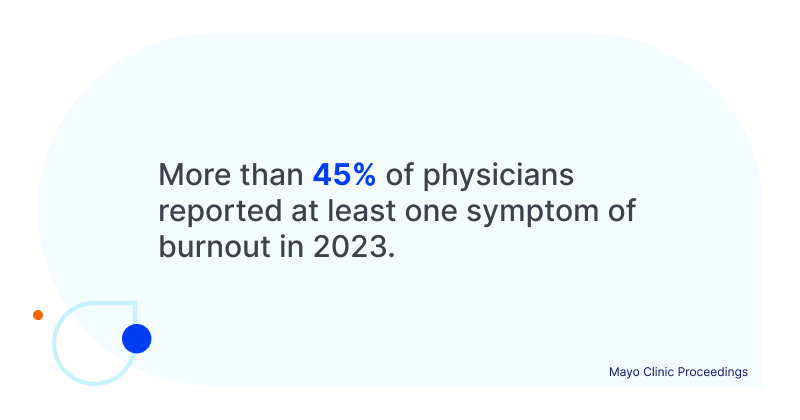
Clinicians are responsible for delivering high-quality care while keeping up with documentation, follow-ups, compliance requirements, and daily operational demands. The workload has grown steadily harder to sustain–and the effects are measurable. A Mayo Clinic Proceedings study found that 45.2% of physicians reported at least one symptom of burnout in 2023.
But workload isn’t the underlying problem. The real problem is the systems that turn routine clinical work into fragmented, inefficient processes–eroding control at every stage of the patient journey.
Five Domains Where Control Has Eroded
The depth of this problem becomes clear when you look at the five domains where control has eroded in healthcare: time, attention, clinical decision-making, workflow structure, and risk.
Less Control Over Time
Primary care physicians spend nearly six hours per day in the EHR, including 1.4 hours during ”pajama time,” according to research published in ACI Open. This is rarely about patient volume, but rather about how small frictions, including documentation, inbox management, and billing tasks, build up throughout the day.
When time is lost to administrative work, clinicians have less capacity to see patients within scheduled hours and less control over how their day is structured.
Less Control Over Attention
The Journal of Medical Internet Research found that cognitive overload from alert fatigue and constant task-switching disrupts workflow continuity. Attention is limited in clinical care, and every interruption forces clinicians to pause, reorient, and return to the task.
Tasks take longer to complete, documentation can become fragmented, and clinicians have less of their attention available for the patient in front of them. As attention becomes harder to control, both care delivery and operational efficiency suffer.
Less Control Over Clinical Decisions
Decision-making authority sits at the center of clinical identity. Medicine depends on judgement, experience, and patient context–none of which can be reduced to a template. Research published in Leadership in Health Services suggests that professional autonomy is strongly linked to physician well-being.
But rigid templates, administrative protocols, and compliance-driven workflows often dictate how clinical decisions are structured and carried out. Clinicians have less room to apply their judgment. Over time, clinical work feels less like practicing medicine and more like managing the system around care.
Less Control Over Workflow Structure
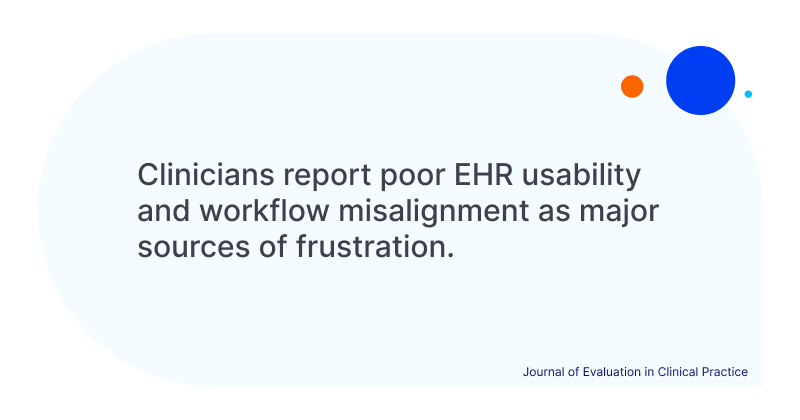
The Journal of Evaluation in Clinical Practice notes that poor EHR usability and workflow misalignment are major sources of clinician frustration. Clinicians often have to move between scheduling tools, charts, inboxes, and billing workflows just to complete routine work.
Fragmented systems create duplicate work, manual handoffs, and extra coordination. Instead of supporting care delivery, workflows require clinicians to adapt to the system.
Less Control Over Risk and Accountability
According to the 2026 Advocacy Impact Report released by the American Medical Association (AMA), regulatory complexity and documentation demands have grown steadily over time. Some clinicians now spend more time documenting for compliance, audits, and payer requirements than on direct patient care.
As these demands grow, clinicians may document more defensively, adding extra details or steps to reduce audit or liability risk. More effort goes toward managing risk, so workflows become slower, more cautious, and harder to sustain.
The Operational and Financial Cost of Lost Autonomy
Loss of autonomy creates ripple effects across the entire practice. Frictions in documentation, staffing, patient access, and billing compound into larger organizational problems and revenue gaps.
Burnout Becomes an Organizational Risk
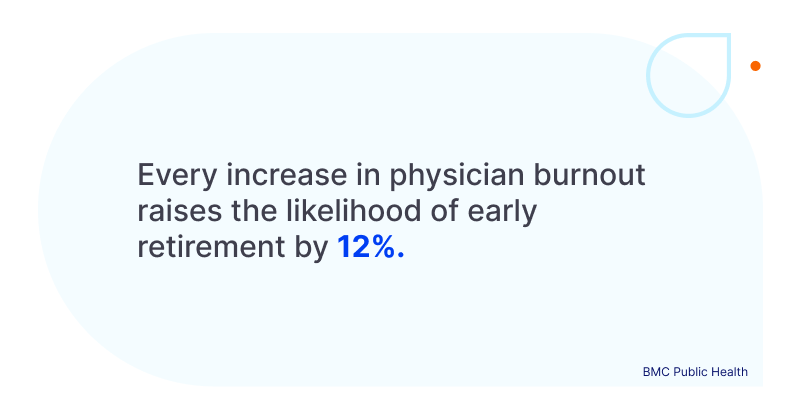
The most measurable organizational risk is turnover. Research from the journal BMC Public Health shows a strong link between burnout and plans to retire: for every increase in overall burnout levels, the likelihood that a physician wants to retire early goes up by about 12%. Work-related burnout alone increased those odds by 7.1%.
Replacing a physician can cost from $150,000 to over $1,200,000, according to Perioperative Care and Operating Room Management. This includes recruitment, onboarding, and training, but it doesn’t account for the cost of staffing gaps, heavier workloads, and disrupted care continuity.
Even when clinicians do stay, burnout can lower morale, cause disengagement at work, and increase the risk of medical errors. Patients don’t see the operational strain behind the scenes, but it can show up in care quality and liability risk.
These operational costs compound across the domains where clinicians have lost control. But these are also the areas where AI intervention can restore it.
Friction Affects Patient Care
Friction in the workflow can quickly affect patient care. When clinicians have less autonomy over scheduling and workload, they have less flexibility to adjust for complex visits or urgent needs.
A clinician may need extra time to review medications, symptoms, and care plans for a patient with multiple chronic conditions, but because the day is already packed with other urgent visits, they only have time to prioritize the most immediate issue, leaving other concerns unaddressed.
Even with consistent staffing, inefficient workflows can affect daily capacity. Administrative tasks take time away from visits, increase turnover time, and make schedules harder to manage. Patients feel the impact through longer wait times, delayed follow-ups, and rushed appointments, which erode both patient satisfaction and long-term retention.
Financial Stability Is Harder to Sustain
Revenue problems often start earlier in the workflow. If documentation is not completed on time or details are missing, coding and billing teams need to follow up before the claim can move forward. They may need to clarify diagnoses, confirm coding details, request missing documentation, or send the chart back for correction.
Those extra steps take staff time and increase billing overhead. They also slow reimbursement, which affects cash flow and makes revenue harder to predict. Practices end up spending more time reacting to payment delays and workflow problems instead of managing the practice proactively.
While healthcare workflow automation and AI aren’t a silver bullet for all of the industry’s growing challenges, AI-powered workflows do have the potential to turn the tide in favor of clinical autonomy.
How AI-Enabled Clinical Workflows Help Clinicians Practice Medicine on Their Terms
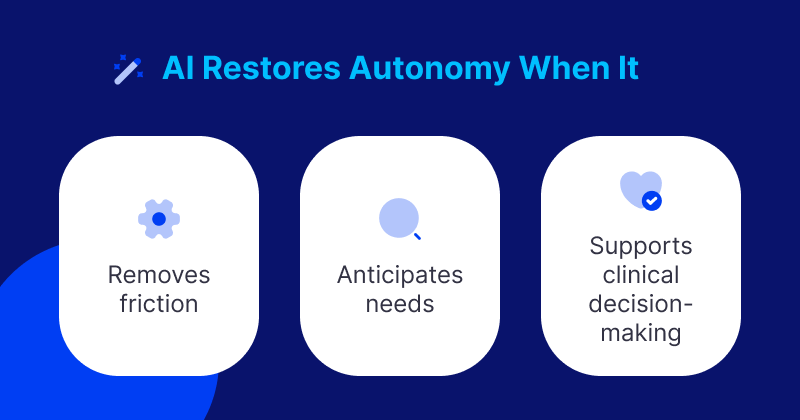
AI restores autonomy when it removes friction, anticipates needs, and supports clinical decision-making, embedded not as a layer on top of care, but as part of how the work happens.
Journey Stage: Access
Unpredictable schedules, no-shows, and misrouted appointments make the day reactive before care even begins. A clinician may have empty morning slots from cancellations, then face an overbooked afternoon with urgent visits and complex patient cases stacked together. Instead of moving through a planned schedule, the clinician has to absorb delays, shorten available time, and manage more complexity with less flexibility.
Intake, pre-visit prep, and staffing decisions become harder to coordinate because the team is working from a schedule that doesn’t reflect real demand. Staff may need to reshuffle appointments, adjust rooming priorities, update intake details, or find openings for urgent patients.
How AI-Enabled Workflows Relieve Pressure at Access
AI helps practices manage that variability. Predictive scheduling uses historical demand patterns and patient behavior to anticipate volume. Teams can better understand when demand is likely to rise, where schedule gaps may appear, and plan accordingly.
No-show prediction tools help teams identify likely gaps in advance so they can plan around potential cancellations. Patient routing tools ensure that visits are directed to the most appropriate care setting, whether in-person, virtual, specialist, or primary care. This helps prevent avoidable mismatches, such as a patient being booked into the wrong visit type or a complex case being placed where there is not enough time or support.
With better visibility into demand, practices can align staffing more effectively and distribute workload more evenly across the day. Scheduling becomes more balanced, staff capacity is better utilized, and clinicians have more control over how their day begins.
Journey Stage: The Visit
During the visit, clinicians are often expected to listen, document, search, respond to alerts, and plan next steps at the same time. A visit should be centered on the patient, but too many tasks are competing for the clinician’s attention.
How AI-Enabled Workflows Improve the Patient Experience
Ambient documentation tools capture notes, allowing clinicians to focus on the conversation instead of typing or entering data during the visit.
Context-aware interfaces surface the most relevant patient information, such as recent history, medication changes, or prior results, without requiring clinicians to search through multiple screens. Low-value alerts are filtered out, so clinicians don’t waste time sorting through information that’s irrelevant to the visit at hand.
With fewer competing demands, clinicians can stay mentally present, communicate more effectively, and move through the visit with greater clarity.
Journey Stage: Documentation
Documentation is where clinicians tend to lose control at the end of the day. Notes may be delayed, incomplete, or pushed into after-hours work. Clinicians often need to revisit charts, reconstruct details from memory, or add extra information to meet compliance and billing requirements. All of this adds hours to the clinical day, and most of them are unnecessary.
How AI-Enabled Workflows Reduce Documentation Time
AI brings documentation back into the care process, where it belongs. Real-time note capture records key details during the visit, reducing manual work and duplicate entry after it. Documentation support can even highlight relevant chart elements, such as diagnoses, medications, and required fields, while still requiring clinician review and sign-off.
Explainable suggestions tied to patient context can also help clarify what needs to be included without forcing clinicians through rigid templates. Other AI tools, like coding support, can flag relevant details at the right time, reducing the need for defensive documentation.
Because documentation is more complete and happens in real-time, the end-of-day backlog decreases, and chart closure happens faster. Less work spills into after-hours, and clinicians regain more control over how their workday ends.
Journey Stage: Follow-Up
Follow-up is where care continuity can easily become fragmented. But AI can make follow-up visible, trackable, and built into the workflow itself, rather than something managed through inboxes and memory.
When follow-up depends on disconnected inboxes, lists, and team handoffs, it’s hard to see what has been completed, what still needs to be done, and who needs to do it. Important actions can be delayed, duplicated, or missed entirely, especially when care teams are managing many follow-up tasks at the same time.
How AI-Enabled Workflows Support Care Continuity
AI centralizes and automates the follow-up process. Task routing can assign follow-up actions based on role and availability, so the right task reaches the right person without manual coordination. Care gap identification highlights what still needs to be addressed, such as overdue screenings, missed follow-up visits, or unresolved lab results.
Risk-based prioritization helps teams identify urgent patients first. A patient with abnormal lab results or worsening symptoms can be flagged for immediate follow-up, rather than waiting behind routine outreach tasks.
Connected workflows make follow-up trackable and manageable by design. Transitions between visits, documentation, and billing become more consistent. Fewer tasks are missed or delayed, and care continuity holds across the full patient journey.
Trust as the Foundation for Autonomy
AI can only support clinical autonomy if clinicians trust how it works. The World Health Organization’s AI ethics guidance names “protect autonomy” and “ensure transparency, explainability, and intelligibility” as core principles for AI in health. Clinicians are more likely to adopt AI when they understand its role, can verify its output, and remain in control of the final decision.
Trust depends on several layers. Transparency helps clinicians see what the system is surfacing and where the information came from. Explainability shows why a suggestion, flag, or care gap appeared. For example, if AI flags that a patient is overdue for a colorectal cancer screening, the clinician should be able to see the last screening date and the guideline criteria that triggered the alert.
Human-in-the-loop design keeps clinicians as the final reviewer and decision-maker. This gives clinicians room to question, confirm, or reject AI-supported outputs based on patient context. It ensures AI doesn’t replace clinical judgment, but supports it with clearer information and structured review.
Audit trails and governance add another layer of confidence in how AI is used in healthcare. They show what the system recommended, what action was taken, and who reviewed it, while governance dashboards help practices monitor how AI is being used across workflows and identify where oversight is needed.
With these safeguards in place, AI can become a trusted support layer that restores autonomy and control back to clinicians.
How Meaningful AI Adoption Reshapes Clinical Practice
Many clinicians entered medicine to focus on patient care, but administrative complexity has made that challenging to sustain. AI creates an opportunity to rebalance that equation.
As noted in the Future Healthcare Journal, AI has the potential to fundamentally transform the practice of medicine.
That transformation is most meaningful when AI supports clinical workflows and augments clinician judgment.
When AI is implemented with clinical autonomy as a priority, it changes how medicine is practiced day-to-day. The most visible shift is immediate: clinicians spend more time caring for patients and less time managing systems. Because fewer tasks rely on manual coordination, workarounds, or reactive adjustments, workflows are easier to manage and less disruptive to care.
AI-powered systems like DrChrono by EverHealth are moving in this direction by integrating documentation, workflow support, and predictive tools into a more connected clinical experience. AI becomes the operational infrastructure that helps clinicians practice medicine in a way that is more sustainable and more aligned with why they entered medicine.
AI Restores Control When It Aligns With Care
The promise of AI in healthcare is not just greater efficiency, but a return to more meaningful clinical practice. The challenge is a fragmented system–one that pulls time, attention, and decision making in competing directions. But when AI is designed around clinical autonomy, it can help bring the work of care back to the patient.
Technology should support the moments that matter most: the conversation, the judgment, the follow-up, and the trust between clinician and patient. It should reduce the friction around care, so clinicians have more room to think clearly, act confidently, and stay present.When AI aligns with care, it helps restore control, focus, and purpose to the practice of medicine. Schedule a demo to learn how DrChrono helps practices build more connected, clinician-centered workflows.