
Executive Summary
A divide is starting to emerge in ambulatory care. The practices pulling ahead aren’t simply adopting more AI tools. They’re operating differently.
Many organizations still work from disconnected systems across scheduling, billing, reporting, clinical workflows, and patient engagement. Leadership teams end up piecing together performance manually because no single system shows what’s happening across the business.
The operational friction is frustrating enough on its own. But the bigger issue is that growth decisions become much harder to make confidently. Many practices still struggle to model hiring decisions, provider capacity, reimbursement changes, expansion plans, or service-line growth using connected data. Planning becomes reactive. Growth carries more uncertainty. Scaling becomes harder to execute with confidence.
At the same time, larger health systems and more operationally mature organizations are moving toward more connected infrastructure and AI-powered workflows. Clinical, operational, and financial information no longer sits in separate reporting silos. Leadership teams can spot operational strain earlier and make decisions without waiting for multiple departments to reconcile conflicting reports first.
In time, that difference creates a widening competitive gap.
By 2027, the organizations best positioned to scale independently, attract strategic partnerships, and compete will be the ones operating from a more connected foundation where data, insight, and decision-making work together.
The Current Ambulatory Care Model Is Creating Strategic Limitations
Most ambulatory practices already use digital systems across scheduling, billing, documentation, and operations. But those systems often evolved separately. This creates workflows that are difficult to coordinate and even harder to analyze as a whole.
As operational complexity grows, executives struggle to make quick, confident decisions using connected, trustworthy data, and teams can’t fully rely on AI tools without high-quality data to train them on.
Strategic Blindness from Layered Tools
Many organizations still rely on systems that were never designed to work together. The problem goes beyond technical complexity. Disconnected systems make it harder for leadership teams to see what’s actually happening across the business.
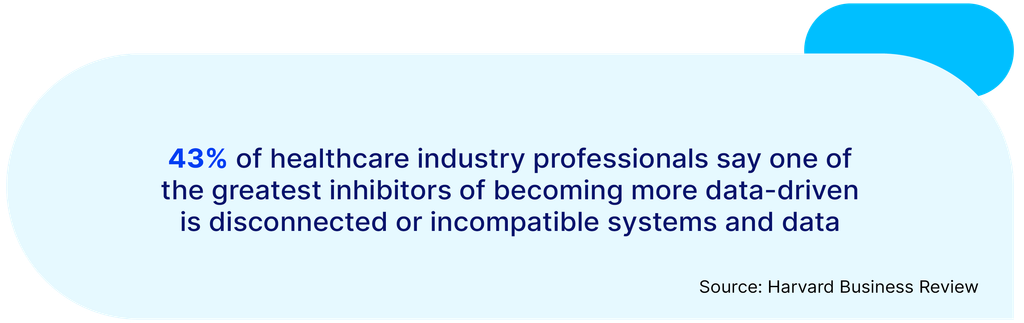
According to recent Harvard Business Review research, 43% of healthcare professionals say interoperability is one of the biggest barriers to making better use of data in decision-making.
When information moves between too many disconnected systems, confidence in the numbers starts to break down. Leadership teams spend most of their time validating reports manually because they’re no longer sure which data is complete, current, or reliable.
That trust gap already appears inside core workflows. The American Medical Association’s (AMA) 2024 Prior Authorization Physician survey found that 30% of physicians say prior authorization data in their EHR is rarely or never accurate. Another study of 2088 physicians found that only 8% felt it was very easy to use information from different EHR systems effectively.
At the same time, most healthcare data never becomes operationally useful. Philips reports that up to 97% of healthcare data is not translated into actionable insight.
At this point, the issue stops being technical altogether. Leadership teams no longer trust the information enough to plan confidently from it.
Growth Planning Based on Hope Rather than Data
These limitations become much more serious when practices try to grow. Most organizations can explain what happened last quarter. Far fewer can model what happens next.
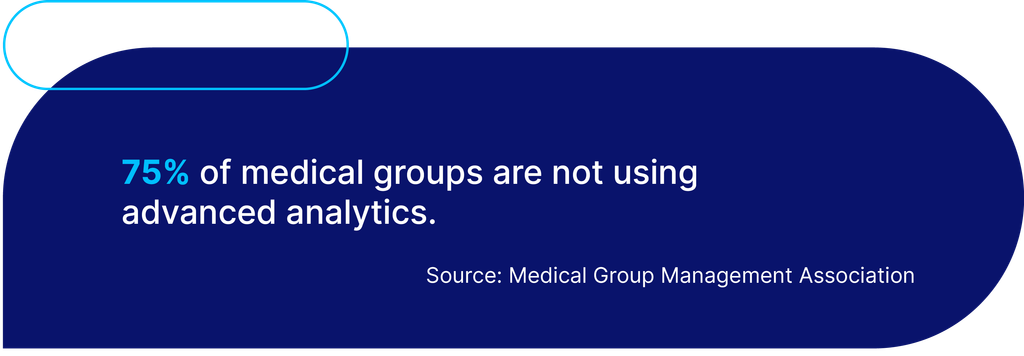
As a recent study in the Health Care Management Science journal found, forecasting plays a critical role in healthcare decision-making. Yet the Medical Group Management Association (MGMA) found that 75% of medical groups report they’re not using advanced analytics tools.
In this sense, the forecasting challenge doesn’t come from a lack of information. It’s the inability to connect and operationalize that information quickly enough to support forward-looking decisions. That uncertainty changes how practices approach growth.
A leadership team considering a new provider, expanded hours, or an additional location often can’t confidently model demand, staffing pressure, reimbursement impact, or operational capacity beforehand. Decisions depend heavily on instinct, fragmented reports, or retrospective financial analysis.
As a result, growth becomes harder to execute proactively because leadership can’t see the downstream operational impact before they commit resources. By contrast, organizations operating with an integrated data infrastructure can evaluate those same decisions in near real time.
Competitive Disadvantage Against Consolidated Systems
The market is consolidating around organizations with stronger operational coordination. Care delivery is increasingly shifting toward larger, system-backed organizations operating with integrated infrastructure and centralized visibility. In turn, smaller private practices are closing. AMA’s 2024 Physician Practice Characteristics report found that only 42% of physicians remain in private practice today, down from 60.1% in 2012.
The issue is not clinical quality or effort. Many independent practices deliver exceptional care. The difference is that larger organizations can make decisions faster as they have access to connected operational intelligence. That affects how quickly organizations can scale, adapt, and respond to market pressure over time.
Inability to Prove Operational Maturity
These limitations become most apparent when practices need to prove performance externally. Partners, investors, buyers, and health systems increasingly assess organizations based on predictability, scalability, and operational maturity.
Yet, as the Healthcare Financial Management Association (HFMA) found in a 2024 survey, many practices say analytics and reporting remain a major challenge. With fragmented reporting structures, those organizations find it tough to unify their data and demonstrate their true capabilities clearly.
That has real strategic consequences.
A practice may have strong providers, healthy patient demand, and stable revenue growth. However, if leadership can’t prove operational consistency, forecasting capability, or system-wide performance trends with defensible data, performance appears less predictable and therefore higher risk.
That uncertainty weakens leverage during acquisitions, payer negotiations, expansion planning, and partnership discussions. One organization presents historical reports. Another presents connected operational intelligence, predictive modeling, and measurable performance drivers. It’s clear which organization seems more reliable.
By 2027, that difference will shape which ambulatory organizations can scale confidently, compete independently, and negotiate from a position of strength.
But here’s the critical issue. These limitations compound over time.
Visibility gaps weaken decision-making. Weaker decisions slow growth. Slower growth increases competitive pressure. And when practices can’t clearly validate performance, operational maturity becomes harder to prove when partnerships, investment, or expansion opportunities arise.
AI-Native Practices Reorganize Around Intelligence Infrastructure to Resolve These Limitations
The organizations moving ahead are changing how the business operates behind the scenes. They’re bringing clinical, operational, and financial information together to manage performance with a clearer, more current understanding of what’s happening across the organization.
From Fragmented Visibility to Unified Strategic Intelligence
When organizational data connects, leadership can see a real-time view of performance and broader operational patterns earlier, rather than reviewing isolated reports after the fact. That allows leaders to understand how changes in one area affect performance across the organization as a whole.
As recent research in the JAMIA Open journal explains, dashboard-based visibility supports continuous operational management better than static reporting cycles, helping decision-makers respond faster as conditions change.
And as Philips Future Health Index shows, this kind of connected data-driven insight translates into actionable intelligence. According to the report, healthcare leaders say it supports optimization, helps identify best practices, and improves system efficiency.
In practice, this means leadership teams spend less time arguing over conflicting reports and more time making decisions from the same operational picture. They know what to prioritize and can act quickly.
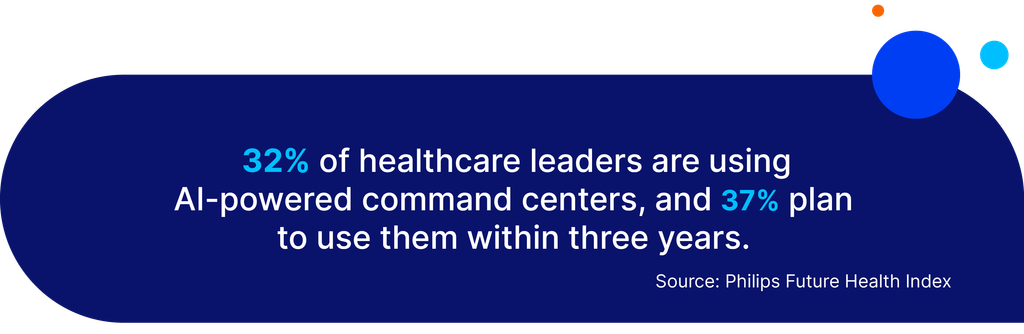
This shift toward system-level visibility is already accelerating. Philips Future Health Index found that 32% of healthcare leaders already use AI-powered command centers, while another 37% plan to implement them within three years.
From Insight Gaps to Intelligence-Driven Decision-Making
AI-native infrastructure also changes how organizations approach growth planning.
Most practices already generate enough data to support forecasting. The challenge has been connecting and operationalizing that information quickly enough to guide strategic decisions. As recent research in the International Journal of Medical Informatics shows, when organizations embed forecasting and scenario modeling into their operations, planning shifts from retrospective reporting toward predictive insight.
That capability is rapidly becoming standard across healthcare. Research published in Health Affairs found that 65% of US hospitals already use predictive models in some capacity.
Organizations that use this approach become less dependent on fragmented spreadsheets, delayed reporting, or instinct-based planning. Leadership teams can, instead, model operational tradeoffs earlier, assess risk better, and avoid costly growth decisions made with incomplete information.
Practices also gain stronger positioning externally because they can support expansion plans with measurable operational assumptions rather than optimistic projections alone.
From Competitive Lag to System-Level Decision Advantage
Historically, this level of operational visibility was mostly limited to large health systems with the resources to build complex reporting and analytics infrastructure internally.
That’s starting to change. AI-driven reporting, automation, and cloud-based platforms are making advanced forecasting, performance analysis, and operational modeling more accessible to independent practices without requiring enterprise-scale IT teams or infrastructure investments.
This means smaller organizations now have access to the capabilities that previously gave larger systems a structural advantage. Independent practices can evaluate growth opportunities earlier, respond to operational pressure faster, and demonstrate organizational maturity more credibly during expansion, partnership, and acquisition discussions.
From Perceived Risk to Provable Operational Maturity
These capabilities also change how external stakeholders evaluate healthcare organizations. Operational maturity depends on the ability to prove performance with defensible data. Unified reporting infrastructure allows practices to connect operational, financial, and clinical outcomes into a measurable performance narrative.
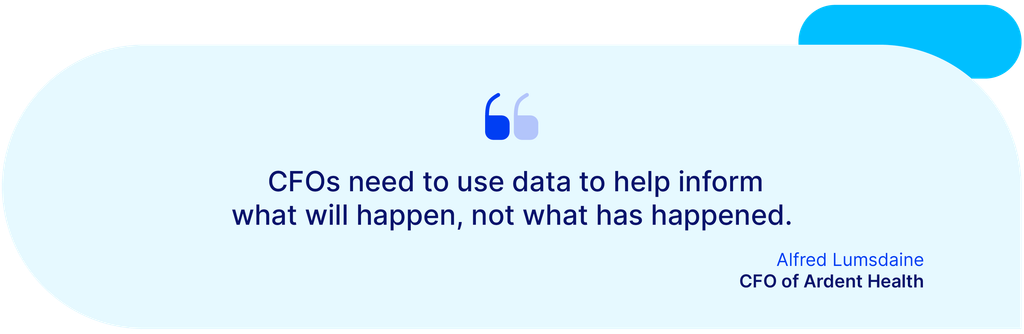
As Alfred Lumsdaine, CFO of Ardent Health, explains, healthcare leaders increasingly need data that informs “what will happen, not what has happened.”
That difference becomes especially important during acquisitions, payer negotiations, partnership discussions, and expansion planning. Organizations with stronger reporting infrastructure can show how operational decisions affect utilization, growth capacity, and financial performance using quantifiable data.
Some organizations are still layering new software onto systems that already don’t work well together. Others are restructuring how information moves across the business so decisions are easier to make and defend. Over the next couple of years, that difference will increasingly shape which ambulatory practices can scale independently and compete long-term.
This shifts practices from price-takers and value-demonstrators in every strategic conversation.
How Intelligence Infrastructure Enables AI-Native Ambulatory Care
AI-native ambulatory care is not defined by isolated AI tools layered onto existing workflows. It reflects an operating model where intelligence is continuously generated, connected, and applied across clinical, operational, and financial functions in real time. Data, insight, and action move together—not in separate cycles—so leadership teams are managing from current awareness rather than historical reporting.
Real-Time Strategic Visibility Changes How Organizations Operate
Staffing strain, reimbursement pressure, and patient demand changes become easier to spot before they begin affecting performance more broadly. Rather than waiting for end-of-month reporting, leadership teams can respond while problems are still manageable.
Automated Intelligence Reduces Strategic Lag
Operational visibility updates continuously as work happens rather than through delayed reporting cycles. That gives leadership teams more time to respond before smaller operational issues begin affecting patient access and day-to-day coordination across the organization.
Predictive Insight Changes How Growth Decisions Are Made
A practice considering a new provider or expanded hours can model likely demand, staffing pressure, and financial impact before making the decision. Forecasting becomes part of day-to-day planning instead of something executives review occasionally during growth discussions. Expansion decisions depend less on instinct and more on defensible operational evidence.
Embedded Intelligence Enables Earlier Strategic Intervention
Smaller operational problems become visible earlier. Leadership teams can see utilization shifts, reimbursement pressure, or patient access issues before they escalate.
On a more strategic level, executives can explain performance more clearly because they can actually trace where operational pressure is coming from and how each decision affects the outcomes.
From Tool-Layering to Intelligence-Native: The Shift Defining Ambulatory Care
Adding more tools to fragmented systems doesn’t resolve the underlying limitation. It often reinforces it by creating more disconnected workflows, more reporting complexity, and less coordinated visibility across the organization.
AI-native operations require a different foundation.
When healthcare organizations embed intelligence directly into clinical, operational, and financial workflows, they can manage performance continuously rather than retrospectively. Decision-making becomes faster, planning becomes more predictive, and operational maturity becomes easier to demonstrate at scale.
The practices making this shift aren’t simply improving efficiency. They’re building the operational model that will increasingly define competitive advantage in ambulatory care by 2027.
DrChrono provides the connected data and workflow foundation that AI-native operations require, unifying clinical, operational, and financial systems into a single platform so data is structured, consistent, and available in real time. Ready to build the foundation for intelligence-driven operations? Contact us today to learn how DrChrono helps practices unify data, standardize performance, and compete at scale.