

Executive Summary
When clinical documentation processes are inefficient, it’s felt across practice operations, putting a heavy administrative workload on clinicians and reducing time and attention available for patients. Primary care physicians are spending more time than ever in the EHR, and documentation is now the main driver of practitioner burnout. Additionally, documentation presents a barrier between providers and patients, as physicians attempt to balance therapeutic presence with accurate note-taking.
Smaller to mid-sized independent practices feel the administrative burden of documentation acutely. With clinicians overworked and spending work after hours on notes, there is less room or energy for growth. When it comes to the appointment experience, note-taking distracts physicians from the conversation and disrupts eye contact and active listening. The need to reconcile appointment notes with structured clinical documentation after hours also introduces risks to data integrity and quality across records.
The problem is that practitioners are forced to balance note-taking speed with quality and accuracy using processes and tools that often create unnecessary friction. Ambient AI technology like EverHealth Scribe represents an opportunity to address this burden. AI-powered note-taking tools (scribes) work within the natural flow of the appointment to capture relevant clinical details from the conversation and automatically structure them into the correct format for documentation.
This technology is so important because it empowers practitioners to quickly review and refine documentation rather than spending time manually taking notes during the appointment. The goal is to support clinical interactions without disrupting them and bring a new level of efficiency to practice operations. This guide looks at the true impact of current documentation processes and how EverHealth Scribe can reduce work, improve note quality, and lead to more time with patients.
How Clinical Documentation Challenges Lead to Burnout (and how EverHealth Scribe Helps)
Physicians have to spend large amounts of time on documentation while managing busy patient schedules. This leads to a range of issues that impact the quality of clinical care.
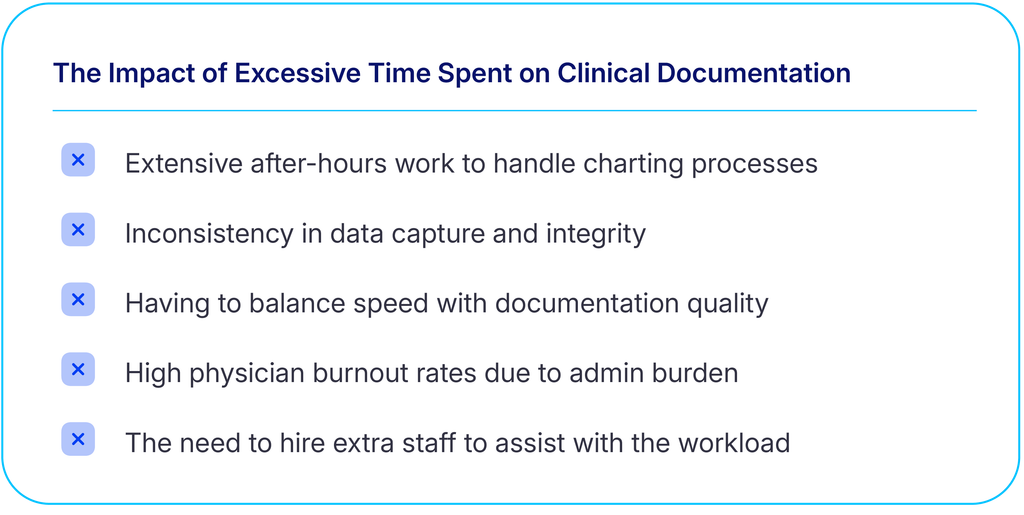
Let’s look at what the data says about the impact of traditional documentation workflows on care today.
When Documentation Workflows Overwhelm Clinical Care
A JAMA Network study found that documentation required solely for billing purposes increases total documentation time for over 84% of medical practices. The same study found that practices participating in value-based purchasing (VBP) spend even more time on documentation than those that don’t. Concerns like prior authorizations and claim denial risk fuel the need to spend more time in the EHR.
Both physicians and admin teams are spending time entering structured fields and reconciling information across different systems. Alongside extra tasks like uploading supporting documentation, standard workflows add multiple admin layers to a practice’s day-to-day. Manual uploads and data entry create redundant work, with staff often entering the same information multiple times.
For physicians, this typically extends well beyond their scheduled work hours. According to research from the American Medical Informatics Association (AMIA), 77.42% of healthcare professionals either finish work later than scheduled or must work extra hours at home to keep up with documentation tasks.
But administrative load is only part of the problem. The tools and systems for capturing and reconciling appointment notes often add to the problem, with only 31.76% of healthcare professionals agreeing that documenting patient care in EHR systems is easy.
For small or mid-sized practices in particular, this level of administrative pressure has significant consequences. It can result in the need for extra support staff, for example, or operational inefficiency that slows practice growth.
How EHR Documentation Disrupts the Patient Experience
At the heart of any clinical encounter is the patient. Listening, engaging, and interacting with them is critical to a productive physician-patient relationship. Documentation processes, however, can be disruptive in a way that patients, as well as physicians, can perceive during appointments.
When attention is divided between patient conversation and a screen, it becomes more difficult to maintain eye contact and the flow of discussion. This makes it easier for important information to slip through the cracks and can impede the physician’s ability to notice important details like body language. Patients, who may not be aware of documentation requirements, might perceive this attention deficit as an overall lack of engagement, or they might feel “rushed” through the appointment.
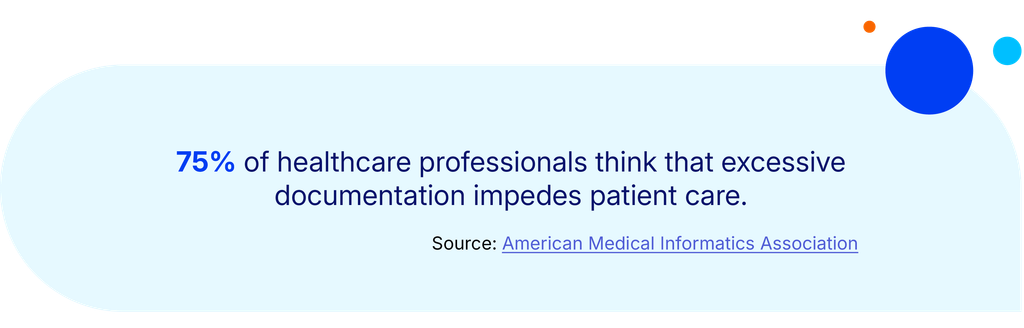
It’s a frustration that many healthcare professionals feel, with 75% agreeing in the AMIA study that excessive documentation impedes patient care.
Research published by the National Library of Medicine also uncovered that every additional hour spent on documentation results in a nearly 10% reduction in the proportion of patients whose external records were reviewed by the primary care physician during the visit, suggesting that documentation reduces the capacity for other important aspects of care and impacts the therapeutic relationship.
The Hidden Cost of Documentation: Disrupted Clinical Reasoning
Divided attention can have an impact on a physician’s ability to think clearly. Diagnosis and decisions about treatment adjustments require careful listening to symptoms and patient histories. Focused listening enables physicians to unlock their clinical intuition and pattern recognition while engaging with the patient.
Note-taking, accessing previous records, and navigating templates while trying to respond to the patient all disrupt that diagnostic thinking as the physician deals with mental task-switching during crucial clinical moments. It’s no surprise that many have come to refer to computers as a “third wheel” in the exam room, as per research published by The Permanente Journal.
Dr. Allen Hsiao, MD, professor of pediatrics and of emergency medicine at Yale School of Medicine and chief health information officer at Yale New Haven Health, described documentation practices in one interview as a “huge cognitive burden,” as physicians must “concentrate on computer screens and typing” rather than fully focusing on the patient.
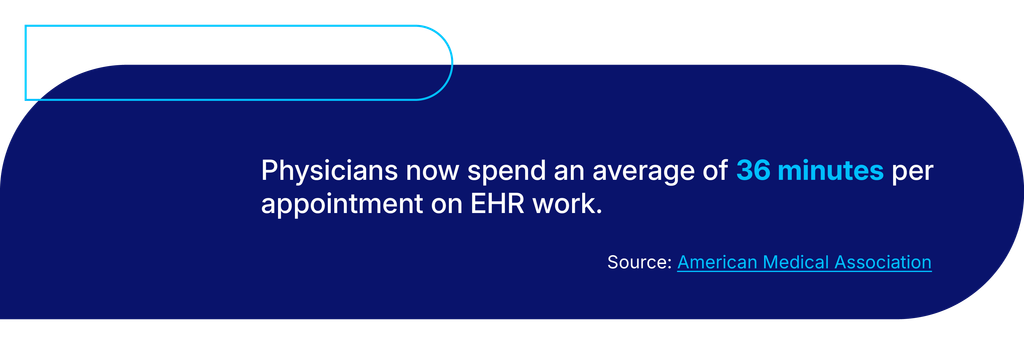
For many, this leads to a compromise that sees physicians spending excessive time updating records after the fact, rather than sacrificing attention during the appointment. According to the American Medical Association, clinicians are now spending an average of 36.2 minutes interacting with the EHR for every patient appointment just to keep up with documentation requirements.
Accuracy and Compliance Risks Manual Notes Bring to the EHR
Part of what forces physicians to spend so many extra hours in the EHR per appointment is the need to meet documentation standards so they’re audit-ready. There needs to be enough detail to support E/M coding and justify the medical necessity for treatment plans. Physicians must reconcile manual notes related to patient histories, assessments, and care plans so EHR data can stand up to potential payer audits.
Even with compliance controls in place in the EHR, like mandatory fields, manual documentation during appointments still introduces the risk of variability. This is especially true when clinicians rely on shortcuts like appointment summaries to keep up with documentation admin tasks. They may inadvertently capture information differently across visits or overlook important diagnostic details in the rush to keep up with the workload.
As a result, practices may have to deal with incomplete or inconsistent records and data, while handoff from one care provider to another means that interpreting patient history or care plans becomes unnecessarily confusing.
Research from the National Library of Medicine confirms that physicians spend the majority of their EHR time on documentation, reducing their capacity for other care-focused tasks such as chart review and direct patient appointments.
Balancing Speed and Quality in Clinical Documentation
Day-to-day operations in a small or mid-sized practice are demanding. Appointment numbers may be high, forcing physicians to keep to a strict pace, while support staff deal with appointment coordination and billing. Complex workflows in this context force clinicians and support staff alike to prioritize speed, sometimes to the detriment of patient care and experience.
Some practices have tried to lean on technology to alleviate the documentation burden. Dictation and transcription software, for example, help with the distraction of note-taking during visits. But they still require manual reconciliation and entry of unstructured notes into structured fields in the EHR. So, while clinicians are seeking solutions to the challenge, the documentation burden continues to rise. A study published in the Annals of Family Medicine found that between 2019 and 2023, the average time primary care physicians spend in the EHR per eight hours of clinical appointments increased by 28.4 minutes (7.8%).
Physicians today face a dilemma: compromise appointment standards by focusing on note-taking while with patients, or spend even more time in the EHR post-appointment fixing unstructured notes or transcripts. At the core of this dilemma is the question of quality. Balancing the patient experience and clinical care with compliant, high-quality note-taking continues to force compromises in day-to-day practice operations.
How Documentation Contributes to Physician Burnout
Apart from the mental strain of concentrating on note-taking and listening to patients during the appointment, the after-hours work clinicians spend on admin and documentation is taking its toll.
In 2024, the American Medical Association found that 43.2% of physicians reported at least one symptom of burnout. Conditions like these come with compounding effects. As physicians experience burnout, it further impacts their ability to be present with patients during appointments and maintain a high standard of clinical documentation.
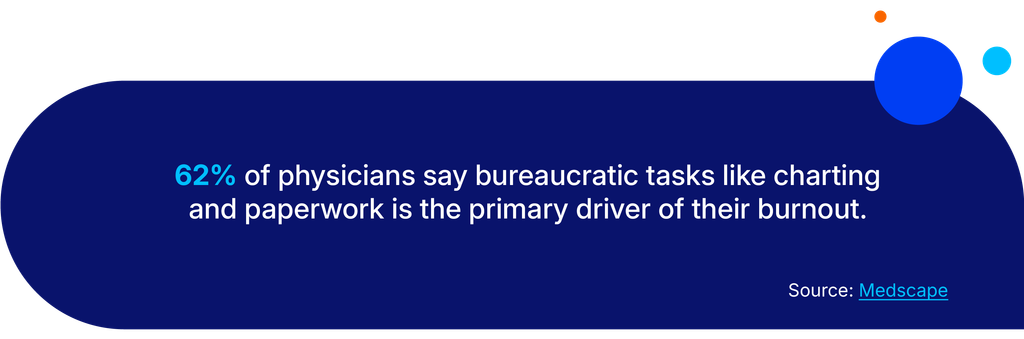
According to MedScape, of physicians who report burnout symptoms, 62% cited bureaucratic tasks like charting and paperwork as the primary driver.
When these symptoms become commonplace, they produce knock-on effects for practices, like lower staff retention rates and workforce shortages. Medical practices also have to ensure that documentation speed does not come at the cost of quality and compliance. That’s where ambient AI scribes are so useful. They are designed to streamline note-taking without sacrificing quality or accuracy.
How EverHealth Scribe Uses Ambient AI to Streamline Clinical Documentation
Instead of manual note capture during appointments, ambient AI documentation tools like EverHealth Scribe listen to the conversation and prepare structured clinical documentation in the background.
The most effective tools are those that clinicians do not have to actively think about or manage because they function silently in the background. That way, physicians can get back to practicing medicine because their technology truly lifts administrative burdens rather than only providing an incremental process improvement.
EverHealth Scribe does not replace physician judgment or clinical decision-making. But it can create fully structured notes for fast approval or editing by a clinician before integrating seamlessly with the EHR.
How EverHealth Scribe Restores Focus to Patient Encounters
One of the most significant benefits of ambient AI is its ability to enable clinicians to fully focus on patient conversations. As a result, there are no longer interruptions to the conversational flow or broken eye contact.
Physicians can pick up on extra cues, spend more time on follow-up questions, and delve deeper into diagnostic thinking or treatment analysis. This shift results in a more relaxed environment for physicians and patients alike, as the appointment can progress without the interruption of clicking and typing. Early data show that the use of ambient documentation technology can reduce keystrokes during patient visits by as much as 91%.
Ambient listening, meanwhile, picks up all the information and context in the background, with reports of 98% accuracy. So the physician can preserve the therapeutic relationship and come out of the appointment with better documentation than before. Unlike typical dictation and transcription tools, EverHealth Scribe also intelligently filters out conversational noise. Clearer notes mean clinicians spend less time on the review and post-appointment editing process.
EverHealth Scribe even supports multi-language conversations, so the provider and patient can communicate naturally while the tool still generates documentation in the appropriate language for the EHR. It also automatically produces patient visit summaries, so both clinicians and their patients have a clear, structured summary of the visit. The goal is to support the encounter instead of interrupting it.
Automating How Notes Are Structured While Maintaining Personalization
Capturing the conversation itself is only the first step in the documentation process, and ambient AI further supports all the tasks and organization that come after, too.
Much of the time physicians spend on documentation revolves around structuring and editing notes into acceptable formats for the EHR. EverHealth Scribe does this automatically, pre-structuring notes in the correct format so documentation admin becomes an approval process rather than extensive data reconciliation.
Instead of manual formatting and entering data into structured fields for hours at home, the system maps key information from the conversation directly into the appropriate sections of the medical record. This can include patient history, assessment details, treatment plans, and even any specialty-specific components of the documentation workflow. The resulting efficiency gains are substantial, including reducing documentation time to 9-10 minutes per average appointment. This translates to more than two hours saved daily for physicians handling typical patient volumes.
Since the information is already organized and pre-formatted, clinicians can review and further edit notes as needed rather than building the record from scratch. The Magic Edit bar in EverHealth Scribe, for example, allows physicians to quickly adjust notes using natural language commands without spending excessive time on manual formatting. The ability to personalize documentation remains, but without the excessive manual work previously required.
Automating documentation notes into structured formats also helps with compliance and reporting. With clinical data captured consistently, practices can ensure documentation aligns across the board.
Seamlessly Integrating Documentation into Existing EHR Workflows
Documentation technology works best when it fits into existing workflows and does not require additional reconciliation processes. EverHealth Scribe works with the technology physicians already use, integrating seamlessly with existing EHR workflows. EverHealth Scribe integrates directly with DrChrono, ensuring documentation automatically syncs within your existing workflows without requiring system changes or workarounds.
In appointments, physicians can lean on a range of templates based on visit type, which they can also lightly customize, to ensure EverHealth Scribe captures every encounter’s notes accurately.
In practice, that means the tool can capture the conversation, structure the information, and pass it directly to the clinical record for approval with no additional steps for physicians or practice staff.
After an appointment, the tool first takes the conversation and prepares structured clinical documentation. Then, a physician reviews and approves the notes. Finally, the system syncs the notes within the patient chart section of the EHR before adding them to the record.
The technology supports both desktop and mobile use. A physician might use the tool via mobile to capture the conversation, but review and finalize the documentation later on a desktop.
Improving Clinical and Practice Efficiency with EverHealth Scribe
When EverHealth Scribe handles the majority of the documentation admin, the entire practice feels the benefit, including patients.
Less time and effort spent on documentation leads to meaningful improvements for clinical workflows, but also the overall operations at a practice. Instead of spending both clinical time and after-work hours in the EHR, physicians can spend more time per appointment or increase their overall appointment capacity. Support staff can also complete their tasks more promptly and efficiently, as they spend less time waiting for documentation to be finalized in the EHR or reconciling data.
As less work spills over into the evenings and weekends, physicians aren’t as burnt out. And rested, focused physicians have more time to concentrate on practice growth.
Physicians can also redirect that time to patients and care coordination to improve outcomes. This might include deeper analysis of patient history or more detailed explorations of potential treatment options.
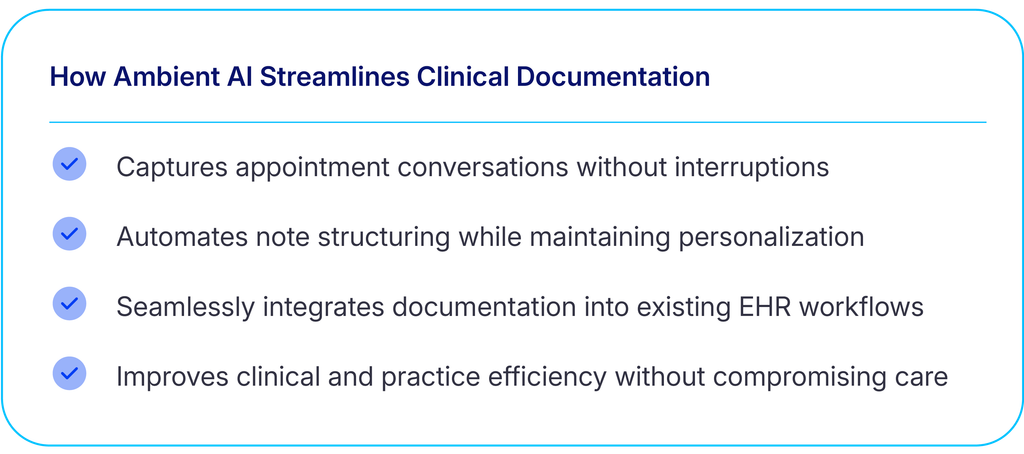
Ultimately, the goal is not just to make documentation faster. It’s about creating workflows that better support physicians, patients, support staff, and the overall success of the practice.
Reducing Admin Time with EverHealth Scribe
As one of the most persistent and burdensome operational challenges in modern healthcare, documentation workflows are due for a change. Expectations to capture highly detailed, compliant health records are placing huge pressure on physicians as they balance these demands with the need to provide thorough clinical care and positive patient experiences.
Beyond the general administrative burden is the impact of documentation processes on clinical care itself. Physicians are constantly shifting between computer screens and note-taking to patient conversations and back again. Not only is it disruptive for the physician, but it also opens up the potential for patients to feel dissatisfied with the appointment. Meanwhile, important context and cues that are crucial to the therapeutic relationship may slip through the cracks.
EverHealth Scribe presents an opportunity for a sea-change in clinical documentation workflows. Like a silent assistant, it can handle all of the manual note-taking and restructuring of conversations into EHR-ready data while the appointment conversation unfolds naturally.
Rather than encroaching on decision-making, it lifts the administrative burden from physicians so they can focus more clearly on the clinical aspect of patient encounters, enabling them to quickly review and edit documentation before uploading to the EHR.
Learn more about how your practice can leverage ambient AI to reclaim admin hours and build more sustainable clinic operations. Book a personalized demo of EverHealth Scribe today to see how it can transform your documentation workflows.