

According to the American Medical Association (AMA), 6 in 10 physicians owned their practice in 2012. Today, that number has dropped to 4 in 10, and the rate of decline is accelerating. The structural forces behind that collapse, including margin compression, consolidation, and operational complexity, aren’t slowing down. They’re compounding.
But the independent practices that reverse this trajectory by 2030 won’t be the ones that fight harder to survive within the old model. Rather, they’ll evolve beyond it, reorganizing their operations around intelligence as core infrastructure and building integrated capabilities across clinical insight, predictive revenue modeling, and operational resilience that legacy-model practices can’t replicate.
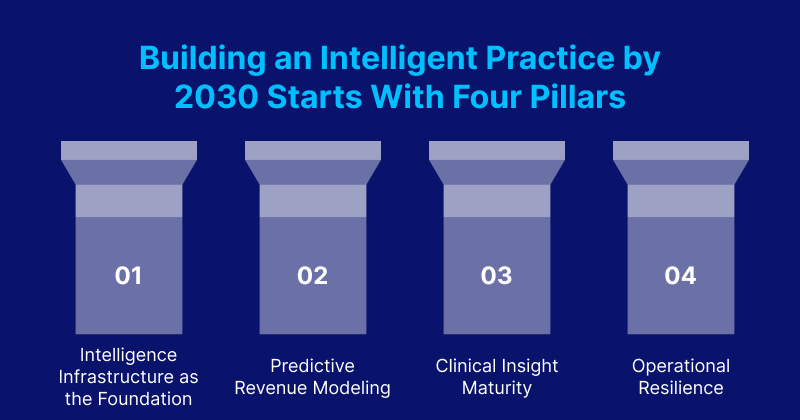
This blueprint for 2030 defines the four pillars of the intelligence-native practice model: intelligence infrastructure as the foundation, predictive revenue modeling, clinical insight maturity, and operational resilience. It maps the phased transformation roadmap from the current state to 2030 maturity, and identifies the market forces that make this transformation non-optional. The critical window for competitive repositioning is 2025 through 2027, which means the independent practices that move first will set the terms. The rest will respond to them.
The 2030 Landscape (And Why The Status Quo Won’t Survive)
The 2030 landscape is being shaped by structural forces that legacy operational models cannot overcome through incremental improvement. Understanding the forces shaping this future is essential because the blueprint that follows is a direct response to market conditions pushing transformation. Independent practices are under simultaneous pressure from margin compression, consolidation, and rising operational complexity. These forces are not isolated—they are compounding, accelerating the erosion of traditional practice models.
The 2030 Intelligent Practice: Three Defining Characteristics
By 2030, the practices that thrive will share three defining characteristics that legacy models can’t deliver.
- The first is intelligence-native operations, where every decision is data-informed in real time rather than reconstructed from lagging reports. This includes clinical, financial, and operational decisions.
- The second is predictive rather than reactive financial management. With this characteristic, revenue shifts are modeled and addressed before they appear in monthly statements.
- The third is clinical insight that drives population health performance, not just individual encounter outcomes.
Together, these characteristics describe a practice that operates as a continuous learning system rather than a collection of disconnected workflows.
The 2030 Market Reality for Independent Practices
Three market forces will converge to define the 2030 landscape. These are value-based care dominance, AI-native operations, and integrated intelligence as the baseline for competitive participation.
The Centers for Medicare and Medicaid Services (CMS) expects to have 100% of Traditional Medicare beneficiaries in accountable care relationships by 2030, and the number of patients in value-based care models is expected to double from 43 million in 2022 to 90 million by 2027. Independent practices that can’t demonstrate intelligence-enabled outcomes will be left out of the highest-value contracts.
At the same time, healthcare AI spending hit $1.4 billion in 2025, which is nearly triple 2024’s investment. That reflects a market-wide repositioning around AI as core infrastructure rather than an optional add-on.
Why Legacy Models Can’t Reach That Future
Practice leaders are investing in point improvements, such as new EHR modules, upgraded billing systems, and additional staff. But these incremental improvements aren’t enough, so many find themselves falling further behind competitors that are transforming their operational models entirely.
This challenge is compounded by the fact that most transformation efforts fail. While 65% of digital transformation initiatives fall short of their goals across industries, success rates in healthcare drop as low as 4% to 11%. Without a structured roadmap, transformation stalls at aspiration.
The operating environment makes the gap harder to close every year. Costs are rising, and physicians are facing a burnout crisis. According to the Medical Group Management Association (MGMA), medical practice leaders reported an average year-to-date operating expense increase of 11.1% in 2025, with 90% of medical groups reporting rising costs. Nearly half of physicians report at least one symptom of burnout, and U.S. primary care physicians would need to work nearly 27 hours a day to complete all recommended care and administrative tasks under the current model. Three of those hours would be dedicated to clinical documentation requirements alone.
The workflows driving margin compression and burnout are the exact ones intelligence infrastructure would transform, which is why optimizing within the legacy model can’t close the gap.
The Consolidation False Choice
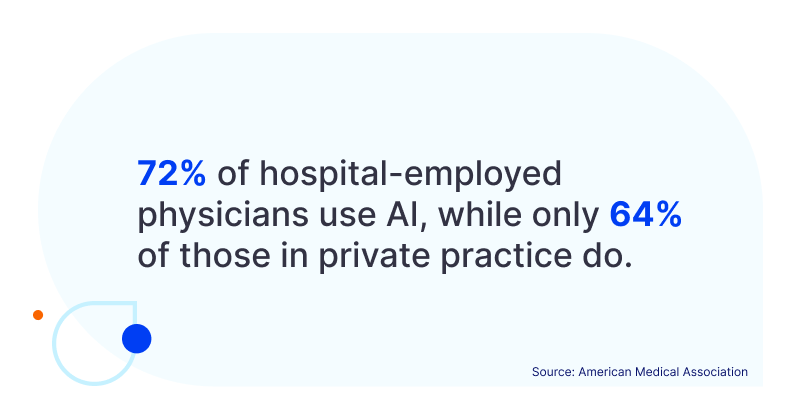
The dominant response to these pressures has been consolidation, but that framing conceals a different option: intelligence. According to the AMA, more hospital-employed physicians use AI (72%) than private practice physicians (64%), reinforcing a growing technology. Today, only 42.2% of physicians remain in independent practices, while 77.6% are employed by hospitals or corporate entities.
Hospitals have organizational scale, but independent practices can build an intelligence infrastructure that produces comparable structural advantages without surrendering autonomy. According to the Congressional Budget Office, physician-led accountable care organizations (ACOs) consistently outperform hospital-led entities. Independence paired with intelligence infrastructure is a competitive position that consolidation can’t replicate.
The Window for Competitive Repositioning
The architectural decisions that determine 2030 readiness are being made between 2025 and 2027. With 2025 already past, the remaining window for meaningful repositioning has compressed into less than 24 months.
Practices that commit to intelligence infrastructure now will enter 2028 with cross-domain capabilities compounding on each other, as data, insight, and action improve with every cycle. On the other hand, practices that delay transformation will face a gap that incremental investment can’t close. This is because competitors won’t be standing still. They’ll be two years into a learning system that widens the separation automatically.
The Four Pillars of Intelligent Independent Practices
The intelligent independent practice of 2030 is organized around four integrated capability domains that function as a unified system rather than a collection of discrete initiatives. Each pillar is independent, compounding the impact of the others.
Intelligence infrastructure makes predictive revenue modeling possible, predictive modeling funds clinical insight maturity, clinical insight maturity produces the outcomes that sustain operational resilience, and operational resilience protects the continuous learning loop that keeps every other pillar improving.
The transformation roadmap that follows shows how practices sequence investment across all four to reach intelligence-native operations by 2030.
1. Intelligence Infrastructure as the Foundation
Intelligence infrastructure is the unified data and analytics layer that connects every clinical, operational, and financial system into a continuous decision-support environment. It’s the foundation because no other pillar can function without it.
According to McKinsey, data-driven organizations are 23 times more likely to acquire customers, six times more likely to retain them, and 19 times more likely to be profitable. In healthcare specifically, that advantage shows up in shorter feedback loops, fewer manual reconciliations, and faster response to payer, clinical, and operational shifts.
In the 2030 model, the intelligence layer is invisible in daily use because it’s continuous. Every patient encounter, billing event, and clinical outcome feeds a learning system that updates scheduling patterns, revenue forecasts, and care pathways without staff having to request reports or reconcile data across platforms.
Clinicians open a single interface that surfaces the patient’s longitudinal record, risk indicators, and documentation cues in real time. Operations leaders see staffing, throughput, and financial performance in a single view that updates as the day progresses, not days after the fact.
DrChrono by EverHealth’s integrated platform architecture connects EHR, billing, scheduling, and analytics into a single intelligence layer. This provides the foundational infrastructure for intelligence-native operations.
2. Predictive Revenue Modeling
Predictive revenue modeling replaces reactive financial management with forward-looking intelligence that anticipates revenue shifts before they appear in monthly reports. In the 2030 model, this pillar translates data infrastructure into financial durability by turning the practice’s raw operational data into early-warning signals and scenario forecasts that protect margin through payer mix changes, regulatory shifts, and contract transitions.
The global healthcare predictive analytics market is projected to grow from $21.87 billion in 2025 to $371.12 billion by 2034. This reflects market-wide recognition of predictive insight as a strategic advantage. At the same time, value-based care payments have doubled since 2021, growing from 7% to 14% in 2025. This means a growing share of revenue now depends on a practice’s ability to model risk, track outcomes, and manage cost trends forward rather than backwards.
DrChrono’s revenue cycle management platform gives practices the predictive visibility to model revenue scenarios and respond to payer changes in days rather than quarters. This positions them to thrive as value-based contracts become the dominant payment model.
3. Clinical Insight Maturity
Clinical insight maturity means the practice generates, analyzes, and acts on clinical intelligence at a level that directly improves patient outcomes and population health performance. This is the pillar where intelligence infrastructure and predictive capability translate into the clinical results that determine value-based contract performance and competitive standing.
Adoption is already reshaping the clinical environment. According to McKinsey, 85% of healthcare leaders are exploring or have already adopted generative AI capabilities. Seventy-five percent of physicians who’ve adopted AI report reduced administrative burden and better job satisfaction. And 73% have stated improved work-life balance, which matters when considering the burnout statistics cited earlier. Additionally, 69% reported better patient care and outcomes, and 39% reported increased patient revenue.
In the 2030 model, clinical intelligence is native to the workflow rather than an overlay. Ambient listening captures the encounter and produces clinical documentation, coding suggestions, and follow-up task assignments. Predictive risk stratification identifies patients trending toward deterioration, gaps in evidence-based care, or rising-risk populations in value-based contracts—and routes each to the right intervention automatically. Agentic systems handle the connective tissue between visits. Clinicians spend visit time on the patient, not on screens.
The workflows that AI absorbs are the same ones driving the documentation burden identified earlier, making clinical insight maturity both a performance pillar and a sustainability one.
4. Operational Resilience
Operational resilience is the practice’s capacity to absorb disruption and maintain performance without relying on heroic individual effort. Resilience often comes down to good leadership and a culture that embraces change. This final pillar ties the others together because those pillars only compound into a durable advantage if the organization can sustain them through staff transitions, payer changes, regulatory shifts, and demand volatility.
The evidence for resilience as a multiplier is clear. Deloitte’s research identifies leadership as the key accelerator of digital transformation by 80% of survey respondents, with management of implementation a close second at 68%. On the other hand, culture is the key barrier for 60% of respondents, with lack of ownership and transparency on initiatives being the second at 48%.
In the 2030 model, governance structures align IT, clinical, financial, and operational leadership around shared KPIs that are measured continuously rather than quarterly. Change management is a repeatable discipline, no longer a crisis response. As a result, operational resilience replaces the need for consolidation’s scale with intelligence’s structural durability.
The Transformation Roadmap From the Current State to 2030
The roadmap below sequences capability, investment, outcomes, and decision points across three phases so leaders can move deliberately rather than reactively.
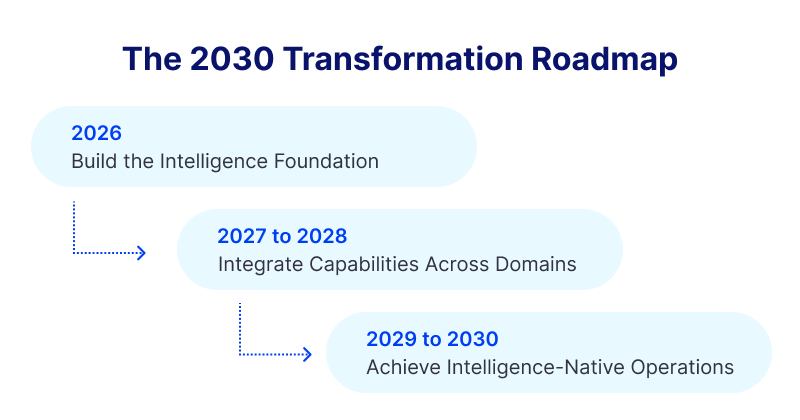
2026: Build the Intelligence Foundation
Capability milestones:
- A consolidated data layer across EHR, billing, scheduling, and analytics
- Ambient listening deployed across the clinician panel
- Automated coding in the billing workflow
- Real-time revenue dashboards replacing month-end reporting
Investment priorities:
- Platform integration
- Clinician-facing AI tooling
- A governance structure with an executive owner and shared KPIs across functions
Measurable outcomes:
- Documentation time down at least 30%
- A 10 to 15 point lift in clean-claim rate
- Near-real-time revenue visibility
The go/no-go decision: Is the integrated data layer producing reliable cross-domain reporting?
Risk indicators:
- Ambient tool adoption below 70%
- Persistent data reconciliation gaps
- Governance that defaults to IT status updates
2027 to 2028: Integrate Capabilities Across Domains
Capability milestones:
- Predictive revenue modeling tied to scheduling and payer mix
- Risk stratification integrated into clinical workflow
- Agentic AI handling referrals and prior authorizations end-to-end
- Continuous value-based contract performance tracking
Investment priorities: Capability expansion and role redesign (new functions like intelligence lead or population health analyst)
Measurable outcomes:
- Denial rates down 25% or more
- Value-based performance payments at or above regional benchmarks
- Documentation time down 50% from baseline
- Panel capacity expanded without proportional staff growth
The go/no-go decision: Is cross-domain intelligence compounding or operating as parallel silos?
Risk indicators:
- ROI plateauing below 2x
- Turnover in new intelligence roles
- Agentic workflows require more oversight than they replace
2029 to 2030: Achieve Intelligence-Native Operations
Capability milestones:
- Continuous learning loops across all four pillars
- Autonomous agentic systems handle most administrative coordination
- Real-time population health management
- Scenario modeling embedded in the weekly operating rhythm
Investment priorities: Shift from building capability to compounding it
Measurable outcomes:
- Total transformation ROI at or above the 10.3x integration benchmark
- Value-based revenue at 50% or more of total
- Burnout indicators trending below national averages
Risk indicators: Complacency—treating 2030 readiness as an endpoint, not a baseline
Start Building an Architecture for 2030 Now
By 2030, intelligence-native practices will operate at margins eight to twelve points higher than legacy models, qualify for value-based contracts their competitors can’t access, and free clinical teams to work efficiently while others drown in administrative burdens. The outcomes they produce will make them essential to payers and patients in ways that scale alone can’t achieve.
By 2028, the gap becomes structurally difficult to close. Practices that haven’t built the intelligence foundation by 2027 will lack the architectural basis for AI-native operations, and the separation becomes structural rather than incremental.
The window for architectural transformation is open now. Practices that commit this year will set the terms of the 2030 market, and the rest will respond to them. The decision is not whether to change, but whether to lead or follow.
DrChrono by EverHealth provides an integrated intelligence platform that makes this transformation achievable for independent practices. Learn more to begin building your 2030 blueprint today.