

The practices that win in ambulatory care aren’t always the ones with the best clinicians or the most locations. They’re the ones that use intelligence to detect pattern shifts in real time—reimbursement trends, patient demand, or competitive positioning—interpret those patterns, and act on them before the competition. This is the foundation for sustainable growth. Timely intelligence drives smarter decisions and enables practice leaders to pivot faster.
This capability is decision velocity: the speed at which a practice moves from signal to insight to action. It’s a leadership competency, not clinical efficiency metric. And it’s becoming a defining advantage in ambulatory care.
The healthcare landscape is consolidating rapidly, margins are tightening, and payer dynamics are shifting faster than quarterly reporting can capture. In this environment, the ability to make faster, better-informed strategic decisions creates compounding returns. Each faster decision builds on the last, widening the gap between high-velocity organizations and those still navigating by rearview mirror.
This report defines decision velocity as a leadership framework, examines the infrastructure that enables it, and maps its applications for practice leaders seeking a durable competitive edge.
When Clinical Decisions Lag, Medical Practices Lose Ground
When decision velocity is slow, every strategic function suffers, from revenue optimization to staffing to growth planning. There are three interconnected challenges that keep decision velocity dangerously slow in most ambulatory practices.
Competitive Response Time Measured In Months, Not Days
The ambulatory care market is consolidating at an accelerated pace. Independent practices face mounting competitive pressure from hospital systems, private equity, and insurance-owned entities.
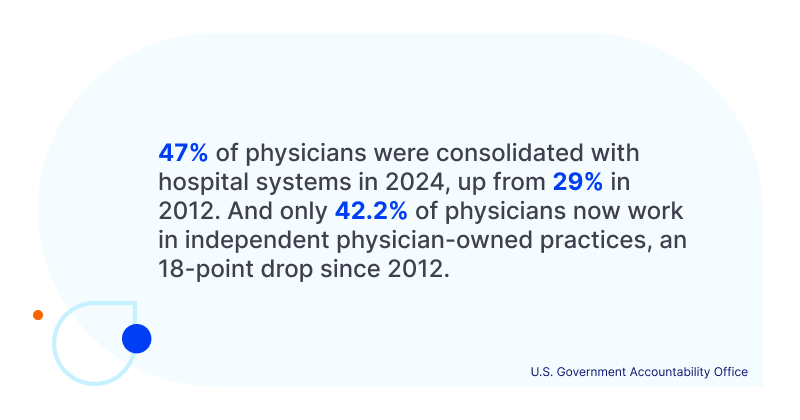
According to the U.S. Government Accountability Office, 47% of physicians were consolidated with hospital systems in 2024, up from 29% in 2012. Consider what this can look like on the ground. A five-physician family medicine practice in a growing suburban market learns that a regional hospital system acquired two competing independent groups in its area within the same quarter. Almost overnight, those acquired practices gain access to the system’s negotiating leverage with payers, its marketing infrastructure, and its referral network.
Unfortunately, this is quite common. According to the Kaiser Family Foundation, only 42.2% of physicians now work in independent physician-owned practices, which is an 18-point drop since 2012. And roughly 90% of U.S. hospital markets are now classified as “highly concentrated.”
With consolidated practices, patients who previously chose among several independent options now see a unified hospital-branded presence across the community. The remaining independent practice hasn’t lost a single clinician or changed anything about its care quality, but its competitive position has fundamentally shifted. When those shifts happen, leadership teams relying on quarterly reports are the last to know and the slowest to respond.
By the time that data arrives, competitors have already adapted, and market share has eroded.
Practices operating on legacy reporting cycles are steering by the rearview mirror, while faster-moving organizations respond to the same signals in days.
Critical Decisions Delayed While Waiting for Analysis
Practice margins are under sustained pressure, which leaves less room for a delayed strategic response. According to the Medical Practice Management Association (MGMA), medical practice leaders reported an average year-to-date operating expense increase of approximately 11.1% in 2025. Ninety-two percent of medical group leaders reported that operating expenses increased in 2024 compared to 2023. Only 56% of medical group leaders reported year-to-date revenue increases in 2025, while 30% reported a decline.
Payer dynamics are simultaneously shifting faster than traditional reporting can capture. Business Wire reports that true accounts receivable days increased 5.2% year-over-year as payors used initial denials to slow payments, even though they ultimately pay approximately 90% of claims. And, according to Fierce Healthcare, the average denial amount tied to medical necessity requests rose 70%, up to $450.
Patient behavior is also shifting in parallel to the above changes. According to Medical Economics, six to 10 patients face rising costs that drive care delays and billing confusion. This creates demand-side signals that practices need to detect and act on in real time.
Each of these shifts—expense growth, denial pattern changes, patient payment delays—requires immediate strategic response. But when these signals reach leadership through monthly reports, practices end up making well-informed decisions too late for those decisions to matter.
Inability to Measure and Improve Organizational Responsiveness
Most practices sense that their organization responds slowly, but have no framework to quantify that slowness or identify where bottlenecks occur. Without metrics for decision speed, there’s no way to know whether efforts to increase organizational agility are working. Only about 15% of organizations practice effective decision-making, according to a Bain & Company survey. Without a way to track the full decision arc, from signal detection to executive awareness to decision to implementation, practices cannot systematically reduce the lag at each stage.
To illustrate the problem, consider a primary care practice that notices a gradual decline in new patient volume. Leadership requests a deeper analysis, but because the data lives across disconnected scheduling, billing, and marketing systems, it takes two weeks to compile the information.
Once done, the analysis reveals that a new urgent care center has been absorbing same-day appointment demand, but by the time leadership has the data to respond, nearly four months have passed from the first detectable signal. No one can say whether the bottleneck was in detection, escalation, analysis, or approval, because no stage of the decision process was tracked. The result is a compounding disadvantage where each slow cycle reinforces the pattern and widens the gap with faster competitors.
Building the Infrastructure for Clinical Decision Velocity
Decision velocity isn’t a function of working harder or holding more meetings. It requires infrastructure that shortens the distance between signal and action at every stage of leadership decision-making.
Without baseline metrics for organizational responsiveness, such as time from signal to awareness, awareness to decision, and decision to action, leadership can’t systematically improve velocity. They can only sense that decisions move slowly and hope that adding more meetings or dashboards will help.
Building decision velocity requires measuring it first. There are three capabilities that form the foundation of a high-velocity practice. Let’s cover each in detail.
Real-Time Visibility as the Foundation
The first requirement for decision velocity is eliminating the reporting lag that forces leadership to operate on outdated information. Traditional practices run on monthly or quarterly data cycles where revenue reports, utilization metrics, and performance data arrive weeks after the patterns they describe have already played out.
Real-time performance monitoring replaces this lag with continuous intelligence. Integrated dashboards correlate operational, financial, and clinical data in a single view. Leadership receives alerts when emerging patterns deviate from expected baselines, whether in patient volume, claims denial rates, payer mix shifts, or revenue trends. Decision support tools model response options quickly, so leadership can evaluate scenarios rather than waiting for custom analyses.
The research backs this up. McKinsey states that data-driven organizations are 23 times more likely to acquire customers, six times more likely to retain them, and 19 times more likely to be profitable. It’s clear that when the data environment supports interactive exploration rather than static reports, leadership can investigate questions the moment they arise instead of waiting for the next scheduled quarterly review.
Real-time visibility is what transforms practice leadership from reactive to proactive. This infrastructure shift is what DrChrono by EverHealth’s integrated platform delivers. Instead of waiting for month-end revenue reports, practice leaders access real-time insights into financial performance, billing optimization, coding accuracy, and reimbursement trends through interactive dashboards. The same system that processes claims and manages the revenue cycle also surfaces the intelligence that drives faster strategic decisions, eliminating the lag between operational reality and executive awareness.
Predictive Analytics as the Accelerator
Seeing what’s happening now is critical for making strategic decisions, but that’s not sufficient for decision velocity. High-velocity practices also need the ability to anticipate what’s likely to happen next.
The global healthcare predictive analytics market is projected to grow from $16.75 billion in 2024 to $184.58 billion by 2032—a 35% compound annual growth rate. This growth reflects a market-wide recognition that predictive insight creates a strategic advantage that reactive analysis can’t match. Predictive analytics enables practices to forecast revenue trends before they appear in monthly reports, anticipate staffing needs based on demand patterns, model the financial impact of payer policy changes before they take effect, and identify at-risk revenue streams before they become write-offs.
Real-time reporting can also dynamically adjust predictive algorithms in line with new insights. This provides the capability to evaluate performance as it unfolds rather than after the fact. According to Deloitte, AI and predictive analytics could save the U.S. healthcare system $200 to $360 billion annually, but most organizations will capture only 10 to 20% of that potential value because implementation is harder than technology. The implementation gap is precisely the decision velocity problem. Organizations that build the infrastructure to act on predictive insights, not just generate them, capture disproportionate value.
Research shows that analytics can predict patient readmission risks, uncover trends, and support population health strategies, but these capabilities only generate returns when organizations can act on them quickly. Velocity without accuracy is chaos, but velocity with predictive insight is strategic power. DrChrono’s integrated reporting and revenue cycle management platform connects financial, operational, and clinical analytics in one system, Providing the analytical foundation that transforms predictive intelligence into timely action.
Measuring and Improving Decision Velocity
The final infrastructure requirement is the ability to measure decision velocity itself and treat it as a leadership performance metric. In other words, what gets measured gets managed. But most practices have never measured how long it takes to move from signal detection to strategic response.
Establishing decision velocity as a measurable metric requires tracking four intervals:
- When an issue first appears in the data
- When it’s escalated to leadership awareness
- When a decision gets made
- When the change gets implemented
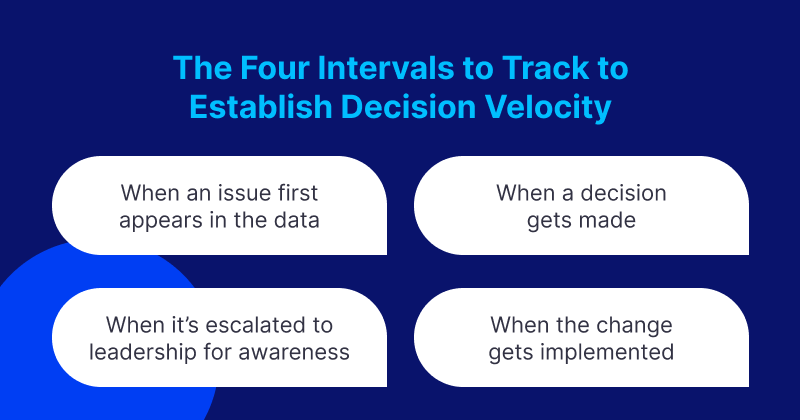
This creates a baseline of organizational responsiveness that can be tracked, benchmarked, and improved over time.
Real-time reporting provides the audit trail needed to identify where decisions stall. Each stage of the decision arc tends to break for different reasons, and each demands a different intervention.
Detection bottlenecks arise when data systems don’t surface emerging patterns automatically, which leaves leadership dependent on someone manually noticing a problem. Analysis delays occur when data must be pulled from multiple disconnected systems and manually reconciled before it can inform a decision. Approval lag results from unclear decision rights or excessive consensus requirements that slow executive action. Execution gaps emerge when decisions are made while implementation stalls due to workflow limitations or a lack of accountability.
Infrastructure that timestamps each phase of the decision cycle makes these bottlenecks visible and addressable, which allows leadership to target improvements where they’ll have the greatest impact on overall velocity.
Understanding revenue cycle management as a strategic function, not just a billing operation, changes how leadership evaluates the speed and quality of financial decisions. As PRS Global Open puts it, “not understanding that ‘it’s not just the work you do, but whether (and how soon) you get paid for it’ results in unrecoverable losses.”
DrChrono’s advanced reporting capabilities, combined with real-time data dashboards and performance analytics, provide the visibility needed to track not just what decisions were made but how quickly the organization moves from signal to action, making decision velocity itself a measurable and improvable leadership metric.
The Compounding Advantage of Faster Clinical Decisions
The practices that thrive in an era of consolidation, margin pressure, and rapid payer change won’t be the ones with the most data, but rather, the ones that move fastest from data to decision to action.
Decision velocity is a leadership competency that can be defined, measured, and systematically improved. It starts with infrastructure that provides real-time visibility into operational and financial performance, then accelerates with predictive analytics that shift leadership from reacting to anticipating. And it matures when organizations track their own responsiveness and eliminate the bottlenecks that slow them down.
This infrastructure advantage compounds over time. Each faster revenue cycle adjustment creates margin that funds the next strategic investment. Each proactive staffing decision captures volume that competitors miss. Each early response to market shifts builds patient loyalty before others recognize the need to compete. Month by month, quarter by quarter, the gap widens between practices that operate on real-time intelligence and those still navigating by historical reports.
DrChrono by Everhealth gives practice leaders real-time intelligence, integrated analytics, and revenue cycle visibility to make faster, better-informed strategic decisions. Learn more to see how decision velocity works in practice.