

AI has moved quickly in healthcare, but adoption hasn’t always been smooth. Many early AI healthcare tools overpromised on automation and transformation, without accounting for the realities of clinical workflows and operational complexity.
So, the question on many healthcare leaders’ minds has shifted from “Should we use AI?” to “Does AI actually help?” The shift is real: According to the American Medical Association’s (AMA) Physician Survey on Augmented Intelligence, 66% of physicians reported using AI in their practice in 2024, nearly doubling from 38% the year before. But adoption patterns reveal something important—practices are gravitating toward practical, operational tools rather than experimental ones.
Healthcare organizations are increasingly turning to AI to help address operational challenges such as administrative stress, patient access, and revenue cycle management. A major area where AI is already making an impact is clinical documentation. AI-assisted documentation tools are helping clinicians complete notes faster and reduce after-hours charting. Research from UChicago Medicine found that clinicians using these tools spend 8.5% less total time in the EHR.
Healthcare AI is also supporting other areas. Scheduling tools help practices manage patient flow more efficiently and reduce no-shows, while AI-assisted revenue cycle tools streamline claims submission and support more predictable billing workflows.
In 2026, the question is no longer whether AI belongs in medical practices. The question is whether practices can remain competitive without it
For independent and smaller medical practices, the shift from experimental to operational AI is especially important. Unlike larger health systems, independent practices often have smaller teams, tighter budgets, and limited administrative resources.
Healthcare AI is moving from point solution to operating layer, shaping how practices manage clinical capacity, care coordination, financial performance, and day-to-day control. When integrated into everyday workflows, these tools improve operations without adding complexity.
This paper explores how medical practices are using AI today and what it really takes to adopt AI in a way that supports operational efficiency and growth.
Why Healthcare AI Is a Necessity for Independent Practices Today
Independent practices don’t have the extensive administrative teams or operational infrastructure that many larger healthcare organizations do. Physicians and administrative staff are often responsible for managing many parts of the practice themselves, from patient care and scheduling to medical billing and daily operations.
Independent practices are being squeezed from every direction: rising administrative complexity, persistent staffing instability, and patient expectations shaped by consumer-grade digital experiences all weigh heavily. AI is becoming essential because these pressures are no longer episodic; they are structural.
Administrative burden contributes to physician burnout. Staff turnover disrupts operational stability. Scheduling inefficiencies affect both patient experience and financial performance.
Independent practices need ways to improve efficiency without increasing staffing or costs. AI is no longer a discretionary technology investment. It is quickly becoming core infrastructure for maintaining access, continuity, and financial viability.
The current administrative burden is unsustainable
A big part of a clinician’s day-to-day workload is still administrative work. A study published in the Annals of Family Medicine found that physicians spend roughly two hours on administrative tasks for every hour of direct patient care.
Much of this time is used to update patient records, coordinate information with other providers, and complete documentation required for billing and compliance. In smaller practices, physicians frequently have to balance these administrative tasks while also seeing patients and making clinical decisions.
Completing documentation can stretch long after the patient visit ends, with many clinicians finishing notes after clinic hours. Delays in documentation can slow down billing processes by increasing the likelihood of claim errors, missing information, or payment delays, so clinical notetaking isn’t something that physicians can deprioritize.
Administrative work can also pull staff away from other responsibilities. Front desk teams may spend more time correcting documentation or verifying billing details instead of responding to patient calls or coordinating schedules. Over time, this administrative strain is unsustainable for smaller practices.
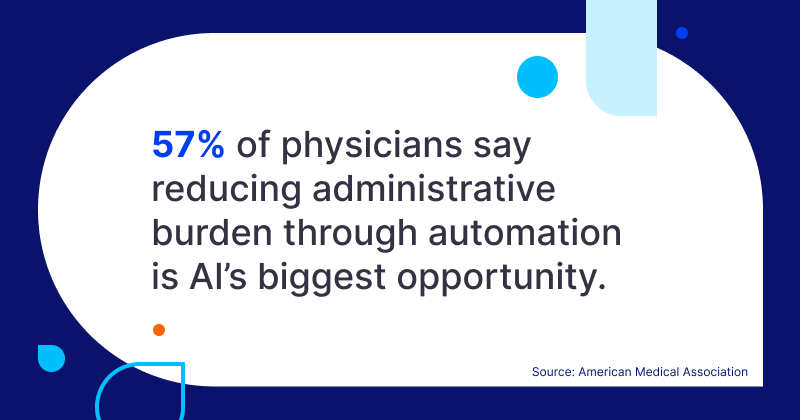
In a recent AMA survey, 57% of physicians identified addressing administrative burdens through automation as the biggest area of opportunity for AI.
There’s growing need for tools that can help manage administrative workload. AI technologies that automate routine documentation, assist with data entry, flag errors, and surface insights can shift the tide for independent practices, helping teams go from reactive to proactive.
Staff Turnover Disrupts Operations
Staff turnover is a persistent challenge for many independent practices. In recent years, the healthcare industry has faced both workforce shortages and high employee turnover. Research published in the journal Healthcare in 2023 estimates a global shortage of 5.9 million nurses and 4.3 million physicians, while a 2025 report by NSI Nursing Solutions shows hospital turnover at 18.3% in 2024.
Staffing changes have an immediate impact on operations in independent practices. Smaller teams rely on each staff member to keep daily workflows running smoothly. When someone leaves, their responsibilities are temporarily redistributed to other employees or even physicians themselves before a replacement is hired and trained.
During these transitions, administrative processes tend to become more inconsistent. Billing details may be handled differently from one staff member to another, documentation standards may vary, and coordination between front desk staff, clinical teams, and billing departments can fall apart if processes change too quickly.
Training new staff also requires time and resources. New hires must learn scheduling systems, documentation procedures, billing requirements, and compliance protocols. While they adjust to new workflows, practices often experience slower patient check-ins, scheduling delays, or temporary disruptions in billing processes.
These disruptions are expensive. The 2025 NSI Nursing Solutions report estimates the average cost of turnover for a bedside registered nurse (RN) at $61,110. For smaller practices operating with tighter budgets and fewer staff, even a single employee leaving can create significant financial and operational strain.
To reduce the impact of staffing changes, AI-enabled workflows can help maintain operational continuity. Automated tools that support scheduling coordination, documentation management, and billing verification keep processes consistent even as team members come and go.
Physician Burnout Impacts Care
One of the most widely discussed challenges in healthcare is physician burnout. The National Physician Burnout Survey released by the AMA found that nearly half (45.2%) of physicians experienced at least one symptom of burnout in 2023.
Long hours, higher documentation demands, and constant administrative coordination all add pressure to already full clinical schedules. It’s no wonder the survey also indicates that physicians are 82% more likely to experience burnout than those in other fields.
But burnout is difficult to address because it’s tied to everyday operational realities that cannot easily be removed from clinical work.
In independent practices, physicians often absorb the operational pressures caused by staffing gaps and documentation demands. As Tait Shahfelt, the Chief Wellness Officer at Stanford Medicine, puts it, “Many physicians still love what they do, but they just can’t keep doing it at this pace in the current practice environment, with its administrative burdens and regulatory burdens, and the proliferation of asynchronous messaging with patients through the electronic health record.”
The consequences of burnout are physician attrition, early retirement, and reduced clinical hours. BMC Public Health estimates that for every one-unit increase in overall burnout, the likelihood of a physician desiring early retirement increases by 11.9%. In this ongoing workforce shortage, physician burnout further intensifies staffing challenges, creating a cycle where fewer clinicians must handle growing patient demand.
As these pressures accumulate, they begin to affect patient care too. Physicians experiencing burnout may have shorter or more rushed patient interactions, less time for follow-up communication, and a greater risk of missing important clinical details. Research from Stanford Medicine links physician burnout with higher rates of medical errors and decreased patient satisfaction.
The fastest path to reducing burnout is not asking clinicians to become more resilient. It is removing preventable administrative friction from the care journey.. By reducing the amount of time clinicians spend on non-clinical tasks, AI tools allow physicians to focus more of their time on patient care and help practices maintain more sustainable workloads.
Patient Experience Is More Important Than Ever
Patient expectations for healthcare have changed as people have more choices in where and how they receive care, and digital tools have streamlined the patient journey. Patient experience is no longer a soft metric. It influences retention, referral patterns, reimbursement, and whether practices can sustain trust at scale.
At the same time, demand for care continues to grow. According to the Population Reference Bureau, the U.S. population aged 65 and older is expected to grow from 58 million in 2022 to 82 million by 2050. This aging population will increase the demand for healthcare services, stronger care management systems, and a larger clinical workforce. But it’s not just healthcare for older adults that’s putting pressure on the industry. In pediatric care, hospitals have been reporting shortages of specialty physicians for nearly a decade, while the prevalence of chronic disease among the pediatric population has risen by 30% over the past 20 years.
For independent practices, it’s hard to keep up. They have to ensure patients can access care in a timely and coordinated way. But limited staffing and operational constraints often don’t allow this. Delays in communication, long wait times, and scheduling bottlenecks make it more difficult to build strong patient–provider relationships and maintain patient satisfaction.
The shift toward value-based care models also emphasizes patient experience. In many payment programs, factors such as patient satisfaction, care coordination, and access to care all influence reimbursement. This means the quality of patient interactions can directly affect revenue.
In response, practices need tools that can help them meet these expectations more effectively. Scheduling optimization tools and AI-driven operational insights help practices respond more quickly to patient needs and provide a smoother overall care experience.
Profit Margins Remain Tight
Financial pressure is a big concern for many independent practices. Even as patient demand grows, practices are still struggling to maintain stable profit margins.
The rising cost of operating a medical practice is a main driver of tighter margins. Expenses related to staffing, higher-priced medical supplies, technology systems, and regulatory compliance all drive up costs. According to the Medical Group Management Association (MGMA), medical practice leaders reported an average year-to-date operating expense increase of approximately 11.1% in 2025.
But reimbursement rates have not kept pace, making it hard for practices to maintain predictable revenue. The American Hospital Association reported that Medicare reimbursed hospitals only 83 cents for every dollar spent on patient care in 2023.
Claim denials add another layer of financial pressure. Health Affairs’ research on Medicare Advantage claims found that 17% of initial claim submissions were denied, resulting in an estimated 7% net reduction in provider revenue even after appeals and adjustments.
Many denials happen due to documentation errors, coding issues, or missing information. Each denied claim requires additional staff time to review, correct, and resubmit, increasing administrative workload and delaying payments.
That’s why practices are adopting operational AI tools that improve documentation accuracy and billing coordination. Better coordination between clinical documentation, coding, and billing workflows helps reduce claim errors and ensures practices are reimbursed more consistently for the care they provide.
Why a Pragmatic Approach to AI is Key to Improving Healthcare
According to the American Medical Association, many physicians see potential in healthcare AI to help with efficiency and burnout, but are still cautious about clinical reliability, accuracy, and risk. In healthcare, AI must be reviewable, explainable, and well governed to ensure it truly supports operations without creating compliance or trust issues.
For independent practices, the value of AI is not novelty. It is operational leverage. The most effective systems do not ask practices to reinvent care delivery; they reduce friction inside the workflows that already determine access, margin, and staff sustainability. When implemented thoughtfully, AI supports the people who keep practices running every day. It reduces administrative strain for clinicians, helps staff coordinate more efficiently across care teams, and improves the overall care experience for patients.
But most of all, it gives practitioners and practice owners greater control over how their practices operate and how care is delivered. With fewer administrative frictions and better visibility into operational performance, clinicians gain more time, mental space, and insight to run their practices effectively.
Healthcare AI Doesn’t Replace Clinicians or Staff—It Supports
A pragmatic approach to AI adoption recognizes that technology should support clinicians and staff, not replace them. AI can assist with repetitive or time-consuming tasks, like drafting clinical notes or flagging potential coding issues, but clinicians still need to review, edit, and approve the final record.
The final decision must remain with healthcare professionals.
Frontiers in Digital Health identifies trust as one of the most significant factors influencing AI adoption in healthcare. Systems that are explainable and governed by clear review processes are far more likely to be accepted by clinicians and staff.
Practices also need to understand how these AI systems work in day-to-day operations. It’s important to ask practical questions: How are outputs generated? How are errors detected? Who reviews what the AI produces? Can results be overridden or edited? Is a human still in control?
Without that visibility, AI can create more uncertainty, making it harder for teams to trust the system or use it consistently in daily workflows.
Transparency is especially important when AI interacts with revenue workflows, where mistakes can carry financial consequences. Inaccurate documentation or coding suggestions can increase denial risk, delay reimbursements, and create additional administrative work for staff.
Clinicians and billing teams need AI that provides clear and reviewable outputs, allowing them to identify potential issues early and make corrections before claims are submitted.
When AI systems operate within clear oversight structures, they become practical tools that support everyday clinical and operational work. Rather than replacing clinicians or staff, AI helps them complete routine tasks more efficiently while keeping expertise, judgment, and accountability in human hands.
Healthcare AI Doesn’t Disrupt Care—It Improves It
The most effective AI tools are the least visible. That means they should operate in the background, supporting everyday workflows without interrupting how clinicians and staff already work. Research published in the European Journal of Medical Research highlights practical AI adoption in specific operational areas such as clinical documentation and workflow optimization. These use cases directly affect how clinicians spend their time during patient visits.
For example, documentation support tools, such as AI ambient clinical documentation systems, capture conversations during patient visits and generate notes for clinicians to review. They don’t interfere with the patient-clinician relationship because they quietly work in the background, taking notes and suggesting next steps. As a result, they relieve paperwork burden and create more time and mental space for care.
The benefits go beyond time savings. When documentation is more complete and consistent, clinical records more accurately reflect the care that was delivered. This reduces the need for follow-up clarification between clinicians and administrative staff.
Integration also plays a critical role in delivering effective care. Clinical workflows rely on multiple systems working together, from scheduling and documentation to billing and care coordination. Disconnected systems can cause information gaps and delays that disrupt patient care.
Research published in the journal Safety Science shows that poorly integrated tools slow adoption because they require additional training, workflow redesign, and ongoing coordination. Even if a tool performs well technically, it may still fail in practice if it doesn’t fit into daily routines.
In healthcare, the most valuable AI is not disruptive by design. It is infrastructure-level technology that makes existing workflows more reliable, visible, and scalable.
Healthcare AI Gives Control Back to Medical Practices
One of the most valuable outcomes of practical AI adoption is that it gives medical practices greater control over their day-to-day operations. Instead of reacting to operational issues as they appear, practices can identify issues earlier and address them before they escalate.
Operational AI can surface patterns that are difficult to spot manually. It can highlight recurring scheduling bottlenecks, identify times when patient demand regularly exceeds capacity, or show where documentation delays are slowing down billing workflows.
For example, data might reveal that on certain days of the week, appointment demand consistently exceeds available capacity. With that insight, practice leaders can adjust schedules, redistribute appointment slots, or allocate additional staff before those bottlenecks affect patient experience.
This visibility also frees up time and mental space for clinicians. Clinicians spend less energy troubleshooting daily frictions as workflows become more predictable. That alone can help ease some of the pressures that contribute to clinician burnout. The cognitive relief can make a real difference in how teams manage busy schedules and coordinate patient care.
By turning operational data into actionable insight, pragmatic AI gives medical practices the clarity they need to run their organizations with greater confidence and control.
How AI Is Being Applied in Medical Practices
AI adoption in healthcare rarely happens all at once. For many practices, the first goal is to apply AI to operational workflows that shape clinical efficiency, care coordination, billing optimization, and operational oversight.
Streamlining Administrative Workflows and Scheduling
Administrative coordination might be the most complex part of running a medical practice. Staff have to balance provider capacity, coordinate intake, and keep the day running on time.
Scheduling decisions influence nearly every part of practice operations, from patient access and clinician workload to revenue cycle performance. When appointment slots go unused, or patient flow becomes uneven, schedules fall behind, and staff have to spend more time making adjustments.
Many practices are now using AI tools to anticipate scheduling disruptions before they happen and maintain more consistent daily operations.
AI-powered scheduling optimization
AI systems can analyze appointment demand, visit types, provider availability, and historical throughput to identify where capacity is mismatched.
Practice managers get a clearer view of when certain providers are overbooked, when specific appointment types run long, or when bottlenecks are forming at certain points in the day. Instead of reacting to delays, cancellations, or last-minute scheduling gaps, teams can rebalance schedules earlier and allocate provider time more effectively.
For example, if morning visits consistently create scheduling backlogs, practices can adjust appointment lengths or provider coverage to prevent delays from cascading through the rest of the day.
Predictive patient outreach
AI is also being used to make outreach more targeted and less labor intensive. In many independent practices, front-desk staff spend significant time contacting patients before appointments to confirm visits, collect intake information, or verify insurance details.
AI-supported outreach tools automate many of these pre-visit communications. Rather than relying on blanket reminders, practices use AI to identify which patients need additional contact before the visit. These systems then prompt patients to complete intake forms and confirm appointment details before arrival.
Stanford’s Human-Centered Artificial Intelligence research center notes that AI-powered intake and scheduling tools are increasingly becoming part of the modern patient visit experience, helping practices collect patient information and coordinate care before patients arrive.
Automating the outreach process reduces front-desk workload. Staff spend less time making reminder phone calls, sending follow-up emails, and tracking down patients who still need to complete pre-visit steps.
Operational dashboards for appointment flow
Operational dashboards give practices real-time visibility into how appointments move throughout the day. These tools track metrics such as appointment utilization, patient wait times, provider availability, and visit throughput.
In one primary care implementation described in JMIR Formative Research, an AI-enabled dashboard integrated with the clinic’s electronic health record allowed administrators to monitor wait times, appointment utilization, and staffing levels.
Having operational visibility helps practice leaders better understand how scheduling patterns and patient flow affect clinic performance and optimize operations accordingly.
Enhancing Clinical Documentation and Charting Efficiency
Clinical documentation accounts for a large share of a clinician’s workload. Charting during visits and completing notes after clinic hours can reduce the time providers spend focused on patient care.
Healthcare AI tools are being introduced to ease this burden by assisting with documentation tasks, such as capturing conversations, structuring clinical notes, and organizing key information.
These systems aim to reduce charting time while ensuring clinicians retain final authority over the medical record.
Ambient AI clinical documentation
Ambient AI clinical documentation tools, or AI scribes, are implemented to reduce repetitive data entry and after-hours charting.
These systems listen to the conversation between the clinician and patient during a visit and automatically generate a draft clinical note. They can also organize key information from the encounter, such as symptoms, medical history, medications, and assessment details, into structured documentation formats.
Clinicians can then review, edit, and confirm the note before finalizing the documentation, ensuring that professional judgment is not replaced by automation.
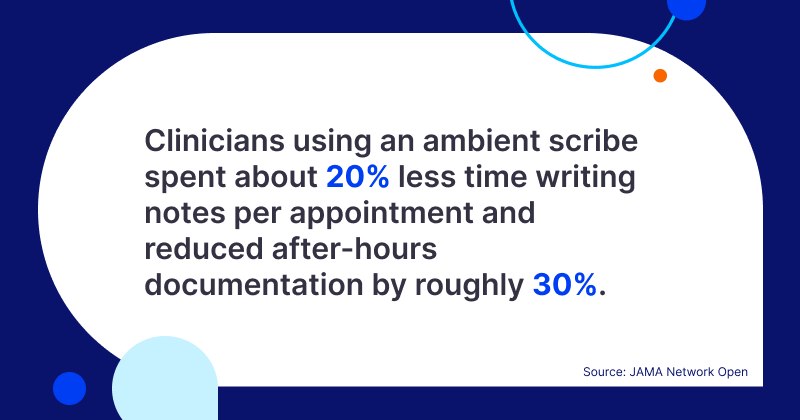
A study published in JAMA Network Open found that clinicians using an ambient scribe spent about 20% less time writing notes per appointment and reduced after-hours documentation by roughly 30%.
Stanford Medicine has also piloted ambient AI listening technology that generates draft notes from patient visits, allowing physicians to spend more time focused on patients rather than typing during the visit.
AI-assisted coding tools
Many EHR and revenue cycle platforms already use AI to analyze clinical documentation and suggest billing codes. AI coding tools review clinical notes and patient data to recommend appropriate ICD-10 and CPT codes based on the care provided. They ensure that documentation supports accurate billing.
Research published in The Journal of the American College of Radiology reported that one hospital using AI-supported coding tools reduced coding errors by 30% and improved first-pass claim acceptance rates by 25%.
By flagging missing details or potential coding discrepancies, these tools reduce the likelihood of incomplete claims that could lead to denials or reimbursement delays or administrative rework.
Improving the Patient Experience
The patient experience is shaped by how smoothly a medical practice runs behind the scenes. Operational AI helps practices deliver a more consistent patient experience across scheduling, intake, and coordination.
When information flows more efficiently between systems and care teams, practices minimize the operational inefficiencies that affect patients directly.
Reducing no-shows and wait times
Patient no-shows are a big operational challenge in healthcare because they waste clinician time, disrupt planned schedules, and delay care for other patients.
AI-powered predictive models can analyze factors such as appointment lead time, patient history, and past attendance behavior to estimate the likelihood of a missed visit. Research cited in Medical Economics shows that these models can accurately identify patients with a higher probability of no-shows.
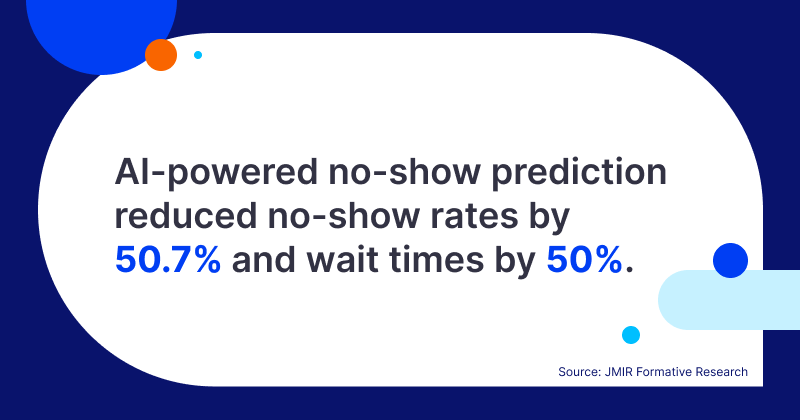
This insight allows practices to adjust their booking strategies in advance. Staff may send targeted reminders, confirm appointments earlier, offer telehealth alternatives, or strategically overbook certain time slots when cancellation risk is high. The operational impact can be significant. JMIR Formative Research reported that implementation of an AI-powered no-show prediction model led to a 50.7% reduction in no-show rates and a 50% reduction in wait times.
These improvements directly affect the patient experience. Patients benefit from shorter wait times, fewer scheduling changes, and more reliable follow-up communication.
Improving care continuity after the visit
Communication after a patient visit is an important part of the care experience. Patients often need follow-up instructions, medication reminders, lab results, or guidance on scheduling their next appointment.
AI tools are applied to support these post-visit communications. Automated messaging systems can send follow-up instructions, remind patients to schedule recommended visits, or prompt them to complete additional care steps such as lab testing or prescription refills. They can also help practices monitor whether patients complete recommended care plans.
Supporting Care Teams Across Roles
Medical practices rely on physicians, front-desk staff, care coordinators, and billing teams working together throughout the day, and administrative AI tools to help support these roles simultaneously.
When AI tools operate within the same EHR and practice management systems, improvement in one area affects the entire team.
Shared operational visibility across teams
AI-powered command centers help healthcare organizations improve coordination across clinical and administrative teams. This centralized visibility allows staff to quickly understand patient demand, staffing levels, and care activity across departments.
According to Thom Bales, the health services sector leader at PwC, “AI has great potential in emergency departments. Things can happen in a matter of minutes in an emergency, and the faster that data can be assembled and brought together, the faster you get a whole picture of the patient.”
Some hospitals are already applying this approach to improve coordination. For example, Bradford Teaching Hospitals NHS Foundation Trust implemented Europe’s first AI-powered hospital command center to help teams monitor hospital operations. The platform aggregates real-time data from multiple hospital systems and displays it on a “wall of analytics” monitored by clinical and operational staff.
Shared operational data means care teams can coordinate resources more efficiently and respond faster to changing care demands.
Aligning documentation and billing workflows
Clinical documentation and billing are closely connected, but in many practices, these workflows happen at different stages of the care process.
A survey from the Healthcare Financial Management Association found that more than 90% of respondents said their organizations want to prioritize improving documentation at or before the point of care, and 8 in 10 believe a proactive approach would improve revenue as well as patient safety and care quality.
An integrated EHR bridges the gap.
Key patient details, including diagnoses, procedures, medications, and treatment plans, are documented and organized earlier in the workflow and directly accessible to billing teams. Billing can prepare claims with fewer errors or follow-up questions for clinicians.
Better alignment between documentation and billing workflows helps practices submit claims faster, reduce claims denials, and maintain more consistent revenue cycle performance.
Strengthening Operational Resilience
In healthcare environments, variability is inevitable. Some days run over schedule, cases vary in complexity, certain providers document longer than others, cancellation rates fluctuate, referral turnaround times differ, and staffing availability changes.
And if variability isn’t managed, daily workloads become harder to balance, schedules become less predictable, and revenue cycle performance can suffer. Operational AI makes variability visible and manageable by connecting all parts of the workflow.
Connecting clinical activity with revenue cycle performance
AI-powered analytics help practices understand how clinical activity affects financial performance. By analyzing scheduling, visit volume, documentation timelines, and claim submission patterns, these systems reveal how daily operations affect financial performance.
For example, if documentation delays regularly push claim submission several days after a visit, practices can identify the workflow bottleneck and adjust staffing or documentation processes. Analytics can also reveal patterns in appointment types, provider productivity, or payer mix that affect reimbursement trends.
Understanding how operations connect to revenue helps leaders make more informed and proactive decisions about scheduling, staffing, and capacity planning to improve financial stability.
Managing stable operations during changes
High-volume periods or seasonal spikes can create unpredictable demand across scheduling, staffing, and patient care workflows. Healthcare systems are using AI-driven demand forecasting to support workforce planning.
In the UK, NHS hospitals are implementing AI-powered demand forecasting tools to predict attendance and emergency (A&E) pressure up to three weeks in advance. The AI then alerts staff to potential upcoming surges. These forecasts analyze historical trends along with variables such as seasonality, weather patterns, and public holidays. Demand projections are also broken down by age group, allowing hospitals to plan for specific resource needs, such as pediatric beds and specialized staff coverage.
Staffing transitions can create similar operational challenges. When roles change or experienced staff leave, practices often rely on institutional knowledge or informal workarounds to keep operations moving. AI-supported workflows help standardize these processes so documentation, scheduling, and billing follow consistent steps regardless of who performs the task.
What to Look for When Evaluating AI Solutions in Healthcare
AI tools can deliver real operational benefits, but successful adoption depends on choosing solutions that produce measurable outcomes and maintain clear governance.
Measurable Operational Improvements
An effective AI tool improves the operational metrics you already track. The best way to evaluate that impact is to measure against a clear baseline before rollout.
Focus on measurable outcomes such as:
- Reduced documentation time: Does the tool decrease time spent in the EHR? Does it reduce the number of unfinished notes at the end of the day?
- Decreased after-hours charting: Are clinicians spending fewer hours completing documentation outside clinic time?
- Improved billing throughput: Are claims submitted faster? Is the time between visit completion and claim submission shortened?
- Reduced administrative rework: Are fewer claims returned for correction? Are staff spending less time reconciling documentation and billing discrepancies?
- Increased scheduling stability: Are no-show rates declining? Is appointment distribution more balanced across providers?
For example, if clinicians at your practice spend two hours per day completing documentation after clinic hours, what would real improvement mean for your practice? It may mean reducing that time by 15 to 20%, so fewer charts spill into evenings or weekends.
Clear benchmarks will help you determine whether the tool is actually offering practical value.
Clear Governance and Vendor Reliability
As healthcare AI tools start to become part of everyday workflows, practices need confidence that systems will remain reliable, transparent, and well governed over time.
Strong governance helps ensure that AI outputs are accurate and accountable. Practices need to understand how AI models are updated, how outputs are monitored for errors, and how clinicians can review or override AI-generated recommendations. Clear oversight structures help prevent mistakes from affecting patient records, billing processes, or clinical documentation.
Vendor reliability plays an important role in maintaining governance. Trusted vendors provide transparent communication about system capabilities, clear onboarding and training processes, ongoing technical support, and predictable product updates.
How DrChrono supports practical AI adoption in medical practices
DrChrono by EverHealth streamlines the day-to-day operations of medical practices through an all-in-one EHR and practice management platform. Documentation, scheduling, and billing all operate within the same system, allowing teams to manage core workflows more efficiently.
Information recorded during a patient visit can carry through the rest of the workflow. Clinical notes support coding decisions, billing teams can access documentation without extra reconciliation, and administrative staff have clearer visibility into claim status and revenue cycle activity.
DrChrono also helps address one of the most persistent headaches in healthcare: documentation burden. Customizable clinical notes, specialty-specific templates, and charting shortcuts help clinicians document visits more efficiently and accurately. An ambient AI tool, EverHealth Scribe, works in the background during visits, taking structured clinical notes integrated directly into the EHR for clinician oversight and approval.
The platform also uses AI-powered forecasting to identify which appointments might no-show. This allows staff can take proactive steps to manage appointment capacity and reclaim lost revenue from no-shows.
Because documentation and billing are connected within the same system, billing teams can work directly from the clinical record created during the visit. Clinicians and billing staff avoid unnecessary back-and-forth clarifications, and claims move through the submission process with fewer delays.
DrChrono’s integrated AI-powered system supports smoother operations, reduces administrative friction, and expands access to care for more patients.
The Future of Healthcare Belongs to Practices that Prioritize Autonomy, Predictability, and Control
The most effective AI tools in healthcare are often the least noticeable. Instead of introducing entirely new workflows, the best systems integrate quietly into the processes teams already use. They provide support, surface insights, and make workflows more efficient, while keeping control and decision-making power with clinicians, practice owners, and staff. The next generation of successful medical practices will not be defined by how aggressively they adopt AI, but by how effectively they use it to preserve autonomy, stabilize operations, and protect clinical time.
In healthcare environments where accuracy, accountability, and compliance matter, automation needs to be balanced with professional oversight. While AI assists with routine tasks, the final review and approval should always rest with the people who make up the practice.
DrChrono is built around the idea that technology should adapt to the provider, not the other way around. By combining EHR, billing, telehealth, and practice management in one AI-powered system, DrChrono helps practices adopt new technology without disrupting existing workflows.
Schedule a demo to see how DrChrono makes AI adoption work for your practice.