

Artificial intelligence has arrived in clinical practice, and physicians are optimistic about its potential. According to the American Medical Association’s (AMA) 2025 Augmented Intelligence Report, nearly 70% of physicians believe AI can be an advantage in patient care.
Across healthcare organizations, clinicians are adopting AI to support documentation, optimize workflows, improve patient communication, and automate routine administrative tasks. Early results show measurable improvements in efficiency and workflow management.
These gains address one of healthcare’s most persistent challenges: administrative overload.
Documentation requirements, billing processes, and bureaucratic tasks remain major drivers of physician burnout. By reducing the administrative and cognitive burden associated with these activities, AI tools are beginning to relieve pressure on clinicians and staff.
But this speed introduces a new challenge. As AI becomes embedded in documentation, care coordination, and decision support, it begins to influence processes with regulatory, financial, and clinical consequences.
Maintaining trust in AI requires preserving a fundamental boundary: responsibility for clinical decisions must remain with licensed clinicians. That means building clear guardrails and systems themselves–making AI outputs transparent, reviewable, and traceable within everyday workflows.
Done well, this allows healthcare organizations to scale AI safely while keeping clinicians firmly in control of patient care.
This paper explores how healthcare organizations can operationalize governance to support AI ethics in healthcare and ensure ethical, trustworthy, and responsibly implemented clinical AI. The challenge is no longer whether healthcare will use AI—it already does. It’s whether the systems supporting it make authority, oversight, and accountability structurally visible.
The AI Transformation in Clinical Practice
AI adoption in clinical practice is accelerating. The AMA’s 2025 Augmented Intelligence Report found physician use of AI nearly doubled between 2023 and 2024. Clinicians already use AI to support documentation, coordinate workflows, generate patient communications, and automate routine administrative tasks.
Physicians’ use of AI while practicing medicine nearly doubled from 2023 to 2024. Also, over a third of physicians reported feeling more excited than concerned about AI in 2024 than they did the year before.
Source: AMA Augmented Intelligence Research, 2025
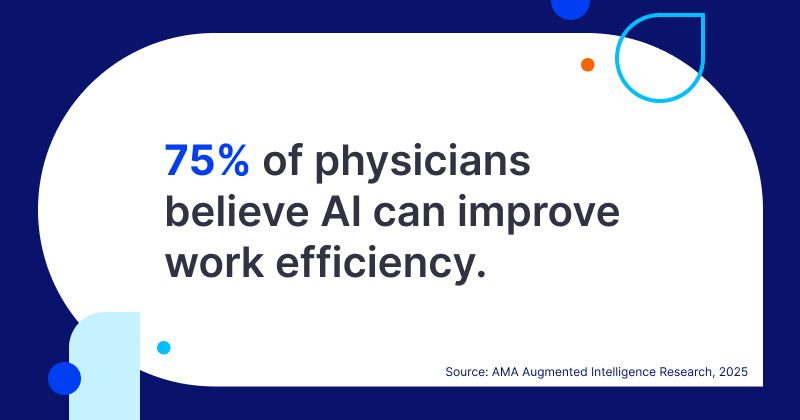
The early results are encouraging. According to the same study, 75% of physicians say AI can improve work efficiency, with many pointing to administrative workload as the area where it could have the greatest impact.
That optimism matters. Administrative work has become one of the biggest strains in modern clinical practice, consuming time and energy that should go toward patient care. AI is emerging as one of the most promising ways to reduce that burden and rebalance clinical work.
The Administrative Relief Is Real
Writing notes, updating charts, and completing visit documentation consumes hours of a physician’s day, often extending work well beyond clinic hours. In fact, physicians consistently identify bureaucratic tasks as a major driver of burnout. According to Medscape’s 2024 Physician Burnout Report, 62% of physicians attribute burnout to excessive administrative requirements.
AI-assisted documentation directly target this challenge.
Ambient scribing systems capture conversations during patient visits and automatically generate structured clinical notes. Instead of typing notes post appointment, clinicians review and finalize AI-generated drafts.
Early results show considerable time savings. Research by Olson et al. found that ambient scribing reduced notetaking by about 20% per appointment and cut after-hours documentation work by nearly 30%.
The impact extends beyond efficiency. Within 30 days of adopting ambient AI tools, reported physician burnout fell from 51.9% to 38.8%. By easing the effort required to produce documentation, AI helps physicians spend less time managing records and more time focusing on patient care.
Healthcare AI’s Influence is Expanding
While physician documentation often receives the most attention, much of healthcare’s operational workload happens outside the exam room.
Practice staff manage appointment scheduling, patient communication, intake forms, insurance verification, and a wide range of administrative coordination tasks. These responsibilities often create bottlenecks that slow patient flow and increase workload across the entire care team.
AI systems now help automate many of these operational processes.
Practices use AI tools to coordinate scheduling, prioritize workflow queues, and generate patient communications. These improvements reshape how care teams work daily. By automating and simplifying routine tasks, AI allows staff to spend more time assisting patients, coordinating care, and supporting clinicians during visits.
AI isn’t just helping physicians with their admin workload. It’s improving the entire operational structure of medical practices.
AI Is Strengthening Revenue Integrity and Operational Efficiency
AI also plays an expanding role in financial and operational management.
Organizations increasingly use AI to review documentation, support coding decisions, and monitor claims before they reach payers. Instead of catching errors after a denial, these systems can flag potential coding gaps or inconsistencies earlier in the process.
For many practices, that shift is already showing real results. According to Experian Health’s 2025 State of Claims Report, 69% of healthcare organizations using AI report fewer claim denials or stronger resubmission success rates.
Research published in the International Journal of Science and Research highlights how generative AI and data analytics tools automate routine financial workflows and help identify patterns that lead to revenue leakage across billing processes.
These capabilities help healthcare organizations manage revenue cycles more reliably while reducing the operational friction that often surrounds billing and claims.
Taken together, these gains show that the AI transformation in healthcare is both real and promising. As AI begins to influence documentation, workflows, and decision support, the next challenge is ensuring these systems operate within clear boundaries of trust, oversight, and clinician control.
The Trust and Ethics Gap: AI Has Influence, But It Shouldn’t Have Authority
AI can support decision-making. It cannot assume responsibility for it. This distinction sits at the center of ethical clinical AI adoption.
Healthcare AI Influences Clinical Decisions—But Only Clinicians Carry Accountability
Healthcare AI systems already influence several processes tied to clinical and operational outcomes. They generate documentation, assist with coding logic, summarize care encounters, and highlight potential risks.
These outputs feed directly into regulated healthcare activities.
- Documentation affects billing and reimbursement
- Care summaries shape handoffs between providers
- Coding suggestions influence revenue cycle integrity
Here, clinical decision support ethics become critical, because systems that influence care decisions must operate within clear professional and regulatory boundaries. Even as AI contributes to healthcare activities, the ultimate responsibility still rests with the physician.
AI systems are not licensed medical professionals. They don’t carry legal or clinical accountability for patient outcomes. As Margaret Lozovatsky, MD of the AMA, puts it: “Clinical decision-making must still lie with clinicians. AI simply enhances their ability to make those decisions.”
That boundary matters: AI outputs can sound confident and authoritative. Without clear review processes, physicians may come to assume they’re correct and rely on them as final answers rather than informed suggestions.
Recent research shows that even advanced AI systems can produce confident but incorrect reasoning. A 2025 study published in Nature Digital Medicine found that large AI models sometimes produce incorrect responses to medical ethics scenarios when researchers present the same problem using different wording or context. In some cases, the models ignored important contextual details but still generated confident recommendations.
AI must remain a tool that supports clinical judgment, not a substitute for it.
It is critical to have a governance structure in place to oversee the development and rollout of AI from conception to implementation, with governance tools providing guidance on various stages of the process.
Source: Hassan et al., 2024, JMIR Human Factors
That requires clear governance around how health professionals introduce and use these systems in clinical environments.
AI Can Introduce Bias into Clinical Decisions
AI systems learn patterns from historical healthcare data–data that reflects how healthcare has been delivered in the past, including long-standing disparities in diagnosis, treatment decisions, and access to care across different populations—disparities that researchers have repeatedly shown can lead to worse outcomes for some groups. When models train on those records, they can unintentionally learn and repeat those same patterns.
As bioethicist I. Glenn Cohen explains, some datasets contain far fewer records from certain patient groups. For example, minority populations are often underrepresented in clinical datasets. When AI models train mostly on data from one population, they learn patterns that reflect that group more strongly than others. As a result, predictions and recommendations may be less accurate for patients who were underrepresented in the training data.
Even when datasets do include diverse patients, algorithms often optimize for overall accuracy across the entire dataset. That means models may perform very well for large population groups while performing less accurately for smaller groups. Because performance metrics average these outcomes together, differences between patient groups can get lost inside that average.
This creates real consequences. When biased outputs influence documentation, diagnostic suggestions, or treatment recommendations, they risk reinforcing structural inequalities rather than correcting them.
Even small distortions matter. Risk scores, prompts, and treatment suggestions influence how clinicians interpret patient information, especially when reviewing large volumes of data quickly. If those signals are biased, they can subtly steer clinical judgment in the wrong direction.
Clinical AI Raises New Data Privacy and Security Risks
Clinical AI systems rely on large volumes of sensitive patient data. Electronic health records, clinical notes, imaging data, and billing information all feed the models that generate AI outputs. As these tools become more common in healthcare environments, protecting that data becomes more complicated.
Some healthcare AI systems process information through cloud infrastructure or external processing environments. When patient data moves between multiple systems, it’s harder to see where that information is stored and who can access it. This makes it more difficult for healthcare organizations to make sure patient data is handled securely and remains compliant with privacy regulations.
Additionally, AI tools create more complex data pipelines. Information may pass between EHR systems, analytics platforms, and external services before producing a final output. Each additional step introduces another place where data could be misconfigured, exposed, or accessed incorrectly.
There’s also the issue of “black box” AI models. Some AI tools don’t allow clinicians and administrators to easily see how they generated a recommendation or how patient data contributed to the result. When the process behind a decision isn’t visible, it’s tough to validate outputs, investigate errors, or explain decisions during audits.
Without clear rules around how AI systems are used, adoption can expand faster than healthcare organizations’ ability to track where patient data moves and how systems handle it.
Considering all these risks, one thing becomes clear. As AI begins to influence clinical work, healthcare organizations must govern that influence with clear oversight, transparency, and accountability.
An Ethical Governance Framework for Responsible Clinical AI
Responsible clinical AI depends on practical rules about how AI systems interact with care decisions, patient data, and the medical record.
The following principles support responsible AI implementation by helping organizations adopt AI safely while preserving clinician authority and patient trust.
The Foundation: Authority Alignment
AI can assist with many parts of clinical work. But it can’t hold licensure, professional accountability, or legal responsibility for patient outcomes. Only a credentialed clinician can assume responsibility for clinical decisions.
Maintaining that boundary is essential for clinician adoption. As the AMA’s 2025 Augmented Intelligence Report found, 82% of physicians say they are more likely to adopt AI if they are not held liable for AI model errors. This finding highlights how strongly liability concerns influence clinicians’ trust in AI systems.
82% of physicians say that they’re more likely to adopt AI if they’re not held liable for errors of AI models.
Source: AMA Augmented Intelligence Research, 2025
Physicians already carry responsibility for clinical decisions. But many worry that if an AI system generates incorrect information, they could still be exposed to legal or regulatory consequences.
Clear authority boundaries address that fear. When AI outputs remain suggestions rather than decisions, physicians can review them confidently while retaining full control over the final clinical judgment.
In practice, this means AI outputs should always require human confirmation before they influence regulated actions. Draft notes should be reviewed before they enter the medical record. Coding suggestions should require clinician approval. Diagnoses, orders, and claims submissions must remain explicitly human decisions.
AI also needs a clearly defined role. These systems work best when they focus on specific tasks such as drafting documentation or summarizing workflows. If AI tools start expanding across multiple functions, it becomes harder for clinicians to understand what the system is doing and where responsibility sits.
When that boundary stays clear, AI strengthens clinical work rather than replacing it. The goal isn’t to automate medicine. It’s to reduce administrative friction while preserving the human judgment and compassion that sit at the center of medicine.
As bioethicist Bonnie Kaplan explains: “These technologies should be employed to support clinicians and patients in ways that keep human values and compassionate, quality care at the forefront.”
The Enabler: Workflow Transparency and Healthcare AI Transparency
For clinicians to trust AI systems, they don’t need access to proprietary algorithms. They need AI transparency. Clinicians need to see how a suggestion relates to the patient information in front of them.
Physicians consistently highlight this point. The AMA’s 2025 Augmented Intelligence Report found that 47% of physicians rank increased oversight as the most important regulatory step for improving trust in healthcare AI. The same report shows that 58% are more likely to adopt AI when they can understand the inputs and outputs behind a system’s recommendations.
In practice, clinicians build trust based on how AI presents its suggestions within the workflow.
- Recommendations should appear within the patient chart rather than in separate dashboards.
- Relevant patient data should remain visible alongside AI suggestions.
- Clinicians should be able to review those suggestions before they influence documentation or care decisions.
Regulation increasingly reflects this expectation.
The U.S. Department of Health and Human Services’ HTI-1 Final Rule introduces new transparency requirements for decision support interventions, requiring developers to disclose the sources, data inputs, and logic behind algorithmic recommendations used in certified health IT systems.
Research frameworks reinforce the same principle.
The FUTURE-AI guidelines published in BMJ identify explainability, robustness, and traceability as core requirements for trustworthy clinical AI.
Ultimately, if healthcare professionals are going to trust AI outputs, those outputs need to appear clearly within the clinical workflow. That way, clinicians can review them quickly, understand what the system is suggesting, and apply their professional judgment.
The Proof: Embedded Accountability
Understanding what AI suggests is only part of the picture. Healthcare organizations must also be able to prove how those suggestions were used.
Accountability, therefore, needs to remain visible inside the medical record. Clinicians should be able to see what content AI generated, what edits were made, and who approved the final version.
This kind of traceability is now a regulatory requirement.
HIPAA’s Security Rule requires systems to log all activity involving electronic protected health information (ePHI). CMS rules also require medical records to clearly show who wrote and authenticated them for reimbursement.
Without this level of traceability, organizations can’t verify documentation integrity during audits, billing reviews, or regulatory investigations.
Research frameworks reinforce the same concept.
The FUTURE-AI and TRUST-AI initiatives both identify traceability and transparency as core components of responsible healthcare AI.
This requires every AI-assisted action to leave a visible record. The system should clearly mark AI-generated text. It should log edits and approvals. Every interaction should create a traceable audit trail.
These mechanisms turn oversight from a policy into something organizations can actually verify.
And when attribution stays clear and traceable, both clinicians and patients are protected. Clinicians keep control over decisions, organizations meet regulatory requirements, and healthcare systems can adopt AI without losing accountability.
How to Implement AI in Healthcare Safely
Healthcare organizations don’t need to slow AI adoption. They need systems that keep AI influence clear, reviewable, and controlled.
Safe AI implementation depends less on policy and more on how technology integrates into clinical workflows. When oversight is built into the systems clinicians already use, organizations can introduce AI tools without creating new risks.
Infrastructure with Governance Built in
Governance only works when it lives inside the workflow.
If AI drafts notes, suggests codes, or helps coordinate care, clinicians must review those outputs inside the same system. Oversight that depends on manual workarounds or separate tools quickly creates gaps. Staff switch between platforms, responsibility becomes unclear, and review processes break down.
Embedding guardrails directly into clinical systems solves this problem.
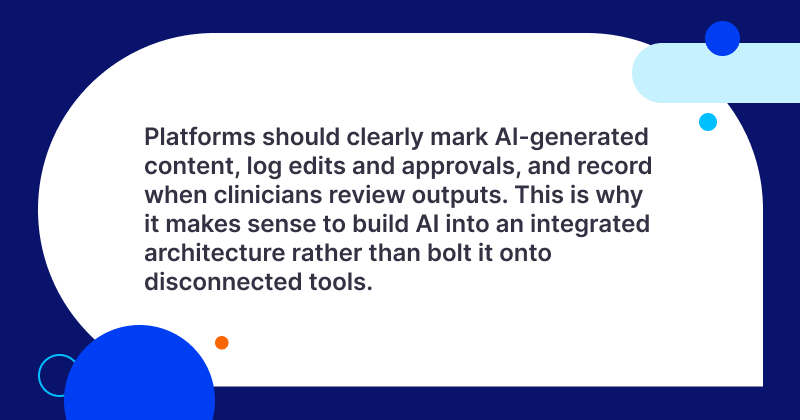
When documentation, billing, and scheduling operate within the same system, AI outputs remain tied to the clinical and operational workflows they affect. That makes review easier, keeps attribution clear, and reduces the risk of parallel systems creating confusion about what the AI generated, who approved it, and how it influenced the record. When that integrated system also provides open APIs, organizations can introduce new AI capabilities without adding disconnected tools that fragment oversight.
Make Governance Part of Core Clinical Architecture for Ethical AI Use
Clinicians already use AI to reduce documentation burden and streamline workflows, showing real promise in easing administrative pressure and returning time to patient care.
As healthcare AI begins to shape documentation, coding, and care coordination, its influence grows. That creates a new responsibility. Healthcare organizations must make sure AI supports clinical work without blurring authority, accountability, or oversight.
Policies alone can’t solve that challenge. Governance has to live inside the systems where clinical and operational decisions happen.
Integrated technological infrastructure is crucial for this reason: it preserves human authority, supports transparent review, and keeps attribution clear. Together, these capabilities make responsible AI possible, creating the foundation for trustworthy medical AI.
Systems that unify documentation, billing, and scheduling keep decisions traceable and reduce confusion about how AI-assisted outputs enter the record.
In Practice: How DrChrono Implements Ethical AI in Healthcare
At DrChrono by EverHealth we’ve built our AI-powered platform around these principles—embedding oversight into the workflow, preserving clinician authority at every decision point, and maintaining clear accountability through integrated audit trails.
Authority Alignment in Action with EverHealth Scribe:
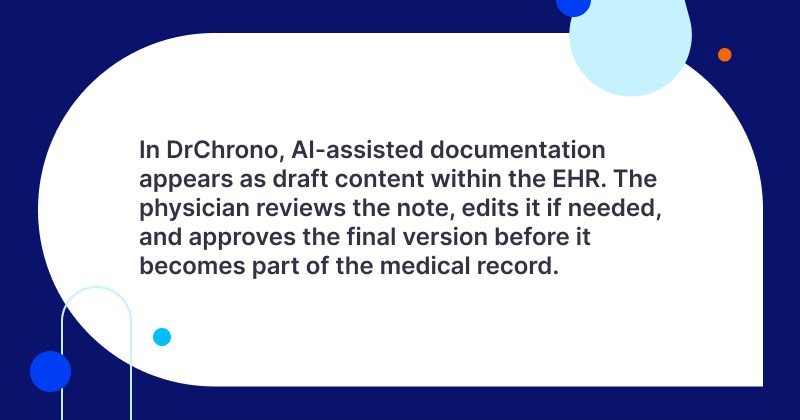
AI-assisted documentation appears as draft content within the EHR. The physician reviews the note, edits it if needed, and approves the final version before it becomes part of the medical record. The system requires explicit confirmation.
Workflow Transparency in Action:
Recommendations appear within the patient chart alongside the clinical data that informed them. Physicians see AI suggestions in context, not in isolation, allowing them to apply professional judgment while the patient’s full record remains visible.
Embedded Accountability in Action:
Every AI-generated note is clearly marked. Edit logs show what changed and who approved it. Audit trails track when AI assistance was used and when the clinician finalized the documentation, creating the traceable record required for compliance and quality assurance.
Organizations adopting AI need infrastructure that makes governance structural, not aspirational. By embedding these principles directly into clinical workflows, integrated platforms allow healthcare organizations to scale AI adoption safely while keeping clinicians firmly in control of patient care.