

AI scribes proved that clinical documentation could happen effortlessly in the background. But what happens to that documentation once the visit ends? Billing-aware coding intelligence is the next layer, allowing practices to connect what providers capture to how the practice gets paid. With this AI-driven framework, clinical and financial work operate as one continuous system to solve unpredictable revenue patterns and operational friction.
In this guide, we look at the evolution of AI documentation in healthcare, what the gap between documentation and medical billing costs, and how AI tools can close the gap, leading to fewer denials, reduced compliance risk, and more predictable revenue.
The Evolution of AI Documentation in Healthcare
Clinical documentation has undergone a steady transformation over the past decade. Practices first moved from paper charts and dictation to structured EHR templates, which improved data capture but introduced click-heavy, time-consuming workflows.
The next wave brought speech recognition and traditional dictation tools, which sped up note creation but still require providers to actively narrate and edit every encounter.
The most significant leap came with ambient AI scribes. Instead of clinicians needing to dictate, these tools listen passively to the natural provider-patient conversation. They then generate structured clinical notes in real time. Providers stay present with patients instead of typing, and documentation happens in the background. The clinician stays in control as they still review and edit generated notes, but overall time spent is dramatically reduced. Ambient AI proved that providers could produce high-quality notes with minimal disruption to the visit.
But documentation was only the first half of the equation. Capturing the encounter accurately is valuable, yet that note still has to translate into the codes that determine whether (and how) a practice gets paid. This next step is where billing-aware AI documentation comes into play.
The Gap Between What’s Documented and What Gets Coded Accurately
Even with high-quality clinical documentation from ambient AI scribes, there’s still a gap between documented clinical content and accurate code selection. Providers who generate complete, well-structured notes still face the task of translating clinical language into precise CPT and HCPCS codes that satisfy payer requirements and maximize appropriate reimbursement.
This translation step is where coding inconsistencies, underbilling, and compliance risks concentrate. Different providers code identical clinical scenarios differently; the same provider may code inconsistently across encounters; and manual code lookup is time-consuming and prone to selection errors under time pressure.
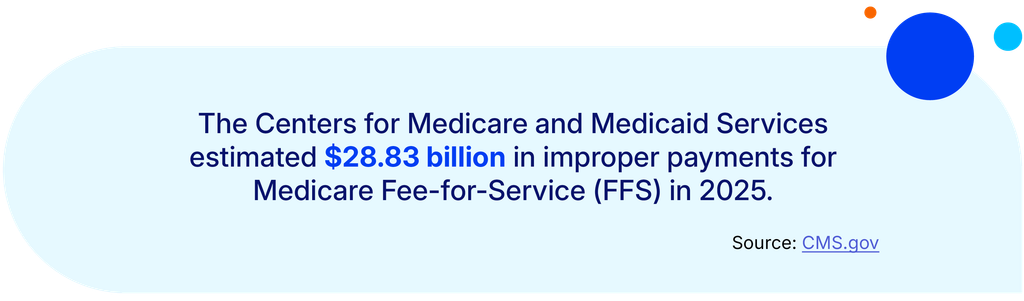
Errors in medical coding represent a high cost for practices. The Centers for Medicare & Medicaid Services (CMS) reported a Medicare Fee-for-Service improper payment rate of 6.55% for 2025. That’s roughly $28.83 billion in a single year.
Insufficient documentation and coding errors were among the leading drivers of these improper payments. Clinically appropriate care still gets flagged when documentation doesn’t translate cleanly into defensible codes. That’s why AI coding assistance in healthcare has significant revenue implications for practices.
Billing-Aware AI: A Framework for Revenue Cycle Operational Infrastructure That Closes the Gap
Medical billing-aware coding AI takes the next step beyond the simple encounter capture of AI scribes. AI-assisted coding guidance connects documentation directly to financial workflows. While AI scribes speed up documentation and preserve presence, billing-aware AI understands what’s being documented, but also what it means for medical billing.
AI analyzes documented clinical content in real-time and surfaces contextual code suggestions. It understands the relationships among diagnoses, procedures, and payer-specific coding rules to help guide staff in code selection. AI coding intelligence also reduces manual code lookup by presenting likely CPT/HCPCS options based on encounter documentation. And practices can also enable coding suggestions that reflect both clinical accuracy and awareness of billing rules.
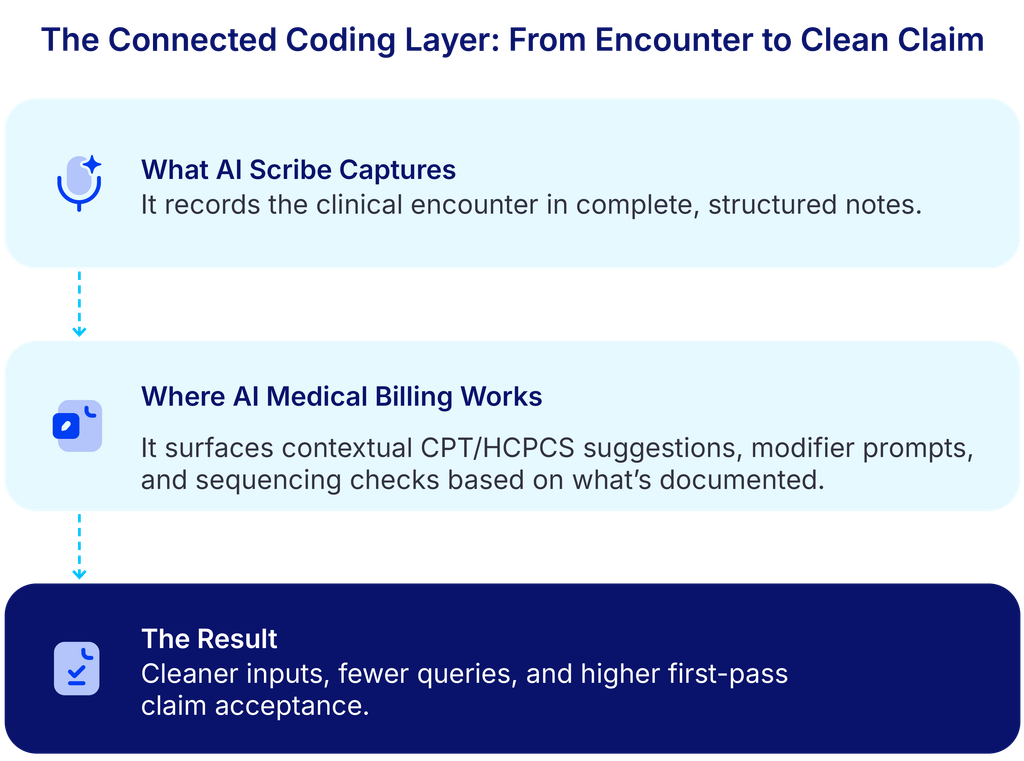
Medical practices that implement billing-aware AI reduce coding inconsistencies. These tools don’t make autonomous coding decisions, which means staff are always making the decisions. However, decisions are made faster, with more ease, and more accurately. For instance, staff can achieve faster code selection through contextual AI suggestions, which eliminate extensive and time-intensive manual lookups. Instead of reviewing coding downstream during billing review, coding accuracy is high at the point of documentation itself, leading to improved reimbursement consistency across encounters.
Billing-aware AI also helps solve coding ambiguity, unpredictable revenue patterns, and operational friction between clinical and revenue cycles. For instance, a report from financial advisory firm William Blair estimates that the healthcare industry could save more than $18.4 billion each year with AI automation.
Let’s look into the specifics of how AI medical coding tools can help close the gap between documentation and what actually gets coded and billed.
How AI Coding Intelligence Reduces Ambiguity and Denial Rates
When clinical documentation supports multiple potential codes, providers and coders make judgment calls under time pressure that may not optimally reflect clinical content, payer preferences, or compliance requirements. These ambiguous coding decisions become denial risks.
For example, a claim that could have been coded for higher complexity gets coded conservatively. A procedure that requires a modifier gets submitted without it. Or, a diagnosis combination that payer rules require in a specific sequence gets reversed.
By deploying AI that surfaces coding options with payer-specific context, your practice can reduce ambiguity in multi-code scenarios. Start by implementing modifier suggestion logic that identifies when modifiers are required based on procedure and payer combination. You can use AI to flag diagnosis code sequencing issues before claim submission when payer rules require specific ordering. And you can enable real-time coding guidance that resolves ambiguity at selection rather than at denial.
Research has already shown the potential of AI in revenue cycle management. A report by Pathak, Samir & Sharma, and Akhil from 2025 found that AI implementations can reduce claim processing costs by 25% to 80%, accelerate reimbursement cycles by up to 40%, and achieve a median return on investment (ROI) of 150% within the first year of use.
AI coding intelligence allows practices to achieve lower denial rates from coding ambiguity. These issues get resolved at the point of the encounter instead of being discovered post-submission. Since AI-assisted coding prevents errors that create correction cycles, you can lower the rework burden and improve the efficiency of your revenue cycle. And instead of memorizing hundreds of manual rules, your staff can achieve stronger coding confidence via AI-surfaced context.
How AI Coding Assistance Optimizes Revenue Through Coding Consistency
Multi-provider practices, such as medical groups, independent practices with multiple clinicians, and specialty practices, experience coding variation across providers, which can create unpredictable revenue performance.
For instance, two providers treating clinically identical patients may submit different codes. Both variations will generate different reimbursement and audit risk profiles. This variation reflects different coding habits, different comfort with complexity levels, and different familiarity with payer-specific requirements. Left unaddressed, it makes revenue difficult to forecast and obscures where the inconsistency is coming from.
Billing-aware AI addresses this by applying consistent logic across all providers, regardless of individual coding habits.
For instance, DrChrono by EverHealth supports this functionality through EverHealth Scribe, which integrates directly into the DrChrono patient chart and surfaces ICD-10 code suggestions at the point of care. It also suggests CPT/E&M code and modifiers that write back to billing sections on the roadmap. Because the same logic gets applied for every provider instead of leaving it to personal preference, code selection reflects documented complexity instead of who happens to be charting. Practices no longer need to bolt on a separate, unintegrated coding tool to achieve this level of consistency.
The AI also normalizes code selection to appropriate levels based on what the documentation actually supports, and it establishes coding consistency benchmarks that surface provider variation. Practices can use this data to provide targeted education to staff members who need it. This enables practice-wide coding standardization through AI assistance rather than relying on individual provider compliance.
The outcomes compound across the practice. Consistent coding across all providers produces more predictable revenue patterns. Practice leaders can see coding inconsistency when it’s a root cause of revenue variation. Provider variation can be addressed through targeted education rather than discovered in audits, and consistently appropriate coding patterns reduce the practice’s compliance risk.
How to Validate Documentation Completeness and Speed Up Billing Cycles with Billing-Aware AI
The transition from clinical documentation to medical billing workflow is a friction point where revenue cycle teams must interpret clinical content, identify coding requirements, and validate documentation completeness. When records are insufficient, they must then query providers directly. This handoff friction delays billing, creates back-and-forth between clinical and revenue cycle staff, and generates provider interruptions that disrupt clinical flow.
The first step to resolving this is to implement billing-aware AI that validates documentation completeness and ensures clinical notes are sufficient for medical billing purposes at the point of encounter, before the clinical-to-billing handoff. AI can also be used to surface what’s needed for clean claim submission, as well as enable smooth documentation-to-billing transitions by preparing encounters for revenue cycle processing instead of requiring downstream interpretation.
This technology is already being used to lead to major cost savings. According to the Healthcare Financial Management Association (HFMA), an independent community hospital in New York saved more than $1 million by leveraging AI to improve its documentation and coding accuracy. This isn’t reserved for hospitals. With billing-aware AI deployed in this way, revenue cycle teams in ambulatory practices can reduce provider queries and achieve a faster medical billing cycle thanks to cleaner documentation inputs. This leads to higher documentation quality and higher first-pass claim acceptance. And the AI-mediated workflow continuity allows for lower operational friction between clinical and financial teams.
Closing the Loop Between Documentation and Reimbursement
When AI can bridge documentation and coding intelligence at the point of encounter, the revenue cycle receives cleaner inputs that require less interpretation, fewer queries, and faster processing. AI coding intelligence turns documentation, coding support, and the revenue cycle into a unified AI-assisted ecosystem rather than a series of disconnected tasks. The result is less compliance risk, fewer errors, and more predictable revenue. Talk to our team to see how DrChrono partners with ambulatory practices to close the loop between documentation and reimbursement.