

Most medical practices still manage patient access the way they always have, that is, filling today’s open slots and reacting when schedules tighten. But the practices growing quickly and sustainably have reframed patient scheduling access entirely. They treat it not as a scheduling problem, but as a forecasting discipline that shapes competitive strategy.
The healthcare landscape is defined by a widening physician shortage, rising patient demand, and accelerating consolidation. As consolidation accelerates and independent practices compete against systems with enterprise analytics, the practices that build forecasting capability now will capture market share, while those that wait will face a permanent competitive disadvantage. Predictive access, powered by AI-driven demand modeling, enables practice leaders to anticipate demand shifts, time provider hiring to match growth curves, and ground expansion decisions in demonstrated need rather than assumption.
This report examines why reactive access management puts practices at a structural disadvantage, how predictive demand modeling works in ambulatory care, and how leaders can build the forecasting infrastructure that transforms access into a sustainable growth engine.
When Access Gets Managed Reactively, Growth Stalls
The default approach to patient access in most practices is reactive. Schedules fill up, patients complain, and leadership scrambles to add capacity after the damage is already done.
This approach treats access as an operational task rather than a strategic function, leaving practices perpetually one step behind both patient demand and competitor positioning. Three interconnected problems emerge when practices manage access reactively, and each one carries significant financial and competitive consequences.
Provider Hiring Decisions Are Driven by Instinct Instead of Demand Intelligence
Practice administrators face one of the most consequential and expensive strategic decisions: when to hire another provider. Hire too early, and the practice carries unproductive salary costs. Hire too late, and patients leave for competitors who have available capacity.
In most practices, these decisions rely on anecdotal signals rather than quantified demand analysis. Examples of these signals can include comments such as:
“We seem busy.”
“Patients are complaining about wait times.”
The financial stakes of mis-timing are enormous.
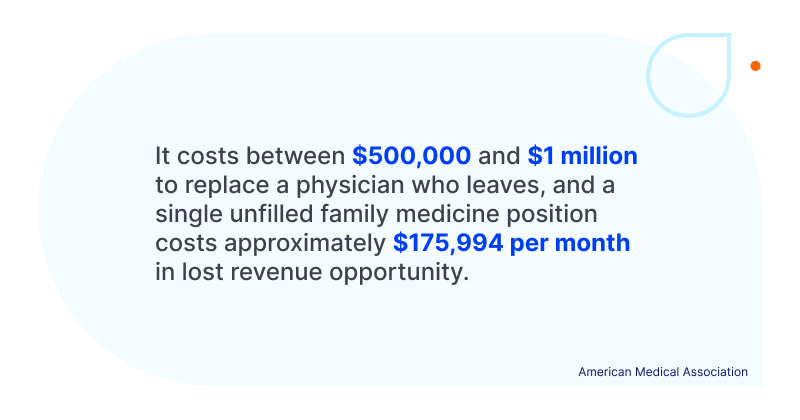
According to healthcare recruiting firm PracticeMatch, the cost of recruiting a single physician ranges from $180,000 to $250,000. The American Medical Association (AMA) has found that, when a physician leaves a practice, it costs between $500,000 to $1 million to fill the vacancy. This includes recruitment, sign-on bonuses, lost billings, and onboarding.
Vacancies left unfilled while leadership deliberates hemorrhage revenue in real time. According to AMN Healthcare, a single unfilled family medicine position costs approximately $175,994 per month in lost revenue opportunity. The cost grows to $1,055,966 if the position remains unfilled for six months. The reality is even worse when replacing specialized doctors. An unfilled vacancy for an orthopedic position for three months will cost a practice $821,691. The cost grows to $6,573,529 after 24 months.
At these cost levels, the difference between a data-informed hiring timeline and a reactive one is measured in hundreds of thousands of dollars per decision, if not millions.
The median time to fill a primary care position is 93 days, and the average physician vacancy lasts 195 days, which means a lot of practices are losing serious money due to this issue. And the underlying demand problem is structural and worsening, which makes forecasting more critical every year. The U.S. faces a projected shortage of up to 86,000 physicians by 2036. More than 42% of active physicians are over 55, meaning a significant share of the workforce will retire over the next decade.
These structural conditions make demand forecasting even more critical. When physician supply is constrained industry-wide, practices that can predict demand 90 days ahead can secure hiring commitments before competitors even recognize they need capacity. This turns forecasting capability into a recruiting advantage.
Access Constraints Become Identified Only After Patients Have Sought Care Elsewhere
Practices typically discover access problems through lagging indicators. These include patient complaints, declining satisfaction scores, or rising schedule pressure that is already weeks or months old.
By the time leadership recognizes an access constraint and responds, patients have already experienced frustration and potentially sought care elsewhere. The demand signals existed in the data long before the problem became visible, but without predictive analytics, those signals went undetected.
Wait times are escalating across the industry, making the detection gap more consequential. According to AMN Healthcare, the average physician appointment wait time across specialties is now 31 days, a 48% increase since 2004 and a 19% increase since 2022. Some specialties face even steeper pressure, for example, with average OB/GYN wait times reaching 41.8 days. That’s a 33% increase since 2022.
The financial impact of losing patients to access frustration compounds over time. This is because retention economics overwhelmingly favor keeping patients over replacing them. Patient acquisition costs range from about $200 per patient for general practice and over $400 for specialty practices such as allergy/immunology and dermatology.
Practices that detect capacity pressure through complaints are already in recovery mode. Practices that detect it through demand signals are still in prevention mode.
For instance, consider a practice that sees appointment request volume climbing and third-next-available slots compressing weeks before any patient complains. With this data, leadership can initiate a provider search while capacity still holds. The competing practice across town doesn’t post a job listing until patients are already leaving frustrated reviews and referring physicians have started sending volume elsewhere. By then, the first practice has captured those referral relationships and established the access reputation that makes it the market default. In this scenario, early detection doesn’t just prevent access failures. It converts a competitor’s staffing gap into a practice’s own growth.
Expansion Decisions Are Disconnected From the Reality of Demand
When practices consider opening new locations or adding service lines, these decisions are often driven by what competitors are doing or what seems strategically logical, rather than what actual demand analysis supports.
The consequences flow in both directions. Expanded capacity sits underutilized because the assumed demand did not exist. Or, practices fail to expand where real demand is concentrated and lose market share to those that do.
Patient dissatisfaction with access is creating competitive openings for practices that can deliver, but only if expansion aligns with where the demand actually lives.
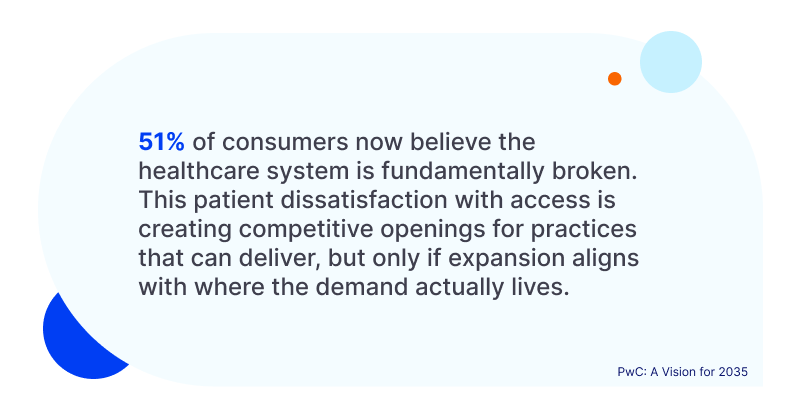
According to PwC, 51% of consumers now believe the healthcare system is fundamentally broken, showcasing how deep patient satisfaction truly goes. However, leading healthcare strategy firms are also warning against untethered expansion. For example, McKinsey advises providers to assess their footprint to balance expansion and contraction, in addition to staying locally relevant while avoiding unsustainable growth.
Without demand forecasting models to ground growth decisions in actual patient need, geographic demand concentration, and service-line pressure data, expansion becomes a high-cost gamble rather than a strategic investment.
Building Predictive Access Infrastructure, From Scheduling to Forecasting
Access strategy is a growth strategy. The practices that can predict and shape demand will outcompete those that react to it. Moving from reactive scheduling to predictive access requires infrastructure that models demand patterns, anticipates capacity thresholds, and informs strategic decisions before pressure becomes visible.
Specifically, three capabilities form the foundation of predictive access: reframing the access problem itself, building demand models from existing practice data, and applying forecasting outputs to the highest-stakes decisions in practice growth.
Reframing Access as a Forecasting Discipline
The fundamental shift is conceptual before it’s technological. Access isn’t a scheduling problem to solve with more appointment slots. Rather, it’s a forecasting discipline that determines competitive positioning. But most practices haven’t made this shift.
According to the Medical Group Management Association (MGMA), only 15% of medical groups currently use predictive analytics to improve scheduling and access and prevent no-shows. The remaining 85% represents the competitive opening for practices that choose to build forecasting capability right now. With a predictive mindset, the question changes from “how do we fill tomorrow’s open slots” to “how do we shape capacity for next quarter’s demand?”
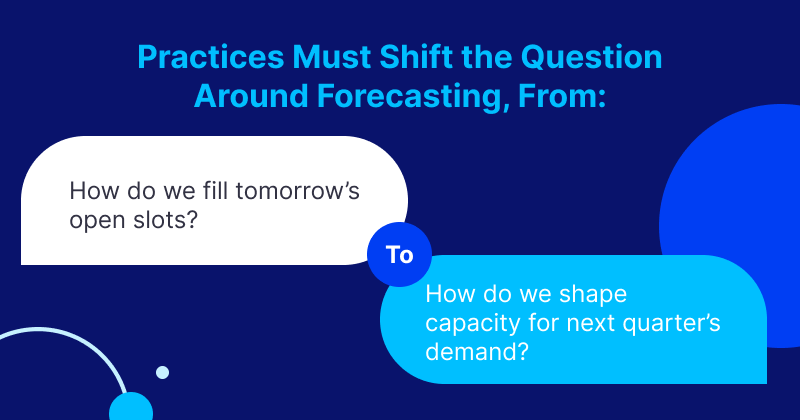
This forward-looking strategy demands entirely different tools, data, and leadership frameworks.
Demand forecasting enables proactive resource planning across three interconnected domains:
- When to hire new providers
- Where to expand physician or service capacity
- Which service lines to invest in for growth
As a result, predictive access moves practices from firefighting to strategic capacity management, where leadership can plan instead of constantly recovering from access failures they didn’t see coming.
How Demand Modeling Works in Ambulatory Care
Predictive demand models work by analyzing multiple data streams that already exist in most practice management systems, such as:
- Appointment request volume and velocity
- Referral patterns
- Seasonal variation
- New patient acquisition rates
- Provider capacity utilization trends
Each of these inputs captures a different dimension of demand. Some, like appointment volume and seasonal variation, reveal existing patterns. Others, like referral trends and new patient acquisition rates, act as leading indicators of where demand is headed. Together, they give a model both a baseline and a trajectory, which is what separates a reactive snapshot from a genuine forecast.
AI and machine learning (ML) algorithms process these inputs to project future demand states, identifying when current providers will reach capacity limits and where demand pressure is building the fastest.
This approach is already proven in healthcare settings. A peer-reviewed study using data from the Geisinger Medical Center demonstrated that machine learning-based demand forecasting achieved a mean absolute percentage error (MAPE) of just 0.49% to 4.10%.
The broader healthcare industry is embracing this transition. Three speakers from Froedtert & MCW, during a Healthcare Information Management and Systems Society (HIMSS) session, highlighted how AI and ML enable healthcare institutions to transition from reactive approaches to proactive, anticipatory models of resource management. A 2024 narrative review published in Cureus also confirmed that predictive analytics can transform patient care by forecasting demand patterns and enabling more effective resource deployment.
AI models are continuously improving as they ingest more practice data over time. This creates a compounding intelligence advantage, where forecast accuracy increases with each cycle. And infrastructure that models demand patterns creates sustainable growth trajectories for practices.
That foundation starts with the platform. Platforms that connect scheduling, financial, and operational data in a single system provide the analytical foundation for demand modeling, because fragmented data across disconnected tools can’t produce reliable forecasts.
Applying the Strategy From Hiring Timelines to Expansion Planning
Predictive demand modeling applies directly to the three high-cost problems outlined above. It can convert each from a reactive scramble into a planned strategic action.
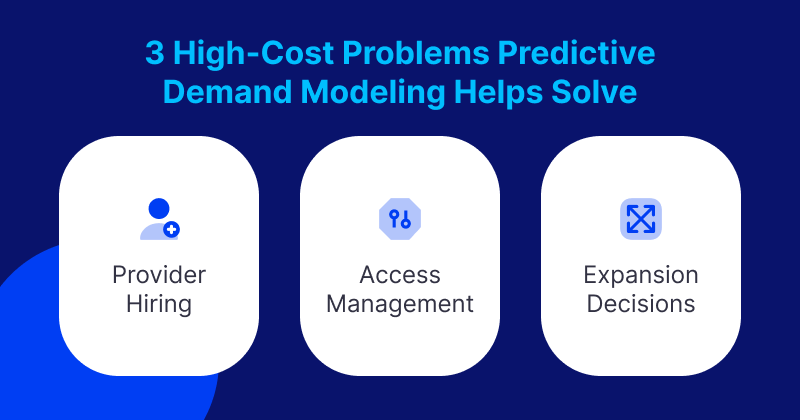
For provider hiring, demand models show current capacity utilization trends, forecast when existing providers will reach capacity limits, and project patient demand growth based on historical patterns and market factors. This enables hiring decisions grounded in 90-day demand forecasts that quantify when utilization will exceed capacity, along with financial models that show ROI timelines for new provider investments. Leadership thus gains confidence that growth investments are timed optimally rather than reactively.
For access management, predictive analytics identify emerging access constraints before they impact patient experience by monitoring appointment request patterns, tracking how quickly specific slot types fill, analyzing booking lead times, and detecting capacity pressure across providers and locations. Proactive capacity adjustments prevent access problems instead of forcing providers to react to them. Practices can maintain a market reputation for excellent access that competitors can’t match, because demand pressure gets addressed before it drives patients to seek alternatives.
For expansion decisions, demand forecasting models show where patient demand is concentrated geographically, what service types are experiencing wait list pressures, which time slots consistently fill first, and how demand patterns vary seasonally or by patient population. Expansion investments achieve target utilization within projected timeframes because they’re aligned with demonstrated demand patterns, not assumptions.
Making these transitions requires an integrated platform infrastructure that connects scheduling data, financial performance, and operational analytics in a single system. Fragmented data across disconnected EHR, practice management (PM), and billing tools can’t produce reliable forecasts because demand modeling needs a unified data architecture. Practices that build this infrastructure now enter a compounding cycle: better predictions yield better decisions, better decisions produce better outcomes, and better outcomes generate better data. The intelligence gap between forecasting practices and reactive practices widens with every planning cycle.
Access Strategy Is Growth Strategy
The practices that will lead in ambulatory care over the next decade won’t be the ones with the most providers or the best locations. They’ll be the ones that forecast demand, shape their capacity to meet it, and make strategic investments grounded in data rather than instinct.
Predictive access is the infrastructure that makes this possible. It shifts leadership questions from “how do we fill today’s schedule?” to “how do we position capacity for growth?. It transforms hiring from a financial gamble into a timed investment. It makes expansion decisions evidence-based rather than assumption-driven.
Every quarter during which a practice operates without demand forecasting is a quarter where hiring costs more, expansion carries more risk, and competitors with analytics insights gain ground. The practices building forecasting capability now are creating advantages that compound.
DrChrono by EverHealth is built for this exact kind of shift. As an all-in-one, AI-powered EHR platform, it unifies scheduling, clinical documentation, billing, and patient engagement in a single system, giving practice leaders the integrated data layer that demand modeling depends on.
Real-time analytics surface capacity and performance trends as they emerge, predictive AI identifies patients at risk of missing appointments before no-shows erode the schedule, and connected workflows ensure every operational decision draws from the same source of truth.
Schedule a demo to learn how DrChrono can turn your practice data into the forecasting-driven access strategy your growth depends on.