

For years, healthcare AI technology has primarily focused on documentation assistance and workflow automation. These capabilities have become the baseline for modern practices, but AI is moving beyond this foundation to solve other pressing challenges clinicians face. The question is, can AI support the work that happens at the bedside, not just behind the desk?
Today, artificial intelligence is being applied to support clinical decision-making. Any physician will tell you the problem. A single patient encounter demands simultaneous command of prior notes, labs, medications, imaging, specialist input, and evolving guidelines—often under serious time pressure. Clearly, the bottleneck isn’t data but the human capacity to process it in real time.
Clinical copilot AI and real-time decision support tools are built for exactly this. Not to replace physician judgment, but to reduce the cognitive load around it. By helping clinicians cut through patient data, surface relevant patterns, and bring the right context forward at the right moment, these tools support decision-making without pulling the decision out of the clinician’s hands.
Physicians’ attitudes are shifting to reflect this. According to an American Medical Association (AMA) survey, seven in 10 physicians see AI as a tool that can automate tasks that contribute to work-related burnout, while 76% believe the technology can help support patient care. That’s not blind enthusiasm; it’s clinicians recognizing where they’re stretched thin.
This guide explores how healthcare AI is evolving from an administrative assistant into a clinical decision support partner. It examines the challenges clinicians face when processing information, recognizing patterns, applying guidelines, and managing uncertainty. It also shows how emerging AI tools can reduce that burden and support better-informed decisions.
Why Clinical Decision-Making Is Becoming Harder, and How AI Is Helping Clinicians Keep Pace
Healthcare AI is evolving. Early tools focused on documentation support and workflow efficiency. Today’s emerging systems are tackling a different problem: helping clinicians process information, evaluate context, and make decisions in increasingly complex care environments.
This shift from administrative automation to cognitive support is shaping the next phase of healthcare AI.
Clinicians Have More Patient Data Than They Can Process During Visits. Healthcare AI Is Surfacing What Matters Most.
Modern clinicians don’t need more patient information. They need less time spent hunting through charts, lab reports, and specialist notes before they can actually use that information.
As healthcare data volumes continue to expand, AI clinical decision support tools are emerging as a practical way to help clinicians navigate that complexity.
A single visit may involve reviewing laboratory results, imaging reports, medication histories, specialist recommendations, prior documentation, and longitudinal health records before a physician can make care decisions. AI can help flag patterns or potential issues that a physician might otherwise miss—not because the issue is invisible, but because assembling the full picture takes time clinicians don’t have.
Take a patient with diabetes who recently started taking prednisone for asthma after seeing a pulmonologist. When the patient goes in for a routine visit with their primary care physician, their blood pressure and blood glucose appear abnormally high.
Without healthcare AI software, their doctor might decide to run more tests to diagnose the underlying cause, suspecting that higher cholesterol levels are impacting insulin resistance and blood pressure. But AI surfaces a synthesized view of labs and medications in real-time, providing a fuller picture of the patient’s health. The primary care doctor can see that the patient just started taking prednisone, which is a medication known to increase blood glucose and blood pressure. From there, they coordinate with the pulmonologist to create a modified care plan that addresses the patient’s asthma and diabetes right away.
Electronic health records (EHRs) provide access to enough data. But clinicians must still identify what’s clinically relevant, connect information across multiple sources, and incorporate those insights into real-time decision-making.
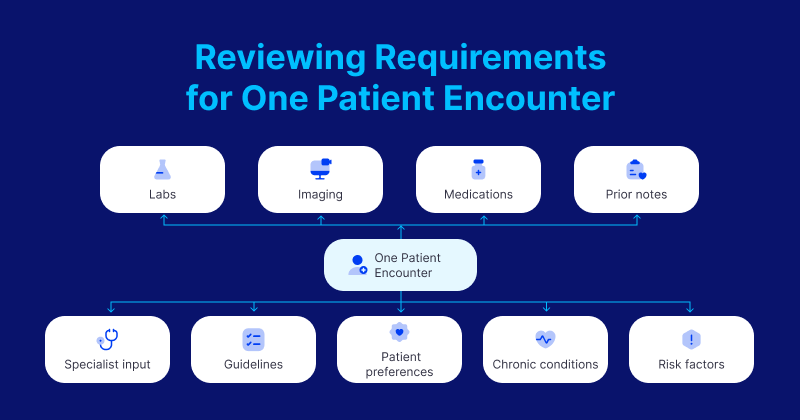
The problem gets harder when records are scattered across documentation layers, systems, and care settings. Physicians end up spending valuable time searching for information rather than evaluating it. According to an Annals of Internal Medicine study, physicians spend nearly half of their office day interacting with EHRs and other desk work. As data volumes increase, the cognitive burden of organizing and interpreting that information keeps growing.
This is where AI clinical decision support does something useful. Clinical copilot AI capabilities can help surface relevant patient context in real time. These tools can:
- Summarize longitudinal patient histories
- Identify meaningful changes in lab reports
- Highlight abnormal findings
- Prioritize information most relevant to the clinical encounter
This shift improves both efficiency and care quality. When clinicians spend less time digging through records, they have more time to evaluate information, engage with patients, and make informed decisions. Faster access also means clinicians can understand the full patient story before the encounter, not after.
Important Clinical Patterns Are Difficult to Recognize. Healthcare AI Is Helping Clinicians Connect the Dots Faster.
Even when physicians have access to all relevant patient information, important clinical patterns can remain difficult to detect. Many meaningful patterns only emerge across large populations, long time horizons, or combinations of variables that exceed what any individual clinician can reasonably track.
That gap has always existed. What’s changed is the scale of data sitting unused around it. EHRs, laboratory systems, imaging platforms, wearable devices, and specialist notes—healthcare organizations are collecting more structured and unstructured data than ever before. The signals are there. The problem is that no one has time to find them during a 20-minute visit.
AI clinical decision support tools are built for exactly this mismatch.

By analyzing patient data across large populations, these systems can surface correlations, outcome trends, and risk patterns that don’t register at the individual encounter level. During a visit, a clinical copilot can flag that a patient’s presentation—this particular combination of labs, history, and chronic conditions—has shown elevated risk or responded better to a specific treatment pathway in similar past cases. That’s not a recommendation. It’s context that a clinician can factor into their own reasoning.
The physician still draws the conclusion. But they’re drawing it from a wider base of evidence than personal experience alone can provide. The result is a clinical workflow that can recognize risk factors, outcome trends, and emerging patterns that might otherwise remain hidden within large volumes of patient data.
Over time, this strengthens the connection between accumulated clinical data and point-of-care decision support.
Clinical Guidelines Don’t Always Fit Complex Individual Patients. AI Is Helping Clinicians Navigate Uncertainty With Greater Confidence.
Clinical guidelines are the foundation of evidence-based medicine, and AI is helping clinicians apply them more effectively. Yet any practicing physician knows the reality: real-world patients rarely fit neatly into standardized treatment pathways.
Many patients present with multiple chronic conditions, overlapping symptoms, medication interactions, incomplete medical histories, or personal preferences that complicate care decisions. A recommendation that works well for one patient population may not cleanly apply to someone with a different combination of comorbidities, risk factors, and clinical priorities. As patient complexity increases, determining the right course of action often means balancing several competing considerations at once.
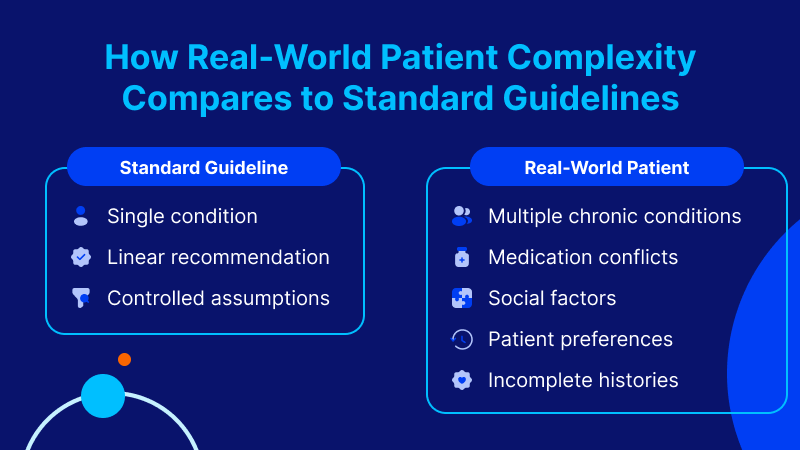
This points to an important distinction between accessing clinical guidance and applying it. Clinicians aren’t simply deciding whether a guideline is correct. They’re evaluating how that guidance fits within a specific patient’s circumstances. Even experienced physicians routinely encounter situations in which standard recommendations must be adapted, prioritized, or weighed against competing clinical concerns.
As complexity increases, so does uncertainty. Physicians make dozens of high-stakes decisions throughout the day while managing time constraints, incomplete information, and competing demands. Research published in the Journal of Health Psychology has shown that repeated decision-making under pressure can contribute to decision fatigue, reducing consistency in judgment over time. The challenge isn’t a lack of expertise. It’s the cognitive burden associated with repeatedly evaluating complex scenarios and determining the best path forward.
This is where AI clinical decision support is starting to move beyond information retrieval and toward genuine cognitive enhancement. Rather than simply surfacing information or identifying patterns, clinical decision support AI helps clinicians evaluate how multiple patient-specific factors interact within a particular care decision. It does so by:
- Surfacing relevant comorbidities
- Identifying potential treatment conflicts
- Highlighting missing information
- Providing additional context around recommendations
The result is a more adaptable clinical workflow—one where physicians can apply evidence-based guidance to individual patients without losing sight of the full clinical picture.
Successful Clinical AI Augments Clinical Judgment Rather Than Replacing It
Much of the conversation around healthcare AI centers on what the technology can do. A more important question is what role it should play.
Historically, healthcare technology has only functioned as a record system. EHRs store information, documentation tools capture it, and reporting systems organize it. Clinicians remain responsible for finding relevant details, connecting information, and determining what it means within the context of patient care.
The emerging generation of clinical AI is designed for a different purpose. Rather than automating tasks, it aims to augment clinical reasoning itself. This is often described as cognitive augmentation—using AI to help clinicians process information, evaluate context, and navigate complexity more effectively, while preserving human judgment throughout.
The distinction matters. Augmentation isn’t about automating diagnoses or removing clinicians from decision-making. It’s about helping clinicians spend less time gathering and organizing information and more time actually evaluating it. AI can help identify relevant factors, highlight meaningful relationships, and provide additional context that informs clinical reasoning.
The clinician remains at the center. Physicians still apply clinical expertise, consider patient preferences, weigh risks and benefits, and determine the most appropriate course of action. Clinical AI contributes additional context and support, but responsibility and judgment stay firmly human. According to the American Medical Association’s Augmented Intelligence research, physicians are significantly more likely to adopt AI when systems preserve transparency, support clinician oversight, and maintain human authority over final care decisions.
As healthcare complexity continues to grow, an AI-augmented medicine model may prove more valuable than automation alone. The future of clinical AI isn’t about replacing physician expertise. It’s about helping clinicians apply that expertise more effectively in situations where information is abundant, uncertainty is unavoidable, and decisions carry significant consequences.
Implementation Considerations for Clinical AI Adoption
The value of clinical AI depends less on the technology itself and more on how naturally it fits into patient care workflows. A system that requires clinicians to step outside their EHR, even briefly, interrupts the cognitive thread of a patient encounter. That interruption has a cost. It’s not just time; it’s the mental reset required to re-engage with the clinical picture after switching contexts.
Effective AI in healthcare is embedded where clinical reasoning actually happens. That means it’s present when a physician is reviewing a chart before walking into the room, when they’re weighing a treatment decision mid-encounter, and when they’re reconciling conflicting information from multiple sources. It connects to documentation, records, coding, and medical billing, not as separate functions but as expressions of the same clinical moment—so the cognitive work done at the point of care doesn’t have to be repeated downstream.
What separates decision support AI from documentation AI is what it does with information. Documentation tools capture what happened. Decision support tools help clinicians think through what should happen next—surfacing the patient history most relevant to the current question, flagging patterns that don’t announce themselves, and bringing competing clinical considerations into view before a decision gets made.
That demands transparency. When AI surfaces a recommendation or highlights an anomaly, clinicians need to see the reasoning, not just the output. A black-box suggestion has no place in high-stakes clinical reasoning. The insight needs to be legible enough that a physician can evaluate it, push back on it, or fold it into their judgment—not simply accept or dismiss it.
The practices that implement clinical AI most successfully tend to have one thing in common: they treat it as an extension of clinical cognition, not an administrative support layer. That framing changes everything about how the tool gets configured, how staff engage with it, and how much of its potential actually shows up in patient care.
Clinical AI Should Help Clinicians Navigate Complexity With Greater Confidence
Modern clinicians are struggling because they have more information, more complexity, and more decisions to process than ever before. Every patient encounter requires synthesizing fragmented records, recognizing meaningful patterns, applying evidence-based guidance to unique patient circumstances, and making high-stakes decisions under significant time pressure.
This is why the future of healthcare AI extends beyond administrative automation.
While documentation support and workflow efficiencies remain valuable, the next stage is helping clinicians manage the cognitive demands of modern care. Clinical copilot AI and decision support tools are designed to surface relevant information, provide context, and reduce the effort required to process growing volumes of clinical data. The goal isn’t to replace clinical judgment but to support better-informed decisions.
DrChrono by EverHealth’s AI capabilities are designed around these realities. By helping clinicians quickly surface relevant patient history, identify meaningful patterns across records, reduce documentation burden, and access decision-support insights within existing workflows, DrChrono helps make clinical complexity more manageable. Rather than forcing providers to navigate disconnected information, hidden signals, and competing priorities on their own, clinicians access the most relevant context when it matters most.
The goal is to strengthen physician expertise, not replace it—and DrChrono is built around that distinction. Connect with a DrChrono expert to discover how AI can support your practice.