

Patient portals were designed to improve access for patients. However, the volume of messages they generate has created an unsustainable operational burden. Providers now manage dozens or hundreds of asynchronous messages daily. That happens alongside full clinical schedules, care coordination responsibilities, and increasingly burdensome documentation requirements.
When a provider’s inbox functions as an unrestricted demand channel with no built-in triage, prioritization, or capacity management, it ends up adding to provider burnout while only providing an incremental improvement in patient experience–because providers simply can’t keep up with the volume.
Healthcare AI offers a practical solution, not by reducing patient communication, but by restoring workflow control. It creates a sustainable digital access model where patients receive faster responses and providers only see the messages that require their attention.
This guide examines how unmanaged inbox volume drives provider burden, how AI-powered triage and response systems address each dimension of the problem, and how practices can maintain expanded digital access without sacrificing the well-being of their clinicians or the safety of their patients.
Digital Access Created an Inbox Crisis That Providers Weren’t Built to Manage
According to research published in Applied Clinical Informatics, patient portal adoption has been increasing for years, but the operational infrastructure to manage the resulting message volume has never followed. Providers now face unlimited asynchronous demand against finite clinical time.
Routine Messages Take Up Clinical Time
A large share of patient messages don’t require clinical judgment. Refill requests, scheduling questions, billing issues, and form requests don’t typically need a clinician to be involved. Yet, all of them land in the same inbox. Someone still has to open, read, and route each communication before anything moves forward. Over a week, that adds up to hours of non-clinical work competing with patient care.
This time drain shows up in burnout numbers, too. According to Medscape’s 2024 Physician Burnout and Depression report, 83% of physicians list professional stress as the primary contributor to burnout or depression. Almost half of physicians report burnout, and a fifth report depression.
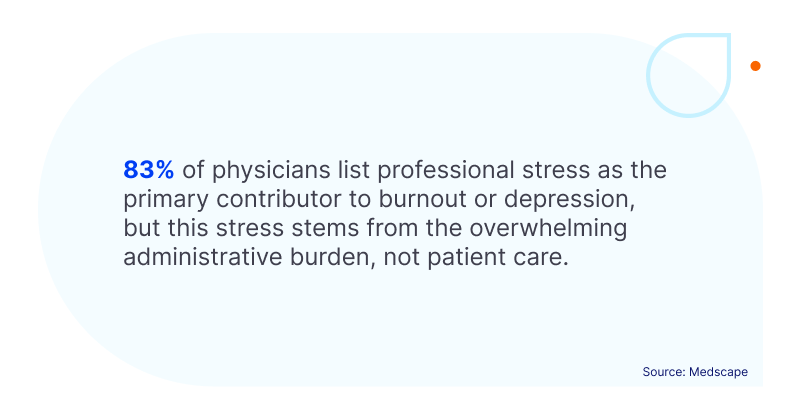
This professional stress stems from the overwhelming administrative burden, not patient care. A physician didn’t go through a decade of training to spend their lunch break confirming appointment times, but that’s where the hours go.
Urgent Messages Get Lost in the Inbox
When message volume is high, everything looks the same at a glance. A message that reads, “I’ve had chest tightness and shortness of breath since this morning,” can sit in the queue right next to a question about parking validation. Both show up as a bolded, unread line with a timestamp.
Clinicians rarely have time to fully triage every message the moment it arrives, and that gap is where risk lives. Something important gets delayed simply because no one flagged it fast enough, not because anyone was careless. The problem is that the system gives every message the same visual weight.
Patients Experience a Gap in Care
This isn’t only a provider problem. When a message goes unacknowledged, patients don’t sit quietly. They send a second message. Then a third. Many assume their note got lost in the system, so they resend it, call the front desk to ask whether it arrived, or bring it up in frustration at their next visit.
Every one of those follow-ups lands back in the same overloaded inbox, which makes the original backlog worse. It’s a feedback loop in which slow responses generate more messages, and more messages slow responses further. Patients wanted faster access and instead got silence, and the practice ends up handling the same request three or four times over. The promise of the portal erodes on both sides at once.
Patient Expectations Outpace Capacity
Patients expect fast responses—often within hours—regardless of when they send a message. But providers still have full schedules, documentation work, and other responsibilities. The result is steady pressure that spills into evenings and weekends, the so-called “pajama time” that has become routine in primary care.
According to a recent Medical Group Management Association (MGMA) poll, almost one-third of healthcare organizations had a physician leave or retire early in 2024 due to burnout. Poor healthcare inbox management isn’t the only cause, but it’s a daily, visible reminder of work that’s never finished.
Message Responses Double as Documentation Work
Responding to a patient message isn’t one task. It’s two. There’s the reply itself, plus a note in the medical record. A quick answer about adjusting a medical dose, for example, needs to be documented as a clinical decision, not just typed into a chat box.
When a question turns into a back-and-forth thread, where patients ask for a follow-up, the provider clarifies, and the patient responds again, that documentation load climbs. It’s one of the biggest reasons inbox management stretches beyond normal working hours.
How AI and Patient Message Automation Restore Control Without Reducing Patient Access
AI-powered communication tools address each of these pressures by sitting between the patient and the provider, handling triage, routing, and routine replies before a message ever reaches a clinician. The point isn’t to limit contact, but to make sure the right people see the right messages at the right time. Patients perceive this shift as faster and more consistent. They sense that someone is actually listening rather than letting their note sink to the bottom of a pile. Here’s how it works.
Automated Triage Separates Clinical From Administrative Messages
With AI-powered triage, healthcare AI software reads incoming message content. Medical practices can use an AI-powered EHR and practice management platform like DrChrono by EverHealth to automatically categorize each communication by message type:
- Clinical questions
- Administrative requests
- Patient scheduling
- Medical billing
- Refills
For example, a billing dispute routes to the billing team, or a refill request heads to the pharmacy workflow. None of it passes through the provider’s inbox first. Clinicians end up seeing only what needs clinical judgment, which cuts their processing volume sharply.
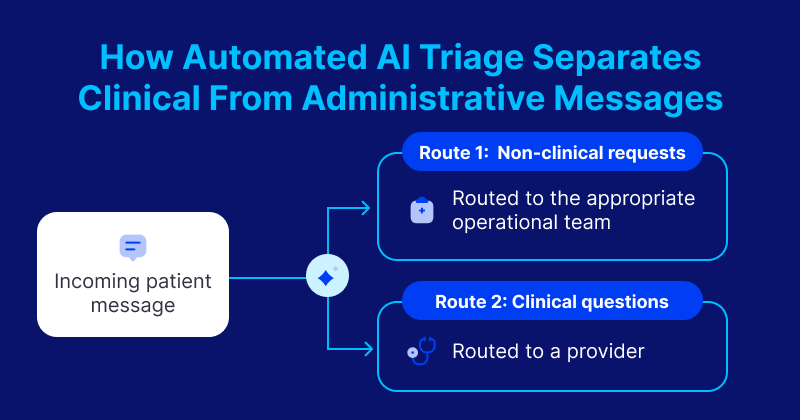
Patients benefit immediately, too. Someone asking to reschedule doesn’t wait two days for a physician to read the note and forward it to the front desk. The message reaches the right team right away, often resolving an issue the same day instead of waiting behind clinical work in a queue it never belonged in.
Urgency Detection Surfaces High-Risk Messages Immediately
The same content analysis flags potentially serious concerns even when a patient doesn’t label them as urgent. Patients often understate things. Someone might bury “my incision is red and warm, and I have a fever,” inside a longer, polite message that opens with “sorry to bother you.” A person doesn’t always know which symptoms are red flags, so they won’t reliably mark a message as an emergency. AI can catch the clinical signal regardless and push that message to the top of the inbox or escalate it through a direct notification.
Because the flag is based on what’s written rather than on the patient’s own sense of severity, critical issues stop slipping through. That lowers clinical risk and takes away the mental tax of manually scanning a full inbox for the one note that can’t wait.
Automated Acknowledgement and Response Manages Patient Expectations
AI-powered patient portals send an immediate confirmation with a clear sense of when to expect a real answer. That single step quiets a lot of the anxiety-driven follow-ups, because patients no longer wonder whether their message disappeared into the void.
Simple requests get resolved on the spot with no clinician involved at all, such as appointment confirmations or basic office information like hours or locations. People feel heard faster, and the inbox stops filling with duplicate pings.
Automated Documentation Closes the “Double Work” Loop
The same AI-driven engine can use message content and its corresponding reply to generate documentation directly. Answering a patient and recording it in the chart stop being two separate jobs. A provider replies once, and the record updates from that same action.
When a thread runs long, it gets condensed into a clean clinical note, which means a provider can review the gist of a ten-message exchange in seconds instead of scrolling through the whole conversation to reconstruct what happened. The duplicate work that pushed inbox management into the evening largely disappears, and the records actually end up more complete because nothing gets skipped when the day runs short.
Build a Sustainable Digital Access Model with AI Patient Communication
The introduction of patient portals promised better access and stronger patient-provider communications. That promise doesn’t have to come at the cost of the well-being of providers. AI-powered message management restores the balance by ensuring that expanded digital access operates within sustainable workflow boundaries.
When AI handles triage, routing, and routine responses, providers reclaim hours each week for clinical work. Patients receive faster, more consistent communication. Urgent concerns surface immediately instead of remaining buried in an undifferentiated queue. And practices maintain the digital access channels that patients expect without placing unbounded demand on the very finite capacity of clinicians.
The inbox doesn’t have to be an open pipeline of unmanaged work. With the right AI infrastructure, it becomes a structured, prioritized workflow that protects provider time while improving patient responsiveness and satisfaction. DrChrono by Everhealth helps practices implement AI-powered patient communication tools that make digital access sustainable. Talk to us to learn more about how AI can help your practice build smarter infrastructure.