

Most conversations about EHR ROI focus on efficiency gains. Faster documentation, fewer administrative bottlenecks, and cleaner medical billing processes all contribute to financial performance.
But for larger medical groups, the biggest return often comes from something else: greater control over the business itself.
The right EHR software creates that level of control through a clearer view of revenue, stronger reporting foundations, and more confidence in your forecasts. It helps you connect financial performance to the operational drivers behind it, making it easier to understand what’s working, what’s changing, and where future growth may come from.
Those advantages become increasingly valuable as your organization grows. Investors, lenders, and potential partners look beyond historical performance. They evaluate how confidently you can explain future performance. They want to see reliable reporting, credible forecasts, and evidence that success comes from systems rather than individual effort.
If your EHR software leaves critical information scattered across disconnected systems, forecasting becomes harder, reporting requires more manual work, and growth creates additional complexity. Buyers and investors often treat that uncertainty as risk—and price it into the deal.
The right EHR helps you build a different story. You can forecast revenue from operational drivers, produce audit-ready reporting, and support growth without constantly adding administrative overhead.
At that point, your EHR software becomes more than a clinical system. It becomes part of the infrastructure that supports long-term enterprise value.
Why EHR Limitations Undermine Investor Confidence
Investors want to know whether growth is sustainable, performance is repeatable, and the business can continue delivering results without relying on a handful of key people. Your EHR software and reporting infrastructure help answer those questions. But when your technology is limited by reporting gaps and forecasting challenges, it can affect investor confidence.
Let’s look at the EHR limitations your practice should address to demonstrate your current value and growth potential.
Revenue Is Visible But Not Predictable
Most healthcare organizations can tell you what happened last month. Far fewer can explain what is likely to happen next quarter and support those projections with evidence.
That’s often where investor confidence starts to weaken. Buyers look beyond current revenue to assess how predictable that revenue is. They want to understand what drives performance and whether forecasts have historically aligned with actual outcomes.
But many organizations struggle to provide that level of confidence because critical information sits across multiple systems. Teams often need to combine information from several sources before they can analyze performance. When those systems don’t communicate effectively, staff end up filling the gaps manually.
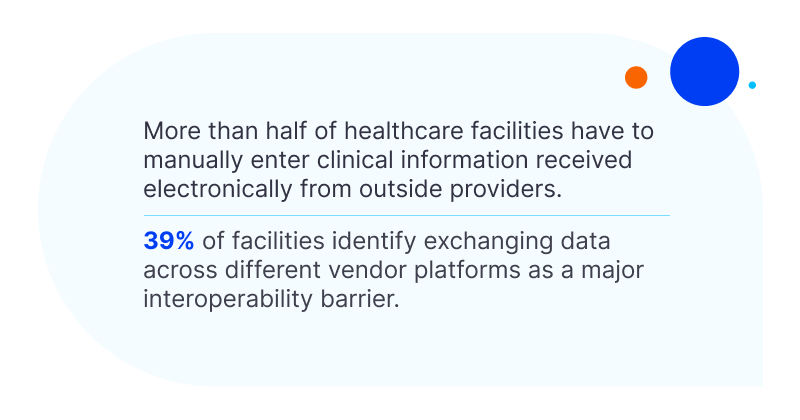
This challenge is common. According to data from The AHA Information Technology Survey presented in the Assistant Secretary for Technology Policy (ASTP) 2026 Annual Meeting, 39% of healthcare facilities still face interoperability issues across vendor platforms, while more than half manually enter clinical information received electronically from outside providers. Every additional handoff creates more reconciliation work, increases the risk of reporting inconsistencies, and makes revenue performance harder to model accurately.
Your EHR system sits at the center of this challenge because it captures a lot of the information that explains financial performance. If you can’t connect clinical activity, billing performance, and financial outcomes, forecasting becomes less reliable, and leadership spends more time validating numbers than making decisions.
And while fragmented reporting doesn’t necessarily signal poor performance, it does make your performance harder to prove. If you can’t clearly demonstrate what drives revenue or show that forecasts have historically been accurate, buyers are left with uncertainty. That uncertainty often affects both valuation discussions and confidence in future growth.
Performance Depends on Individuals, Not Systems
Investors want to know whether strong performance comes from the business itself or from a handful of people holding everything together.
When critical processes rely on individual knowledge, manual workarounds, or team-specific practices, consistency becomes harder to maintain. Staff spend time correcting errors, reconciling data, and moving information between systems instead of following standardized processes. Over time, performance starts to vary across providers, locations, and departments.
The cost extends beyond administrative inefficiency. It absorbs expensive clinical and operational capacity that could otherwise support patient care, revenue generation, or growth.
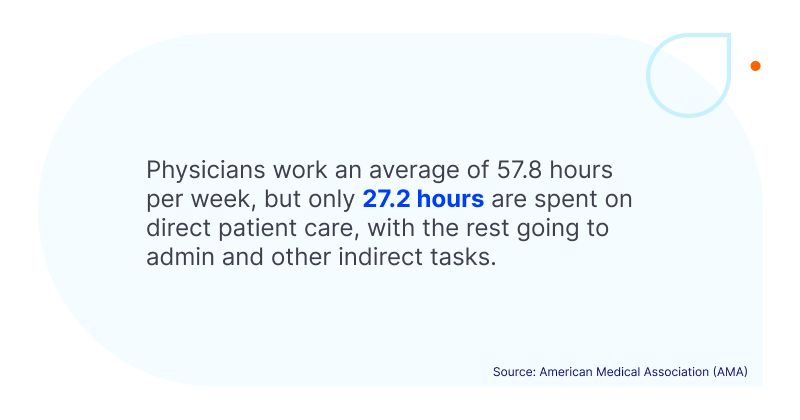
For example, the American Medical Association (AMA) found that physicians work an average of 57.8 hours per week, yet less than half of that time is spent on direct patient care. The AHA IT Survey mentioned earlier also found that 43% of physicians spend substantial time manually obtaining and uploading outside health information, while 41% spend several hours a day documenting care outside normal working hours.
There’s also a longer-term risk worth noting. When processes depend on institutional knowledge rather than embedded system logic, that knowledge doesn’t automatically transfer. For practice owners considering a future exit, partnership, or transition, buyers will ask whether performance holds without the people currently driving it.
When organizations rely on people to bridge system gaps, performance becomes harder to scale, and costs become harder to predict.
The financial consequences often appear in reporting and reimbursement performance. Cognizant Technology Solutions’ 2024 Revenue Cycle Rollercoaster Report found that 48% of finance leaders report billing errors tied to manual processes and staffing constraints. When revenue accuracy depends on people catching mistakes rather than systems preventing them, forecasting becomes less reliable, and financial performance becomes harder to substantiate.
Growth Plans Lack Infrastructure-Backed Credibility
Growth projections can strengthen valuation, but only if buyers believe they’re achievable.
Convincing buyers becomes difficult when growth projections rely more on assumptions than operational data. Buyers want to understand how additional providers, locations, services, or patient volume will affect revenue, operational costs, and staffing requirements. But if leadership can’t model those relationships with confidence, growth projections become harder to validate.
The challenge often starts with infrastructure. As organizations expand, disconnected systems create more reporting complexity, increased manual coordination, and less visibility into performance across the business. Instead of supporting growth, the technology environment begins creating additional operational overhead.
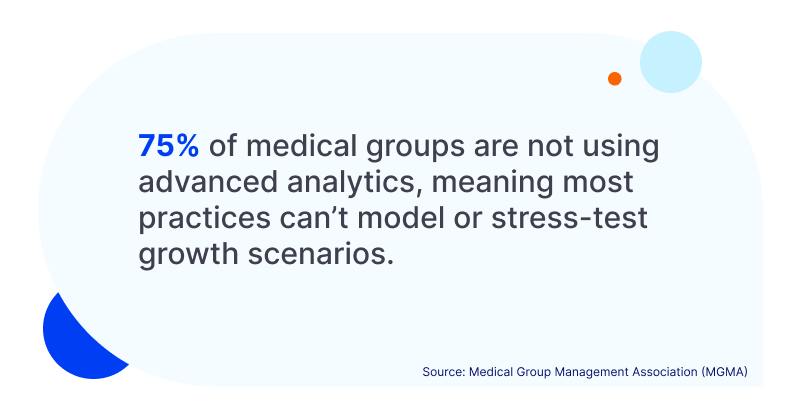
Industry data highlights the scale of the issue. The Medical Group Management Association’s (MGMA) August 2024 Stat poll found that 75% of medical groups are not using advanced analytics capabilities, limiting their ability to model or stress-test future growth scenarios.
The Healthcare Financial Management Association’s (HFMA) 2024 Revenue Cycle Management Survey also found that only 20.5% of healthcare organizations use automation to address staffing challenges, leaving many organizations dependent on additional labor as they scale.
So while growth potential is attractive, buyers will question how much work it takes to realize it. If expansion requires additional staffing, new technology investments, or significant operational changes, buyers may view growth as too costly and unpredictable. In those situations, buyers often treat projected growth as uncertain rather than achievable, reducing the value they assign to future performance.
How Mature Practices Build Investor-Ready Performance with the Right EHR Software
The difference between a practice that attracts investor confidence and one that struggles during diligence often comes down to evidence.
Higher-value organizations can explain what drives revenue, demonstrate how performance is measured, and show how the business can grow without introducing significant risk or complexity. Rather than relying on historical reporting alone, they build systems that make future performance easier to understand, validate, and trust.
Build Forecasting Models From Operational Drivers
By connecting financial results to operational drivers such as patient volume, payer mix, provider productivity, and service-line performance, leadership can spot trends earlier, test assumptions, and respond to changes before they become larger financial problems. Over time, that creates a clearer understanding of how the business performs and what influences future growth.
Forecasting becomes a by-product of that understanding. Instead of relying on assumptions, organizations can show how projections are built, which factors influence them, and how previous forecasts compared with actual results. That helps buyers assess one of the most important questions during diligence: how predictable future revenue appears to be.
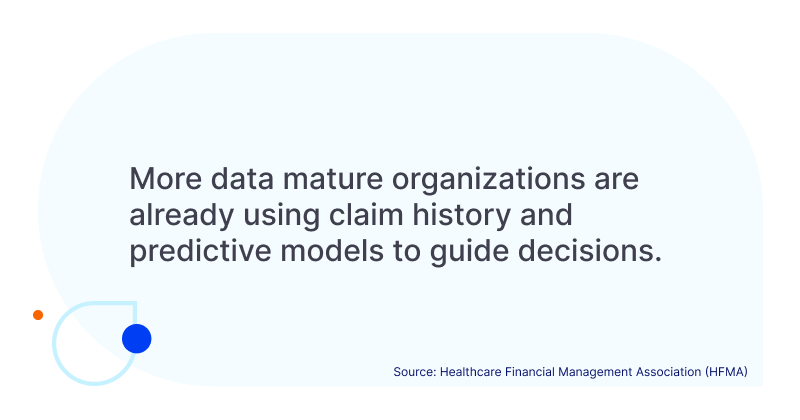
HFMA’s 2025 Healthcare CFO of the Future Report shows that more healthcare organizations are using predictive modeling and historical claims data to support operational and financial decision-making.
As these capabilities become more common, the gap widens between organizations that can support projections with evidence and those that cannot.
One organization can demonstrate how future performance is generated, measured, and improved. The other asks buyers to trust that future results will materialize. Those situations rarely receive the same valuation treatment.
Structure Reporting for Auditability and Due Diligence
Forecasting helps buyers understand where the business is going. Reporting helps them verify where it has been.
When reviewing financial statements, investors want to understand where the numbers came from, how they were calculated, and whether reported performance can be traced back to underlying operational activity.
Mature organizations make that process easier. Financial and operational reporting draws from the same underlying data, with consistent definitions across revenue, productivity, utilization, and reimbursement metrics. As a result, reported performance remains consistent regardless of how it is viewed or evaluated.
That level of consistency signals strong financial governance and operational control. This explains why, as HFMA’s Healthcare CFO of the Future Report found, mature healthcare organizations continue investing in integrated analytics, predictive modeling, and enterprise-wide financial visibility.
When reporting is traceable and verifiable, confidence builds more quickly, and conversations can focus on the opportunity rather than the accuracy of the data.
Design Infrastructure that Supports Growth from the Outset
Mature practices build infrastructure that scales alongside the business. Growth can be measured, managed, and monitored using the same systems that support day-to-day operations.
This approach is becoming increasingly common across healthcare. The AHA IT Survey found that 80% of facilities either participate in or plan to participate in TEFCA (the Trusted Exchange Framework and Common Agreement), while 93% have implemented FHIR-based APIs (Fast Healthcare Interoperability Resources (FHIR) is a data standard that helps healthcare systems share data securely and in real-time). Both trends reflect growing investment in infrastructure that supports connected operations and scalable growth.
This shift is important because, for investors, growth alone isn’t the goal. They want confidence that growth can occur without a substantial investment in new technology, extensive process redesign, or significant operational disruption. When infrastructure already supports expansion, growth appears more predictable and less risky. That predictability often translates into stronger valuation positioning and greater investor interest.
How the EHR Software Becomes a Measurable Enterprise Asset
The right EHR does more than support daily operations. In less mature environments, it functions as a system of record—capturing activity but not controlling outcomes. In investor-ready organizations, it becomes the financial and operational control layer, creating the visibility and consistency that investors look for when evaluating enterprise value.”
Creates a Single Source of Financial Truth Across the Business
Mature organizations connect scheduling, clinical, operational, and financial data within a single environment. That makes it easier to track performance over time, validate forecasts against actual results, and explain what drives revenue. Buyers can trace financial performance back to the underlying activity that generated it, strengthening confidence in both the numbers and the business behind them.
Standardizes Financial Logic Across Reporting and Decision-Making
When financial metrics use the same definitions across dashboards, reports, and financial models, reported performance remains consistent regardless of who generates the report. The result is reporting that’s easier to audit, easier to explain, and easier to use during diligence.
Enforces Consistent Execution at Scale
Mature organizations reduce variation by standardizing the way they capture, process, and report information across providers, locations, and services. As a result, performance becomes easier to manage and less dependent on individual knowledge or workarounds.
By connecting scheduling, clinical, and financial activity within a single environment, DrChrono by EverHealth helps organizations build the reporting consistency and financial traceability buyers expect during diligence. It embeds operational processes directly into day-to-day workflows. Rather than relying on individuals to interpret, coordinate, and manually manage activity across the organization, teams work from the same operational framework as the business grows.
That consistency signals scalable execution. Growth appears repeatable, infrastructure-enabled, and less dependent on individual effort, strengthening confidence in the organization’s long-term value.
When Technology Drives Value Under Investor Scrutiny
As healthcare organizations grow, investors increasingly look beyond revenue and profitability alone. They want to understand how you generate, measure, control, and sustain performance over time.
That’s why infrastructure maturity has become an important part of valuation discussions.
The organizations that command the strongest valuations are often the ones that make future performance straightforward to understand. They can explain what drives revenue, demonstrate how decisions improve outcomes, validate forecasts against actual results, and produce reporting that stands up to scrutiny.
In that environment, the EHR software becomes more than a clinical system. It becomes part of the infrastructure that supports enterprise value.
For practice owners considering growth, partnership, succession, or a future exit, one question is worth asking: if an investor reviewed your organization tomorrow, would they see a business that performs well today, or a business that can prove it will continue performing into the future?
Platforms such as DrChrono help organizations build the visibility, consistency, and operational control needed to answer that question with confidence. Schedule a consultation to learn more about how DrChrono can help you strengthen financial visibility, operational consistency, and long-term growth readiness.