

Most medical practices try to grow by filling out their schedules. They attract more patients, book more slots, and ramp up the volume. But a full schedule doesn’t guarantee practice efficiency.
When intake, rooming, or checkout can’t keep pace, the entire system backs up. Patients wait longer, providers fall behind, and staff members burn out. And all of this happens even when the calendar looks productive from the surface.
Nothing makes the patient flow efficiency problem clearer than by looking at AMN Healthcare’s 2025 Survey of Physician Appointment Wait Times, which states that the average wait time for a physician visit is now 31 days—a figure that’s still climbing. A survey by the Medical Group Management Association (MGMA) found that 72% of clinics operate at room utilization rates 20 points below the average range of 80% to 89%. More critically, the respondents noted that not hitting their capacity targets decreases patient throughput and, as a result, their revenue.
This guide reframes practice performance around patient throughput: the ability to move patients smoothly through every step of the visit, from arrival to exit. It identifies where the flow breaks down, then lays out a practical framework for redesigning operations around patient throughput rather than appointment volume alone.
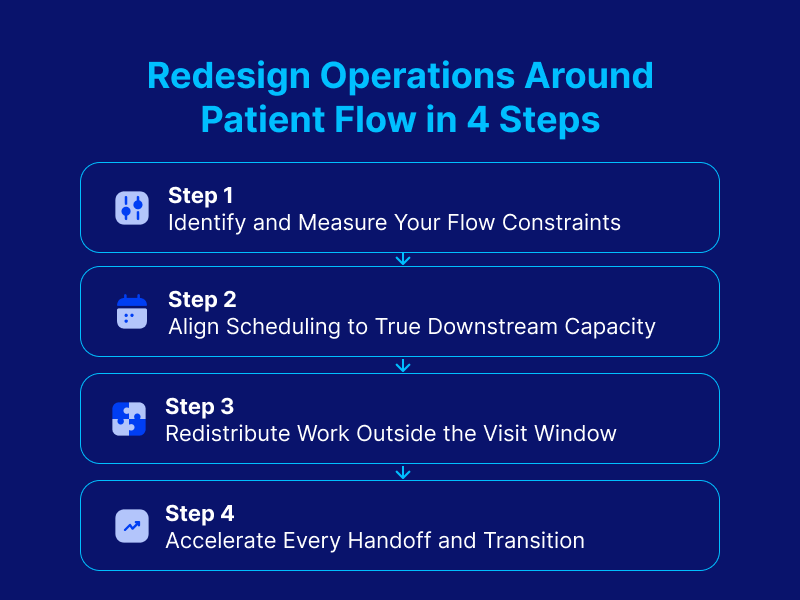
Practices that want to break this cycle can do four things. First, measure where the flow actually breaks down. Second, align scheduling to true downstream capacity, not calendar availability. Third, redistribute administrative work outside the visit window. And finally, accelerate every handoff and physical transition between steps. Done in sequence, these changes compound and turn a collection of what seems like isolated fixes into a coherent operational model that improves revenue, patient experience, and staff sustainability simultaneously.
The Hidden Cost of Volume-First Thinking for Patient Throughput
When practices focus primarily on filling the schedule, they often overlook the operational systems that need to support that volume.
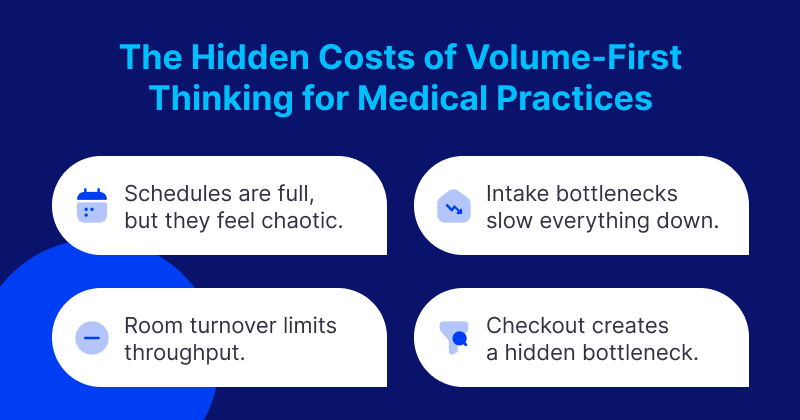
The costs of this misplaced focus show up in longer wait times, higher staff stress, and inconsistent patient experiences. If intake, rooming, or checkout can’t keep up, the entire system backs up. Patients wait longer, providers fall behind, and staff feel constantly rushed.
According to The American Journal of Managed Care (AJMC), the clinical ambulatory patient experience is heavily influenced by the time spent waiting for provider care. Wait times impact the likelihood that a patient will recommend a practice, as well as overall satisfaction.
Increased patient wait times also affect perceptions of information, instructions, and the overall treatment provided by physicians and other caregivers. In the end, the practice works harder, but not more efficiently.
The Solution: Identify and Measure Your Patient Wait Times Constraints
Throughput is achieved by removing the friction that slows each patient’s movement through the system. When you redesign operations around flow rather than volume, the same schedule produces better outcomes for patients, providers, and the bottom line.
The first step is to identify bottlenecks in intake, rooming, clinical care, and checkout. This gives leadership a clear picture of where time is actually being lost.
You also need to track and optimize room turnover time. By doing this, your practice can achieve a more consistent patient flow. Measurement creates a baseline that makes improvement visible and manageable over time.
Once you know where time is being lost, your next question is:
“Why is it being lost there?”
In most practices, the answer will trace back to a mismatch between how the schedule is built and what the operation can actually support downstream. Measurement, then, isn’t the endpoint. Instead, what you identify and measure will diagnose the problem and help you figure out where to intervene first.
Patient Intake Bottlenecks Slow Everything Down
Check-in is often one of the biggest constraints in patient flow. Paperwork, insurance verification, and manual processes take time, and delays at the front desk ripple through the entire schedule.
Adding more staff can help temporarily, but it doesn’t fix the underlying issue if the process itself is slow.
The Solution: Align Scheduling to True Downstream Patient Capacity
Instead of hiring more staff as a temporary band-aid, align scheduling with actual capacity across the full patient workflow. This leads to shorter wait times without reducing volume because the schedule reflects what the practice can actually absorb, not just what the calendar allows.
You should also balance volume so no single step becomes overwhelmed. This minimizes stress on staff and providers. When there are fewer cascading delays from one backed-up step dragging down everything after it, everyone can work more efficiently.
Aligning the schedule to true capacity solves the pacing problem, but it doesn’t address everything that happens within each visit slot. Even if your practice balances arrival intervals, the visit window itself can become bloated with administrative tasks that compete for clinical time.
The next lever in the throughput framework, then, is to look at what work is happening inside that window that doesn’t need to be there.
Room Turnover Limits Medical Patient Throughput
Even when providers stay on schedule, patient flow can break down if exam rooms aren’t ready for the next visit. Cleaning, prep, and rooming delays create gaps that reduce overall capacity.
This is a common problem. According to the MGMA survey cited earlier, two-thirds of health systems lack visibility into their exam room utilization. Providers may be ready, but the space isn’t. In these cases, rooms, not clinicians, become the limiting factor. And having no visibility into this issue makes the problem worse.
The Solution: Redistribute Work Outside the Visit Window
Work done during the visit window should be clinical, not clerical. To make the most of this window, move data collection and verification before the visit. The result is faster movement from arrival to exam room, with fewer delays cascading through the schedule.
Digital patient check-in also reduces front desk workload. Front desk staff can remain focused on exceptions instead of routine tasks.
You can also streamline patient intake steps to remove unnecessary delays. With digital check-in in place, patients spend less time in the waiting room and more time in clinical care.
Redistributing work outside of the visit compresses the non-clinical time inside it. However, it also exposes the final constraint. When intake is faster and clinical time is protected, the remaining drag on throughput is physical. It’s how quickly patients move between spaces and how quickly those spaces are reset. This is where the system either sustains its gains or gives them back in transition delays.
Patient Checkout Creates a Hidden Bottleneck
The visit isn’t over once the provider has done their job. After the provider leaves, patients still need to schedule follow-ups, receive instructions, and complete checkout. When this process is slow or crowded, it delays room availability and backs up the rest of the schedule.
Staff may rush through important steps just to keep things moving, which can cause gaps in care and follow-up.
The Solution: Accelerate Every Handoff and Transition
The smoother your practice can make every handoff and transition, the more patient throughput you can achieve without sacrificing quality of care or increasing volume.
First, streamline room prep between patients. Staff can achieve better use of existing space and rooms, and the practice increases capacity without adding providers. Next, coordinate staff workflows to reduce idle time between visits. Doing this allows each team member’s time to be used more intentionally, reducing the gaps that compound throughout the day.
To create faster, smoother patient exits, you also need to simplify and streamline checkout workflows. You can achieve this by using tools that help automate scheduling and after-care coordination at checkout. As a result, patients leave with clear next steps, and the room is available sooner for the next visit, improving flow across the entire practice.
Designing the High-Throughput Practice
Patient throughput doesn’t happen via a single fix, but rather by adopting a new design philosophy. When you optimize how patients move through each step, the entire system performs better without demanding more from the people inside it.
The practices that run the most smoothly aren’t necessarily seeing more patients. However, they’ve removed the friction between each step of the visit. That requires tools built around the full patient journey, not just one piece of it.
DrChrono by EverHealth is a cloud-based EHR platform built to support this kind of integrated thinking. From scheduling and intake to charting, billing, and checkout, it gives practices visibility across the entire workflow, making it easier to spot constraints, measure what matters, and redesign operations around flow instead of volume.
When the technology reflects how patients actually move through a practice, the gains in efficiency, experience, and revenue follow naturally.
If your schedule is full, but your operations still feel strained, the issue likely isn’t volume, but flow. Schedule a conversation with the DrChrono team to identify where throughput is breaking down in your practice and how to redesign your workflows around patient movement instead of appointment count.