

Executive Summary
For most practices, asynchronous care didn’t arrive as a strategy. Rather, this model accumulated over time. A messaging feature here, a digital intake form there, a remote monitoring program added to close a gap. Each piece seemed like a modest change when implemented. Together, they move a meaningful share of clinical work outside the appointment, where none of the operational scaffolding built for in-person visits applies.
The result is work that’s real, often billable, and largely invisible that gets absorbed after hours, documented inconsistently, and unaccounted for in staffing math. This isn’t just a persistentproblem—it’s a growing structural issue that requires a deliberate shift to fix. This paper treats the rise of asynchronous healthcare as the operational shift that it actually is and maps where practices need to rebuild to keep up.
What Is Asynchronous Care, And How Is it Different From Telehealth?
Asynchronous healthcare is clinical care delivered without the provider and patient interacting in real time. It’s not the same as telehealth, which includes live interactions between patient and provider through any telecommunications channel, such as a video call or phone.
Asynchronous care requires a fundamentally different operational model from both telehealth and traditional, synchronous, in-clinic care. And this operational model has direct consequences on the entire operations of a practice, especially if they’re not equipped for it.
Unlike synchronous telehealth, which relocates the live visit to video, asynchronous care changes when and how clinical work happens, not just where.
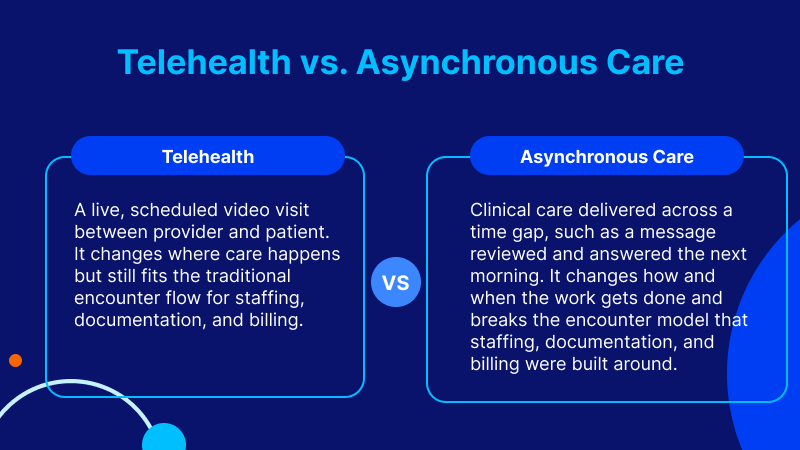
Here’s an example of what this can look like, as well as the potential impact on practice operations.
Let’s say a patient submits a secure message overnight describing worsening eczema. The same patient also uploads photos of their symptoms. The next morning, a clinician reviews the message and the images. After observation, the clinician adjusts the patient’s treatment plan and sends them an updated prescription. The issue gets resolved without a scheduled visit. For the patient, this is great news, but for the clinician, this unscheduled issue still demands the same operational steps as an in-clinic visit. There’s a chart review, clinical judgment, and a documented record.
This type of asynchronous healthcare does not occur because a practice purposefully adds it to its list of services, but because of technologies implemented to solve other problems. Secure messaging, digital follow-ups, remote intake, and virtual check-ins all solve operational problems, but in doing so, they change how work gets done. Let’s explore these implications further.
The Operational Implications of Asynchronous Healthcare
Asynchronous care continues to rise and isn’t likely to go down because of the convenience it offers patients. According to the Journal of General Internal Medicine (JGIM), patient messages rose significantly during the peak of the COVID-19 pandemic, and that volume has remained significantly higher than pre-pandemic levels. Fielding these messages represents real work. Each additional 10 patient messages is associated with an average of 12 minutes of additional time spent in the EHR per quarter. It also increases after-hours EHR time.
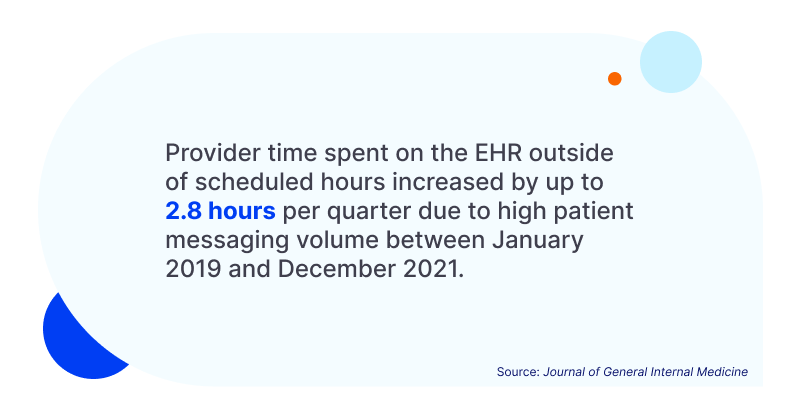
This additional workload is structural. And the operational implications of asynchronous care are underestimated by practices treating it as a simple communication channel. Not only does this care model require additional time, but provider workflows, staffing models, documentation patterns, and patient expectations all shift when it’s implemented in a practice. Asynchronous care requires a completely different infrastructure from synchronous care. It requires different staffing logic and different documentation approaches as well.
The specific requirements and implications of asynchronous care can be represented across four dimensions of practice operations: staffing, documentation, patient expectations, and revenue models. Practices that operationalize asynchronous care effectively, via these four dimensions, will expand their capacity and improve patient access without adding encounters.
Staffing Models Designed for Synchronous Care Encounter Throughput Can’t Handle Asynchronous Volume
Traditional practice staffing is built around encounter throughput: how many patients can be seen per provider per day. But when care is increasingly delivered through asynchronous healthcare channels, such as messages requiring clinical responses, digital follow-ups requiring review, and remote intake processing, the work no longer fits these throughput-based staffing models.
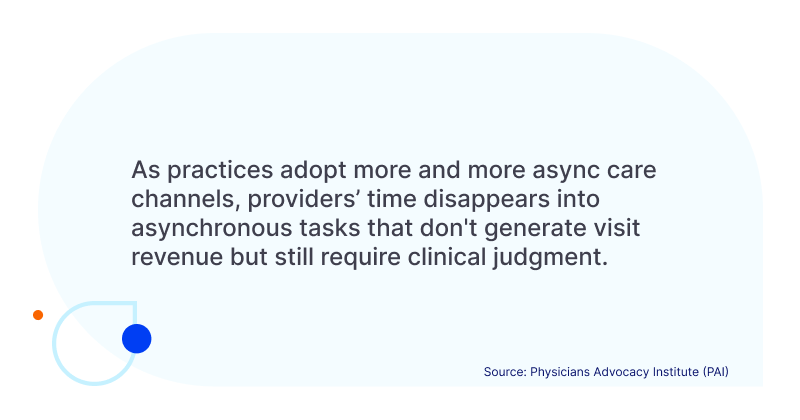
As a result, a provider’s time disappears into tasks that don’t generate visit revenue but still require clinical judgment. And because practices typically make their staff capacity calculations based on encounter volume, these calculations don’t account for asynchronous care labor.
Both providers and support staff become overstretched by increasing asynchronous volume without clear visibility into why.
How to Redesign Staffing Models for Asynchronous Care
The first step to solving the staffing dimension is to redesign staffing models so they account for asynchronous healthcare labor alongside synchronous encounter capacity.
To do this, implement measurement frameworks that capture provider and staff time used for patient messaging and other asynchronous care activities. Additionally, deploy care team staffing that includes roles specifically designed for asynchronous care management. Once you have reliable asynchronous care volume data and are tracking time spent, you can make staffing decisions that reflect total clinical work.
With this updated, more accurate staffing model, your staffing will better match total care delivery. Provider workload in your practice will be accurately reflected in capacity planning rather than invisibly absorbed outside encounter hours. And your operational cost models, now that they include asynchronous care labor in practice economics, will also become more accurate.
Documentation Requirements for Asynchronous Healthcare Create Compliance and Quality Risk
Traditional documentation frameworks are built around the clinical encounter. These frameworks expect a structured note that captures a synchronous patient visit. Asynchronous healthcare creates documentation requirements that don’t fit these templates. For example, a clinician may exchange messages with a patient to provide clinical advice, send a digital follow-up that changes a care plan, or perform a remote intake that affects clinical decision-making.
Because of the lack of flexibility for these documents, practices either under-document asynchronous care, which creates compliance and quality risk, or force their notes into encounter templates that don’t fit, which creates an additional documentation burden. Both of these workarounds create regulatory exposure and gaps in record quality.
Documentation Frameworks for Asynchronous Care
Solving the documentation dimension requires documentation frameworks specifically designed for asynchronous care modalities. You can deploy structured documentation templates for message-based clinical interactions, digital follow-ups, and remote intake. Use asynchronous care documentation tools that capture clinical content to make the process more efficient.
Implementing these frameworks allows for complete and compliant documentation of all clinical care, regardless of delivery modality. For practices, this reduces the compliance risk caused by under-documentation of asynchronous clinical interactions, but it also leads to more accurate clinical records because they capture care plan evolution through asynchronous interactions.
Patient Expectations for Response Time Create Unsustainable Demand on Clinical Staff
Asynchronous care shapes patient expectations around response time. In digital messaging, fast responses are the norm, so there’s an assumption that clinicians or staff will answer quickly. But practices have enabled this access without building the care team infrastructure to manage it, which means patient-preferred timelines don’t align with clinical workflow realities.”
For example, patients sending messages at 9 p.m. might expect responses before their appointment the next morning. Digital follow-up questions assume rapid clinical review. Remote intake assumes real-time processing.
All of these examples cause clinical staff to face constant demand, which fragments their attention throughout the day and impacts operations. This happens because practices adopt asynchronous modalities without managing response time expectations and creating appropriate care team workflows. Managing asynchronous access sustainably requires a workflow dedicated to this care modality
.
How to Design Asynchronous Care Team Workflows
The first step to creating an asynchronous care team workflow is to establish clear response time standards by asynchronous care type. Then, these standards must be communicated to patients at adoption.
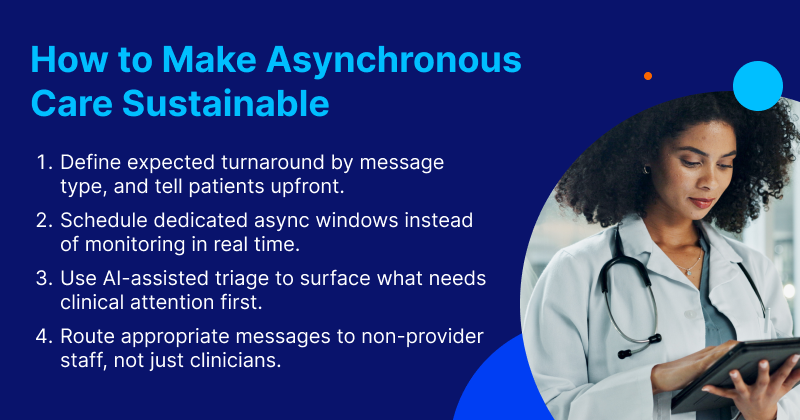
Staff and clinicians can batch and schedule asynchronous care review rather than feel obligated to engage in constant real-time monitoring. You can also use AI-assisted triage that prioritizes clinical review of asynchronous content by urgency. Once this is in place, you can deploy team-based asynchronous care management where non-provider staff handle appropriate message types.
Practices that create these workflows will achieve sustainable asynchronous care delivery and avoid the constant interruptions of sporadic messaging.
Additionally, when clinician responses follow structured timelines, patients experience reduced frustration because their new expectations align with the reality of the workflow. Provider focus will be protected through scheduled asynchronous care review rather than fragmented real-time response, and care teams will have the capacity to scale asynchronous care volume through structured management rather than placing additional burden on individual providers.
How to Capture Reimbursement for Asynchronous Clinical Work
Significant clinical work happening through asynchronous channels goes uncompensated because practices haven’t implemented billing infrastructure for asynchronous healthcare services.
E-visit codes, chronic care management billing, and remote physiological monitoring codes create reimbursement opportunities for clinical work that practices are often already delivering. This clinical labor consumes provider and staff time without generating appropriate reimbursement, creating a revenue gap. This is because billing for asynchronous care requires coding and documentation approaches that most practices haven’t implemented.
Turning Asynchronous Care Into a Competitive Advantage
To implement coding and billing workflows for asynchronous care, start by identifying applicable reimbursement codes for asynchronous care services being delivered. This may include e-visits, CCM, TCM, RPM, and more. Then, implement the documentation workflows that support asynchronous care billing requirements.
This includes training your billing staff on asynchronous care coding to ensure appropriate reimbursement capture. You should also start using asynchronous care delivery as an opportunity to access value-based care reimbursement tied to care management activities.
By developing this infrastructure, practices can turn asynchronous care into a model that’s both operationally and financially sustainable, which becomes their new competitive advantage. They start capturing revenue for clinical work that was previously delivered without reimbursement. Their asynchronous care becomes both clinically valuable and financially sustainable, and their billing capacity keeps pace with the evolution of their care model.
How Asynchronous Care (Done Right) Expands Capacity Without Adding Encounters
When asynchronous healthcare is properly staffed, documented, and managed across all four dimensions, it stops being invisible overhead and becomes true operational capacity. The work that was previously absorbed after hours now has dedicated roles, structured workflows, and reliable measurement behind it. Providers regain focus because asynchronous review happens on a schedule instead of constantly interrupting their work, and support staff handles the message types that don’t require a clinician.
The result is a practice that serves more patients without booking more visits. Issues that once required an appointment, such as medication adjustments, follow-up questions, or symptom checks, are resolved through asynchronous channels that are now compensated, compliant, and sustainable. Capacity expands without packing the schedule tighter because clinical work is matched to the right modality and the right team member.
Practices that make this shift deliberately will turn expanded patient access into durable competitive advantage. As asynchronous volume continues to climb, their operations will scale with it instead of straining against it. What was once a structural problem becomes a strength that competitors who simply absorb the work by accident can’t match.
Build the Medical Practice Operations Before the Volume Overwhelms You
Asynchronous care will keep growing whether or not practices prepare for it. The only real choice is whether it scales on purpose or by accident. The practices that pull ahead won’t be the ones offering the most digital channels. They’ll be the ones whose staffing math, documentation, response workflows, and billing were deliberately rebuilt to support care that no longer fits the encounter. That groundwork doesn’t happen on its own, and the cost of waiting compounds with every new inbox message.
DrChrono by EverHealth helps practices operationalize asynchronous care by capturing the clinical work, documentation, and reimbursement that legacy systems leave on the table. Get in touch with our team to see where your operations stand and how we can support you.