

Executive Summary
Patient experience in healthcare is more than a soft metric. It’s a revenue driver that affects reimbursement, retention, and growth. In value-based reimbursement models, satisfaction and experience measures can directly affect payment performance. That makes patient experience part of the financial equation.
Poor experience can create revenue leakage that is often hard to trace because it rarely appears as one clear financial problem. It can show up as missed appointments, online reputation damage, patient churn, and lower satisfaction scores.
Accenture research shows how quickly experience issues can affect retention: one in five consumers switched providers in 2024, and nearly 90% did so because the organization was hard to do business with.
Instead of seeing patient experience as an expense, practices should build it into their financial strategy to help drive growth. By connecting experience metrics with revenue indicators, practices can identify where friction affects performance, prioritize improvements with the clearest business case, and build a clearer patient experience ROI framework.
The Revenue Cost of Underinvesting in Patient Experience
Here’s what practices that still separate patient experience from financial performance are getting wrong:
Treating Patient Experience as a Cost Center
Many practices still treat patient experience improvements as expenses, especially when teams are already managing staffing pressure, administrative workload, and tight margins. But neglecting patient experience doesn’t eliminate the costs; it just makes them harder to see.
Poor patient experience can create financial pressure across the practice. It may show up as lower patient retention, unused appointment slots, weaker referrals, delayed payments, added staff follow-up, or poorer performance in value-based models. These costs often appear as separate operational problems instead of one clear patient experience problem.
How practices can better understand the financial impact of patient satisfaction
Instead of treating patient experience as a service or satisfaction goal to hit, evaluate it as part of financial performance. That means quantifying how experience affects revenue across retention, referrals, reimbursement, completed visits, and collections. For example, what’s a referral worth for your practice? Are collection rates higher among patients who report higher satisfaction?
By tracking those patterns, leaders can see which experience issues deserve priority. They have more clarity on the potential return on experience investments, so they can make better-informed decisions about where to invest.
Underestimating the Cost of Patient Loss
Many practices invest heavily in attracting new patients, but overlook the patient retention economics behind keeping existing ones. What they don’t realize is that patient loss costs more than just the next appointment.
When patients leave because of poor access, long wait times, unclear communication, billing frustration, or inconsistent follow-up, practices are losing future visit revenue, preventive care and chronic care opportunities, and downstream services.
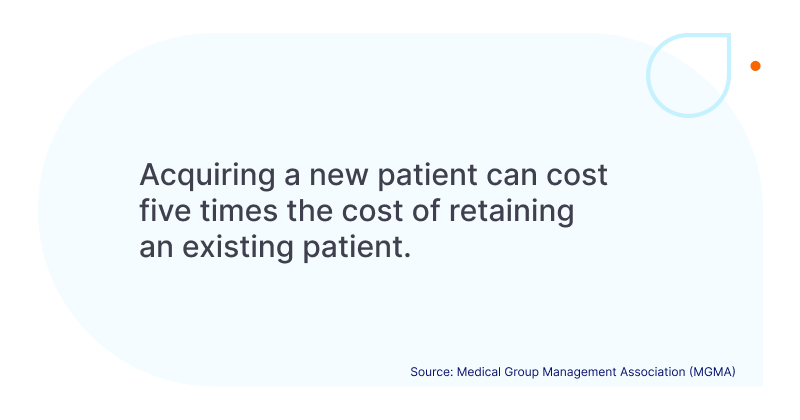
Replacing those patients also creates more expenses through marketing, staff time, and unused appointment capacity. According to the Medical Group Management Association (MGMA), acquiring a new patient can cost about five times more than retaining an existing patient.
How practices can improve patient retention economics
Calculate patient lifetime value to understand the full cost of attrition. Track why patients leave and identify experience-related drivers, such as access, communication, or billing.
With that insight, practices can compare retention costs with acquisition costs and prioritize efforts that reduce avoidable churn to protect long-term patient value and lower replacement costs.
Separating Patient Satisfaction Scores from Financial Planning
Healthcare satisfaction metrics are often reviewed, but not financially interpreted. When medical practices fail to evaluate the financial impact, they miss where experience performance is affecting retention, reimbursement risk, and value-based contract performance.
For example, if patient satisfaction scores show repeated frustration with scheduling, the issue may not just be a service problem. It may also mean patients are less likely to return for future visits or complete the next step in care.
Research published in INQUIRY: The Journal of Health Care Organization, Provision, and Financing found that patient satisfaction had a significant positive effect on patient loyalty. In value-based payment environments, experience metrics can affect payment performance when they’re tied to quality, access, engagement, or patient-reported outcome measures.
How practices can better utilize patient satisfaction metrics
Satisfaction scores need to be evaluated as part of financial planning. Practices should track experience metrics alongside revenue indicators and quantify their impact when those measures are tied to value-based reimbursement.
When patient satisfaction data signals retention, reimbursement, or revenue risk, it should inform forecasting and budgeting. Leaders move from reviewing satisfaction scores to using them to improve financial decisions.
Treating Online Reputation as Only a Marketing Metric
While online reputation is often seen as a marketing concern, it directly influences patient acquisition and growth. Before a patient books an appointment, they may already be comparing providers through reviews, ratings, and feedback.
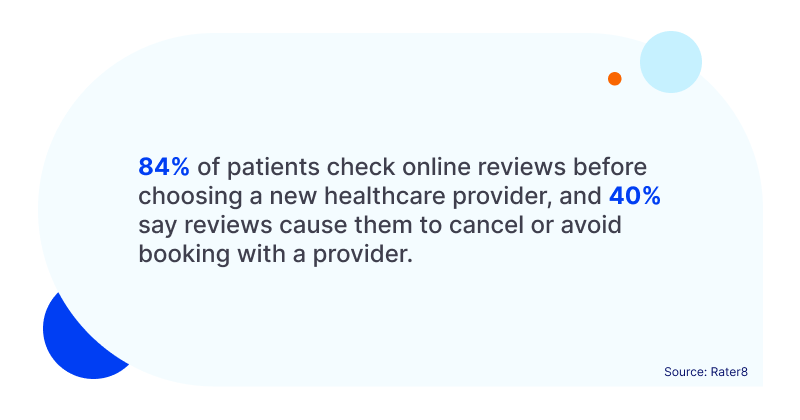
A 2025 rater8 survey reported that 84% of patients check online reviews before choosing a new healthcare provider, and 40% said reviews caused them to cancel or avoid booking with a provider. Negative reviews, poor ratings, or a lack of recent feedback can all reduce appointment conversion and increase reliance on paid acquisition.
How practices can use reputation feedback to improve patient experience ROI
Practices should treat online reputation as part of growth performance. Track how reputation connects to new patient volume through rating trends. Review volume and recency, referral sources, call or form conversion rates, and acquisition costs.
It’s also helpful to review patient comments for recurring operational issues, such as access problems, long wait times, communication gaps, or billing frustration, and identify areas for improvement. By fixing experience gaps, practices can earn stronger reviews, which can lower acquisition costs and increase patient volume.
Why Patient Experience Has Become a Financial Performance Issue
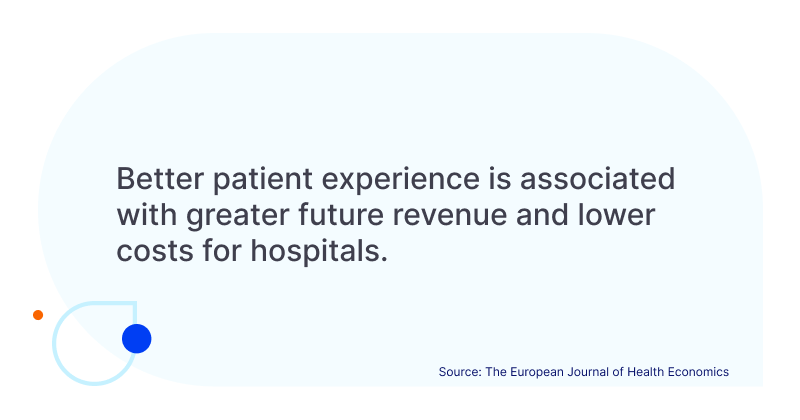
A 2023 study published in the European Journal of Health Economics found that better patient-reported experience was associated with greater future revenue and lower costs for hospitals.
Here are the different ways patient experience shapes financial performance.
Reimbursement
Experience-based reimbursement can affect payment performance when satisfaction, access, communication, and care experience measures are tied to value-based contracts.
For example, the Centers for Medicare & Medicaid Services (CMS) uses HCAHPS to measure patients’ perspectives of hospital care. The HCAHPS reimbursement impact is reflected in the Hospital Value-Based Purchasing program, which adjusts acute care hospital payments based on quality performance.
CMS QualityNet also lists Person and Community Engagement as one of the four Hospital VBP domains, weighted at 25%. Appointment access, front-desk responsiveness, clinician communication, follow-up instructions, care coordination, and billing clarity all become financially relevant.
When experience metrics are tied to payment, everyday workflows become part of the reimbursement strategy.
Patient Retention and Churn
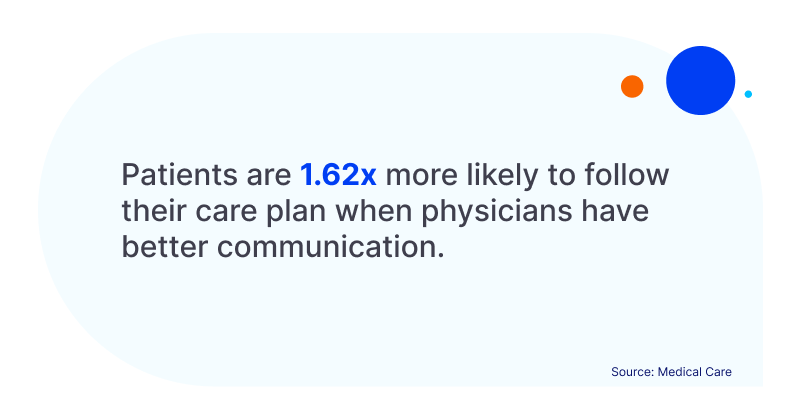
Patient experience affects whether patients complete visits, return for follow-up, and continue care over time. In fact, a meta-analysis published in the journal Medical Care found that the odds of patient adherence were 1.62 times higher when physicians had better communication.
Front-end issues, such as friction in scheduling, reminders, intake, check-in, communication, or payment, can quickly become revenue issues. No-shows, late cancellations, incomplete intake, and scheduling delays all reduce capacity utilization and create revenue leakage. Over time, repeated friction can also push patients to leave the practice entirely.
Practices that prioritize reducing friction across the patient journey have a steadier base of future visits and more predictable revenue.
Online Reputation and New Patient Growth
A positive patient experience can help generate new patient demand. Patients who had a good experience are more likely to recommend the practice, leave strong reviews, and help build trust among prospective patients.
Online reputation often shapes the top of the growth funnel. If two practices offer similar services, the one with better reviews, clearer communication, and fewer complaints has a higher chance of turning an online search into an appointment.
Poor experience can hurt the practice’s reputation, reduce appointment conversion, and increase the need for paid advertising.
How to Build a Patient Experience ROI Framework
To measure patient experience ROI, practices need a clear way to connect patient friction with financial impact:
Identify the Patient Experience Problem
Start by defining the specific experience issue the practice is trying to solve. This may be scheduling friction, no-shows, or long wait times. Without a clear problem, practices may spend on broad experience initiatives without knowing which issue is actually affecting financial performance.
Quantify How Patient Experience Affects Revenue
Once the problem is defined, connect it to the revenue channel it affects, including retention, referrals, reimbursement, and growth. For example, poor communication may weaken follow-up and create reimbursement risk, while difficult scheduling may lead to fewer completed visits and higher churn.
Choose Metrics That Show Financial Impact
Next, choose metrics by revenue channel so patient experience issues can be connected to measurable financial impact:
- Retention: Track patient churn, retention rate, patient lifetime value, and common reasons patients leave.
- Reimbursement: Track satisfaction scores and identify where those scores affect value-based payments, payer performance, or quality incentives.
- Reputation and growth: Monitor rating trends, volume and recency, new patient appointments, call conversion rates, referral sources, and acquisition costs.
Estimate Revenue at Risk
To understand the cost of inaction, estimate how much revenue is at risk if the experience problem continues:
- If no-shows are tied to poor reminders or scheduling friction: Estimate the value of missed visits.
- If churn is tied to access, communication, or billing problems: Estimate lost revenue using patient lifetime value.
- If bad reviews reduce new patient volume: Estimate the impact on acquisition cost and growth.
Practices can better identify where poor experience poses the greatest financial risk and prioritize improvements with the strongest business case.
Compare Improvement Costs Against Return
Finally, compare the cost of experience improvements with the revenue protected or gained. Costs may include online scheduling, digital intake, appointment reminders, patient communication tools, payment workflows, or staff training.
Prioritize improvements with the clearest financial upside. For example, if no-shows are creating revenue leakage, investing in better appointment reminders may protect more revenue than a less targeted patient engagement campaign.
Remember, ROI should be tracked over time because some returns appear quickly, while others, such as stronger retention or reputation, take longer to measure.
Start Driving Sustainable Growth with a Better Patient Experience
A better patient experience is a growth strategy. When practices understand how experience affects retention, reimbursement performance, reputation, and patient growth, they can make more focused decisions about what to improve.
DrChrono by EverHealth helps practices manage the workflows behind patient experience and revenue performance in a unified way. Instead of treating experience issues as isolated fixes, your practice can manage them as connected parts of the same patient journey and build a stronger foundation for sustainable growth.
Learn more about how DrChrono can help your practice turn a better patient experience into sustainable growth.