

Family medicine is the first point of contact for many patients. Family physicians handle acute care, preventive services, and chronic disease management across all age groups, and often in the same clinic session. These different care needs compete for the same time, staffing, and scheduling capacity.
When urgent cases have to fit into an already full schedule, preventive visits and chronic follow-ups are often the first to be shortened, rescheduled, or reassigned. Cancellations often result from pre-set scheduling templates that cannot absorb same-day urgent demand, forcing practices to move planned visits to create space for acute needs.
While this may solve an immediate scheduling problem, it makes preventive care less predictable and weakens the patient-provider relationship over time. Reactive scheduling also increases administrative burden and financial strain as repeated inefficiencies build across daily operations.
Rigid workflows aren’t built for this level of variation. Fixed templates, reactive scheduling, and manual coordination make access unpredictable and disrupt care continuity. As patient demand grows, these issues only become more apparent.
The issue is not just insufficient appointment slots. It’s inflexible systems that force every visit type through the same templates, creating ongoing scheduling instability across the practice.
Flexible clinical workflows in family medicine strengthen access and preserve continuity of patient care. When systems are designed to reflect visit diversity and real patient demand, practices can expand access without compromising care delivery.
Demand Variation in Family Medicine Impacts Continuity and Care Coordination
Family medicine operates with a broader scope than most specialties as it treats patients across all ages and conditions. In fact, according to research released by the American Board of Family Medicine, IBM Watson Health, and the Robert Graham Center, family medicine accounts for the largest share of office-based physician visits, making it the focus of healthcare for most Americans.
Over 200 million visits each year start with family medicine.
Source: Primary Care in the United States: A Chartbook of Facts and Statistics
Family physicians are often the primary point of contact and the ongoing care provider. As such, they play an important role in long-term patient outcomes. But there’s also more variation in care delivery. Family practices have to manage different patient needs, timing, documentation, and follow-up requirements, all within the same operating model.
That’s where operational complexity begins to build. Family medicine requires workflows that can adapt to changing demand, but many standard EHR systems are designed for more episodic care patterns.
When systems are built to document visits one at a time rather than support care across visits and life stages, care coordination and continuity become harder to sustain.
Treating Patients Across Ages Makes Continuity More Complex
Family medicine treats pediatric, adult, and geriatric patients. The broad age range means that not only is there more work volume, but also more complexity.
Every age group has different visit goals. A 12-year-old may visit for vaccines or growth monitoring, while a 30-year-old might come in for reproductive health counseling or acute care. A 50-year-old, on the other hand, may need follow-up for a chronic disease or medication management.
All these visits require different templates, documentation sets, preventive protocols, and follow-up intervals that most generic EHR systems aren’t designed to support. This matters because continuity has a measurable impact on clinical outcomes and the overall cost of care. According to Health Services Research, uninterrupted care is strongly tied to fewer hospitalizations and emergency department visits.
This complexity can also trickle down to the scope of care. When clinical workflows are too rigid to efficiently accommodate pediatric and adult care, practices often reduce their age range rather than try to go against the tide. Research from Annals of Family Medicine found that children are 5% less likely to receive care from a family medicine practice.
Maintaining a broad age range of care becomes operationally difficult when staff rely on manual coordination, but managing different types of visits also creates strain.
Urgent, Preventive, and Chronic Care Compete for the Same Capacity
One of family medicine’s biggest operational challenges is that very different visit types have to fit into the same schedule. Family practices often have to move through all of the following within the same day:
- Same-day acute concerns: Needs fast triage and quick appointment access
- Preventive visits: Depend on protected time and standardized documentation
- Chronic care follow-ups: Require consistent intervals, medication review, and ongoing care planning
These visits don’t operate on the same logic. They require different appointment lengths, documentation needs, and follow-up timelines, yet they all compete for the same daily capacity.
When the day is already full, urgent demand is often absorbed first, and preventive and chronic care are pushed aside. A same-day asthma flare-up may take the place of an annual wellness visit. A blood pressure follow-up may be moved to create room for an acute infection.
Tradeoffs become a part of the operating model. Access becomes less predictable as same-day needs compete with planned care. Patients learn they can get same-day appointments for acute needs, but they struggle to book preventive care weeks ahead.
Continuity weakens as follow-ups get pushed out or reassigned. When routine visits are repeatedly moved, patients see different providers or delay care entirely. This increases the chance that unresolved issues from delayed treatment will resurface later as urgent health issues.
Missed or moved visits do not reduce workload; they actually create more of it. According to the journal, Intelligence-Based Medicine, these disruptions create inefficiencies that ripple throughout the healthcare system. Staff have to spend more time coordinating schedules, handling rescheduling calls, managing additional inbox messages, and reworking follow-up plans.
As the JAMA article, Advanced access: reducing waiting and delays in primary care, suggests, same-day access improves when practices redesign capacity around real demand rather than forcing all visit types through rigid templates. That means building flexibility into the schedule so there’s room to absorb variation.
Now, let’s look at how a lack of flexibility in family medicine workflows can cause other challenges downstream, including reactive scheduling, staff burnout, and unpredictable financial performance.
Inflexible Clinical Workflows in Family Medicine Create Downstream Strain
Family medicine demand is inherently variable, but many practices still rely on workflows that assume predictability.
Rigid Scheduling Creates Ongoing Instability
Many family medicine schedules are built on fixed templates that assume predictable demand. Set blocks for annual exams and follow-ups booked weeks in advance are the norm. While this model may work in more predictable specialties, it’s a poor fit for family medicine. There are constant demand shifts, whether because of same-day illness, seasonal spikes, medication issues, or patient availability shaped by work and school schedules. The usual response is cancellations, double-booking, overflow slots, and last-minute shuffling to create space.
Schedule management then becomes reactive. A schedule may look full and organized on paper, but in practice, it’s unstable. Let’s say a week is booked well ahead with annual visits and chronic follow-ups, but by Tuesday, several same-day acute requests arrive. Staff create room by compressing visit lengths, moving routine care, and relying on no-show openings. By the end of the week, the schedule has been patched together, but it’s no longer predictable.
A 2025 Annals of Family Medicine study found that schedule lead time is the strongest predictor of missed appointments. The further out care gets pushed, the more likely it is to fall through. The longer patients wait for care, the more likely they are to forget, have scheduling conflicts, or find care elsewhere.
This reactive approach to scheduling simply redistributes strain. Staff face frustration managing constant changes, patients endure delays and rescheduling, and providers navigate overbooked or compressed schedules.
Access to Care Is Limited and Fragmented
A 2025 National Academy of Medicine policy brief reveals that more than 100 million people in the U.S. are experiencing a serious lack of access to primary care. The average wait time to schedule a family medicine appointment is 20.6 days, even for patients who already have a regular primary care provider. Because family medicine often manages both immediate concerns and ongoing care, delays can disrupt treatment and worsen downstream outcomes.
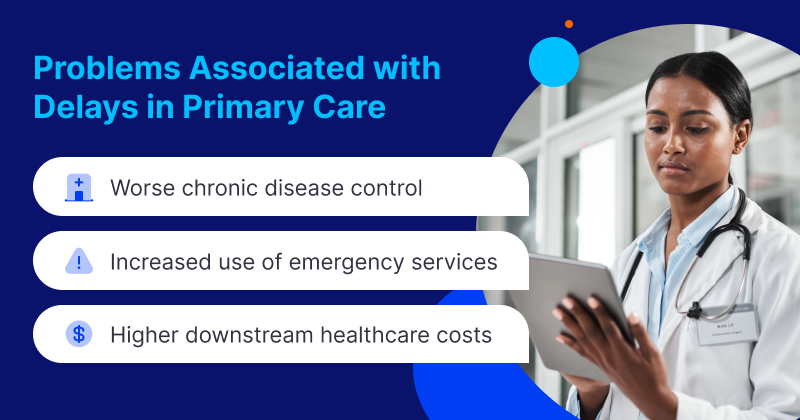
The Agency for Healthcare Research and Quality shows delays in primary care are associated with worse chronic disease control, increased use of emergency services, and higher downstream healthcare costs.
Patient behavior often changes when there’s limited access to care. Many patients end up seeking care in urgent care or emergency department settings, delaying care until symptoms worsen, or skipping preventive visits altogether.
When care happens across multiple settings instead of one consistent provider, it becomes fragmented and harder to coordinate. A systematic review from Nursing Open found clear evidence that care fragmentation is associated with adverse outcomes for people with chronic illness.
If a patient with worsening blood pressure cannot get a timely family medicine appointment, they might go to urgent care for interim treatment, but then have their medication adjusted without the full longitudinal context. The immediate issue may be addressed, but the broader care plan is still unresolved. Follow-up with the PCP may then be delayed even further.
With weaker access, the role of a PCP is harder to maintain as the central point of continuity and coordination.
Operational Efficiency Breaks Down
Operational inefficiency in family medicine is often not a staffing issue, but a system design issue. When workflows aren’t easily adaptable, teams are forced to manage variation through manual workarounds instead of built-in flexibility.
Inefficiencies show up across daily operations, from scheduling and documentation to follow-up, referrals, and patient communication. A significant portion of staff time may be redirected from care coordination to managing exceptions. Teams often spend time handling rescheduling calls, searching for alternative appointment slots, manually routing urgent requests, and reconciling mismatches.
Administrative burden already consumes a big portion of clinical time. The AMA reported that physicians spend nearly two hours on EHR and desk work for every one hour of direct patient care. In primary care practices, the median value of all the time spent interacting with health plans is nearly $48,000 per year per physician, according to the American Academy of Family Physicians (AAFP).
When schedules are unstable, that burden amplifies. Clinicians need to re-review charts for rescheduled patients, and staff must coordinate labs, referrals, and instructions across shifting timelines. Documentation is more likely to be finished outside clinic hours.
For example, when a chronic care visit is rescheduled due to schedule pressure, lab orders and follow-up plans need to be re-coordinated. Staff must re-contact the patient, update the schedule, and track outstanding tasks across multiple touchpoints. One visit becomes several disconnected tasks.
More effort is spent managing processes than delivering care. It’s not that staff are inefficient; it’s that they’re working within systems that require constant correction, and teams are left playing catch-up.
Provider Strain and Burnout Increases
Family medicine practices have to handle broad clinical variation, continuity responsibilities, and repeated workflow disruption in a single day. Reactive workflows only make that harder. Clinicians lose control over pacing and visit flow when the day is shaped by constant changes and urgent add-ons. A 2025 study from The College of Family Physicians of Canada found that administrative burden in primary care is pervasive and structurally embedded, affecting physicians’ sense of control over clinical work and contributing to strain in day-to-day practice.
That strain leads to physician burnout. The 2025 Survey from the Commonwealth Fund reports that more than two in five U.S. primary care physicians report burnout, one of the highest rates among 10 high-income countries.
U.S. primary care physicians have one of the highest burnout rates among high-income countries.
Source: The Causes and Impacts of Burnout Among Primary Care Physicians in 10 Countries.
Reactive workflows create a constant sense of unfinished work, which contributes to emotional exhaustion, lower job satisfaction, reduced scope, and difficulty retaining family physicians.
Simply adding providers does not automatically reduce strain in family medicine. Adding providers without fixing workflows may increase appointment capacity, but it doesn’t reduce the coordination burden, scheduling instability, or sense of fragmentation. A five-provider practice with rigid workflows can feel more chaotic than a three-provider practice with flexible systems.
Financial Performance Becomes Less Predictable
In family medicine, financial performance depends on a stable mix of visit types. Preventive and chronic care are central because they support quality performance through measures like the Healthcare Effectiveness Data and Information Set (HEDIS), and they create more predictable reimbursement.
Changes in appointments, on the other hand, create revenue variability. For example, when a chronic disease management visit is delayed, the practice may lose timely opportunities for medication adjustment, lab review, follow-up planning, and the reimbursement tied to that completed care episode. Some practices may start to rely too heavily on same-day acute visits to fill immediate demand. But acute visits don’t replace the financial value of preventive and chronic care.
A study in Frontiers in Health Services found that missed appointments cost the U.S. health care system more than $150 billion a year and individual physicians an average of $200 per unused time slot. While administrative inefficiencies and overhead increase, billable care doesn’t. Flexible workflows in family medicine change all this.
Flexible Clinical Workflows Protect Access, Continuity, and Growth
Flexible workflows are built around three operating principles: visit-type awareness, real-time adaptability, and integrated coordination across the care team.
With those in place, practices are better able to absorb changing demand while keeping care delivery stable and coordinated.
Scheduling that Adjusts to Visit Type and Demand
Instead of forcing all visits through the same scheduling template, flexible scheduling allows practices to protect preventative care slots, set aside time for same-day urgent needs, and adjust visit length based on clinical complexity.
The International Journal of Academic Health and Medical Research reports that advanced access scheduling improves same-day access without eliminating planned care. Because the schedule is built around the type of care being delivered, access is more responsive and predictable.
But flexible scheduling only works if the scheduling system is connected to documentation and medical billing. If schedule changes do not flow directly into documentation and billing, staff still need to reconcile those changes manually.
DrChrono by EverHealth’s integrated EHR connects scheduling directly to documentation and billing. Practices can more effectively manage demand variation without creating more downstream administrative work with:
- Visit type templates: Set different time blocks and documentation sets for preventive, chronic, and acute visits.
- Flexible capacity management: Create templates that protect preventive slots while reserving same-day capacity.
- Family-centered scheduling: Coordinate appointments across household members.
- Patient self-service: Offer mobile scheduling and kiosk check-in to reduce front-desk friction.
- Automatic coordination: Schedule changes flow to charting and billing without manual updates.
Range Urgent Care used DrChrono’s integrated scheduling, online booking, and kiosk check-in to handle both scheduled and walk-in demand more flexibly. New appointments appeared on the shared calendar immediately, helping staff prepare without adding front-desk friction.
Capacity Visibility Across Providers and Panels
Capacity problems may not always be obvious at first. A practice may not realize one provider’s panel is overloaded until wait times increase, preventive visits slip, or clinicians start feeling burnt out. By that point, continuity is already affected.
In family medicine, continuity depends on patients seeing their physician at the right interval. Early capacity visibility helps preserve that consistency and protect provider-patient trust.
With that visibility, practices can spot workload imbalances across providers and panels before those problems begin affecting care. They can redistribute an overloaded panel, shift scheduling more intentionally, and respond to rising demand before patients are moved unnecessarily or follow-ups pile up.
With DrChrono, practices can view operational and financial data together. They can use real-time reporting on visit trends, provider productivity, appointment availability, and visit-type performance to make capacity more measurable. Analytics on patient populations and family-level patterns can also help leadership anticipate demand and plan more proactively.
Dashboards give office managers a way to compare provider backlog, monitor appointment distribution, and identify early signs of access imbalance before they turn into continuity problems. Better visibility helps practices make earlier, more intentional decisions that protect capacity and continuity.
After adopting DrChrono, Healthy Brain Center gained 24/7 visibility into revenue performance and early alerts when cash flow trended above or below expectations, giving leadership earlier insight into operational changes.
Built-In Support for Longitudinal Care
Family medicine practices need workflows that keep preventive care, chronic disease management, referrals, and patient communication consistent and connected. When family profiles, templates, and follow-up tracking operate in one system, clinicians can maintain continuity without drowning in manual coordination tasks.
DrChrono supports longitudinal care by connecting those functions in one place. Linked family profiles help clinicians see household health histories, hereditary risk, allergies, and shared care needs. Customizable templates help practices easily manage variations across visits. The patient portal also helps reduce communication gaps between visits by keeping scheduling, forms, reminders, and secure messaging in one place.
And when care needs to extend beyond the office, integrated telehealth and referral workflows help practices provide coordinated care and maintain continuity.
Dr. Sharon Lemmons of Lemon Tree Family Medicine said that since implementing DrChrono, it’s been easier to spend more time with patients and move more smoothly from one visit to the next, helping the practice support continuity while bringing on new patients.
Choose a Healthcare Solution Designed to Support Family Medicine
Workflow flexibility isn’t a convenience feature in family medicine. It’s a core part of the operational infrastructure that supports access, continuity, and coordinated care across visit types and patient needs.
DrChrono is designed to support that complexity by connecting scheduling, charting, and billing in one system. Learn more about how an integrated family medicine EHR can lead to better care and practice growth. Schedule a demo today.