

Medical practices operate across three distinct operational layers. The front office, clinical workflows, and back office revenue cycle each face their own escalating pressures.
Front desk teams are overwhelmed by patient communication volume that outpaces staffing capacity. Providers lose clinical attention to documentation mechanics that interrupt rather than support care delivery. Revenue cycle teams spend disproportionate time reacting to claim denials instead of preventing them. And across all three layers, departmental silos break the workflow continuity that modern practices require to function as a fully coordinated operation.
AI agents in healthcare are operating as specialized operational tools designed to address each of these domain-specific challenges. Rather than a single all-purpose AI assistant, the model reshaping practice operations today is a network of purpose-built agents. Each agent works across departments to create the operational continuity that individual tools can’t deliver. This paper maps how that agent-based structure operates across every layer of the practice right now.
Why Modern Practice Operations Are Breaking Down Across Every Layer
Each layer in a medical practice is under strain from challenges that have outgrown the capacity of existing teams and tools to manage them.
Front Office Operations Are Overwhelmed by Communication Volume and Scheduling Complexity
Front office teams manage a high volume of patient interactions that has grown dramatically because of digital access—appointment requests, confirmations, reminders, reschedules, insurance inquiries, patient portal messages—while staffing hasn’t kept pace.
In practices that don’t have the staff to handle high volumes, front office teams are perpetually behind, patients experience slow responses, and no-show rates remain stubbornly high because reminder and re-engagement workflows can’t be executed consistently at scale.
This unlimited patient communication demand is an operational problem. Against finite front office capacity, it creates the kind of service gaps that drive patients to competitors with more responsive access.
Clinical Workflow Documentation Interrupts Rather Than Supports Care
Providers spend significant time on documentation that fragments clinical attention during encounters.
According to the Annals of Internal Medicine, physicians spend 27% of their time on clinical face time with patients and 49.2% on EHR and desk work. Those who reported after-hours diaries stated they spend one to two hours of work each night. Most of that time is spent on EHR tasks.
Despite significant EHR investment, the documentation burden hasn’t meaningfully decreased. Systems require providers to manually capture clinical information within structured interfaces. The technology demands provider attention and cannot simply work in the background.
The documentation created from this problem consumes time between encounters, extends workdays, and—most critically—interrupts the provider-patient relationship during visits when documentation competes with clinical presence.
The Back Office Revenue Cycle Is Reactive
Revenue cycle teams spend disproportionate time responding to claim denials, correcting medical billing errors, and managing reimbursement exceptions after submission. This is reactive work that’s more expensive and less effective than prevention, and it’s a widespread problem. According to the American Hospital Association (AHA), nearly 15% of all claims submitted to private payers initially were denied in 2022. Overall, 15.7% of Medicare Advantage and 13.9% of commercial claims were initially denied. More than half of the payer-denied claims (54.3%) ultimately were overturned, but typically only after providers went through multiple rounds of costly appeals.
Claims and revenue workflows that power back office operations are designed to fix problems after they occur rather than prevent them before submission. However, AI agents in the revenue cycle can shift this operational model from reactive cleanup to intelligent revenue management by identifying claim risk, prioritizing interventions, surfacing denial patterns, and orchestrating reimbursement workflows proactively.
Departmental Silos That Break Workflow Continuity Across Practice Layers
Front office, clinical, and back office teams often operate with limited visibility into each other’s workflows. This creates handoff failures that compound throughout the care cycle. For example, a scheduling error creates a documentation problem, a documentation gap creates a billing error, and a billing error creates a patient communication issue.
When each department uses tools designed for its own function without connection to adjacent workflows, the practice operates as three separate operations rather than one coordinated system. The organizational consequence is that problems cascade across departments because there’s no operational continuity infrastructure connecting them.
How Specialized Healthcare AI Agents Address Each Layer of Practice Operations
The operational breakdowns across front office, clinical, and back office layers share a common structural cause. Each department’s tools and processes were designed in isolation, and human capacity alone can no longer absorb the volume, complexity, and speed these workflows demand.
Healthcare AI software, in the form of AI agents, addresses this structural flaw by operating as specialized, domain-specific tools. Each agent is purpose-built for the operational problems of a specific layer, yet designed to share context across the full practice workflow.
Front Office AI Agents in Healthcare
The fastest way to close the gap between communication demand and front office capacity is to put an agent on the routine volume. Front office AI agents handle scheduling optimization, automated reminders, and patient communication at scale. They operate around the clock without a matching increase in staff.
The distinction that matters operationally is triage. These healthcare AI agents resolve routine interactions automatically and route only the genuinely complex situations to a person. No-show reduction works on the same principle, using intelligent outreach sequencing that adapts to how individual patients respond instead of firing identical reminders to everyone.
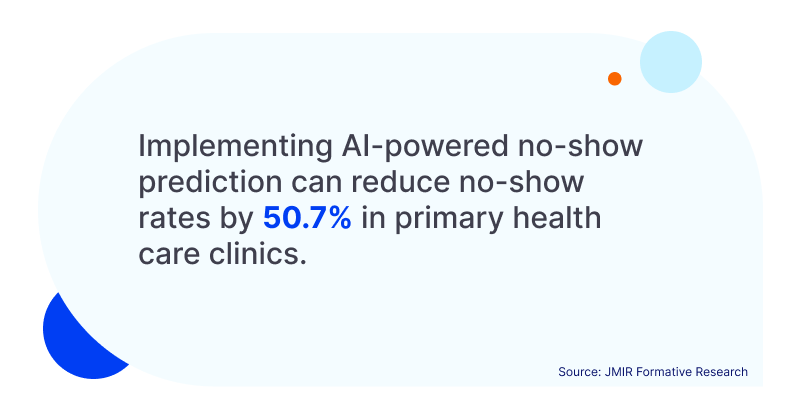
The result is a front office that spends its human hours where they count. Staff capacity shifts toward complex, judgment-heavy interactions instead of routine message volume, and no-shows fall measurably. A study published in JMIR Formative Research showed that implementing AI-powered no-show prediction resulted in a 50.7% reduction in no-show rates. Patients experience consistently responsive access without the practice adding headcount, and volume growth no longer forces a proportional staffing decision.
Clinical AI Agents in Healthcare
In the clinical layer, the goal isn’t simply to transcribe faster, but to remove documentation from the foreground of the encounter altogether. Clinical AI agents such as EverHealth Scribe capture and structure encounter documentation in the background. Ambient clinical intelligence generates visit summaries without requiring provider-directed data entry. Scribe goes further by suggesting ICD-10 diagnosis codes and CPT procedure codes based on the encounter transcript, reducing the manual effort of post-visit coding and keeping the chart moving without additional provider input. Just as important, the agent carries clinical context forward from one encounter to the next without manual carry-forward. Documentation functions as a continuous infrastructure rather than a task that resets at every visit.
That shift changes where provider attention lives. During the encounter, clinicians stay present with the patient instead of competing with a structured interface, and the charting that once stretched the workday no longer requires synchronous post-visit effort. In the near term, Scribe will extend into prescribing workflows as well—analyzing the encounter transcript to recommend appropriate medications and queue up an eRx draft ready for provider review and submission, reducing manual data entry at the point of care. The clinical impact of this shift is real. According to a JAMA Network Open study of 263 physicians and advanced practice practitioners across six health care systems, burnout among those working in ambulatory clinics decreased from 51.9% to 38.8% after 30 days of ambient AI scribe use. The resulting records are consistent and complete, produced without diverting clinical attention.
Back Office AI Agents in Healthcare
Back office AI agents perform claim prioritization, denial risk identification, and reimbursement intelligence before submission. They intervene on high-risk claims proactively instead of waiting for denial outcomes. By surfacing denial trends and reimbursement patterns, these agents enable systematic instead of one-off correction, and they orchestrate claim routing and prioritization without requiring manual oversight of routine cases.
The payoff is a revenue cycle that prevents rather than reacts. Denial rates fall through risk intervention applied before claims go out, and revenue cycle staff concentrate on complex exceptions instead of routine processing and rework. Collection rates improve through a systematic, AI-managed workflow, and revenue performance becomes more predictable because the operating model now stops problems at the source rather than documenting them after the fact.
Cross-Department Orchestration
Specialized healthcare AI agents deliver real gains within each layer, but the structural problem of departmental silos is solved only when those agents share context. Cross-department orchestration means deploying AI that passes relevant operational context from scheduling through the clinical encounter through the revenue cycle, where each agent’s outputs become the next layer’s inputs without a manual handoff. Practice-wide continuity emerges as agent coordination, not staff coordination, carries information across functions.
This is where the error cascades described earlier get stopped in their tracks. When context is maintained automatically, a scheduling detail no longer becomes a documentation gap, and a documentation gap no longer becomes a billing denial. Handoff failures decline, the practice begins to operate as one coordinated system rather than three connected but independent departments, and efficiency stops being trapped inside any single layer.
Operational Continuity with AI in Healthcare
A standalone scheduling tool, a standalone scribe, and a standalone medical billing tool each optimize their own function. But their gains stay isolated.
Coordinated healthcare AI agents, by contrast, produce compounding efficiency. Each layer’s improvement strengthens the next, so the practice’s total operational gain exceeds the sum of what any one agent contributes on its own.
From Isolated AI Tools to a Coordinated Operational Ecosystem
The breakdowns examined above aren’t four separate problems waiting for four separate fixes. They’re symptoms of the same structural reality of workflows built in isolation, stretched past what human capacity can absorb, and disconnected at every handoff. That’s why specialization and orchestration have to arrive together. Deploying capable agents in each layer addresses the local strain. Connecting them so context flows from scheduling through documentation through the revenue cycle is what dissolves the silos that let the problems compound.
This is the structural shift that’s already underway in medical practice operations. Staffing shortages aren’t reversing, patient communication volume isn’t declining, and documentation burden and denial complexity aren’t simplifying. Practices that keep treating these as isolated departmental problems will continue to fight them independently. Practices that deploy healthcare AI agents as an integrated operational ecosystem will compound efficiency gains across every layer.
DrChrono by EverHealth’s AI solutions are built for exactly this model. Contact DrChrono to explore how these agents, spanning front office, clinical, and back office operations, can help your practice move from isolated tools to coordinated operational intelligence.